
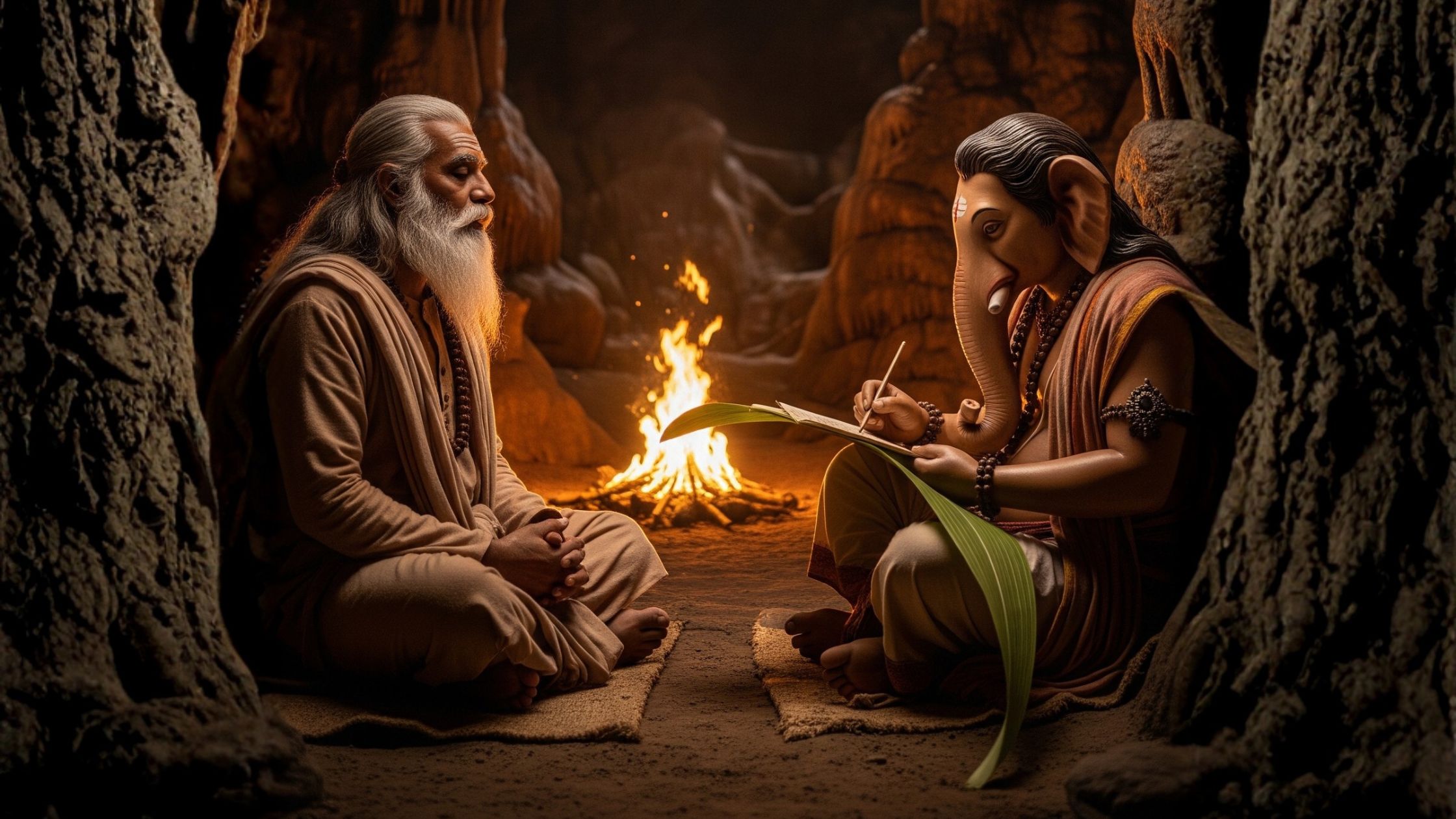
Why the Mahābhārata Is Written in Poetry: The Genius of Vyāsa and Ganesha’s Compact Watch the full video explanation https://youtube.com/shorts/FuGvqRaUQPI Why the Mahābhārata Is Written in Poetry: The Vyāsa-Ganesha Method Explained Introduction: The Question Nobody Asks Why is the Mahābhārata written in poetry? With over 100,000 verses (ś lokas)—making it the longest epic poem ever composed, roughly ten times the length of the Iliad and Odyssey combined—one might expect it to be written as straightforward prose narrative. Why verses? Why metrical composition? Why the dense, compact structure of śloka after śloka? The answer isn’t aesthetic preference. It isn’t literary convention. It’s practical necessity born from an extraordinary situation. The Mahābhārata is written in poetry because it was spoken without stopping and written with understanding—and normal speech could not survive those conditions. Let me explain. Part I: The Situation—Vyāsa’s Problem The Scale Was Immense Sage Ved Vyāsa (वेद व्यास), also called Krishna Dvaipayana (कृष्ण द्वैपायन), had witnessed the entire Mahābhārata unfold before him—through divine vision (divya-dṛṣṭi), spiritual insight, and direct participation in the events. He was not an outside observer. Vyāsa was: Grandfather to the heroes of the epic (father of Dhritarashtra, Pandu, and Vidura) Witness to the Kurukshetra war Compiler of the Vedas Author of the Brahma Sutras Custodian of civilization’s knowledge He had seen it all—past, present, and future—and understood that this story needed to be preserved for posterity. But there was a problem. The Content Was Already Complete in His Mind According to the Ādi Parva (first book) of the Mahābhārata itself, Vyāsa had already composed the entire epic in his mind before dictation began. “Sage Vyāsa, who was deep in contemplation, had visualized the whole Mahābhārata as if it occurred before his eyes. He saw the creation, the Vedas, the four Puruṣārthas (Dharma, Artha, Kāma, Mokṣa), and the code of conduct of mankind.” The text existed. Completely. Fully formed. In Vyāsa’s consciousness. But it needed to be externalized—written down—without: Pausing to revise Stopping to edit Breaking continuity Losing the flow Why No Pausing? The scale was simply too large to approach piecemeal. Think about it: ~100,000 verses (some counts say 100,000 ślokas, others 200,000 individual verse lines) ~1.8 million words total 18 Parvas (books/sections) Thousands of characters Multiple storylines woven together Philosophical discourses embedded throughout Complex timelines spanning generations If Vyāsa paused: He might lose the thread of the narrative Details could become inconsistent The monumental structure could collapse The integrity of the whole could be compromised The Mahābhārata needed to flow as one continuous revelation—like a river that, once it starts flowing, cannot be stopped mid-course without disrupting the entire current. So Vyāsa decided: the epic would be narrated, not written by him. He would speak it into existence, and someone else would transcribe. But who could keep up? Part II: The Scribe—Enter Ganesha Vyāsa Seeks Advice from Brahma According to Mahābhārata, Ādi Parva 1.73-78, Vyāsa meditated on his dilemma and was visited by Lord Brahma, the Creator. Vyāsa explained his situation: “Lord, I have conceived an excellent work of immense scope and profound significance. But I cannot think of anyone capable of taking it down to my dictation at the speed and scale required.” Brahma, recognizing the civilizational importance of preserving this knowledge, responded: “O sage, invoke Gaṇapati (Ganesha) and request him to be your amanuensis (scribe).” Why Ganesha? Ganesha is: Lord of Wisdom (बुद्धि-विनायक – Buddhi-Vināyaka) Remover of Obstacles (विघ्नहर्ता – Vighnahartā) Master of intellect and learning (सिद्धि-दाता – Siddhi-dātā) Capable of writing faster than any human Possessing perfect comprehension If anyone could handle the complexity and speed required, it was Ganesha. The Meeting Following Brahma’s advice, Vyāsa mentally invoked Ganesha. Ganesha appeared before him. Vyāsa’s Request: “O Lord Gaṇapati, I shall dictate the story of the Mahābhārata. I pray you to be graciously pleased to write it down.” Ganesha’s Response: Ganesha smiled—and agreed. But with a condition. Part III: The Conditions—The Genius of the Setup Condition #1: Ganesha’s Demand 📖 Mahābhārata, Ādi Parva 1.78 Sanskrit: गणेश उवाच — लिखिष्यामि मुने व्यास तव प्रोक्तम् अनुत्तमम् । यदि स्कन्दो न भवति कदाचित् कलमो मम ॥ IAST Transliteration: gaṇeśa uvāca — likhiṣyāmi mune vyāsa tava proktam anuttamam yadi skando na bhavati kadācit kalamo mama Translation: “Ganesha said: ‘O sage Vyāsa, I shall write this excellent work you will recite—but on one condition: my pen must not stop even for a moment. If you pause in your dictation, I shall stop writing and depart.’” What this meant: Continuous dictation with zero breaks No pausing to think No stopping for water, food, rest No hesitation Relentless flow This was an enormous challenge. Even the most trained orator cannot speak continuously for hours, let alone days or weeks, without rest. Condition #2: Vyāsa’s Counter-Demand Vyāsa, being equally wise, accepted Ganesha’s condition—but imposed his own: 📖 Mahābhārata, Ādi Parva 1.79 Sanskrit: व्यास उवाच — बुद्ध्वा मा लिखा क्वचित् ॥ IAST Transliteration: vyāsa uvāca — buddhvā mā likhā kvacit Translation: “Vyāsa said: ‘Agreed—but you too must not write a single syllable without properly understanding its meaning first.’” What this meant: Ganesha could not write blindly Every verse had to be comprehended before transcription Understanding was mandatory No mechanical copying Ganesha, smiling at the cleverness, responded: “Om” (Agreement) And thus began the dictation—and the writing—of the Mahābhārata. Part IV: The Problem—And the Solution The Impossible Situation Now stop and think about what these two conditions created: Condition 1 (Ganesha’s): Vyāsa cannot pause. Condition 2 (Vyāsa’s): Ganesha cannot write without understanding. The paradox: If Vyāsa speaks too fast → Ganesha has no time to understand → violates Condition 2 If Vyāsa speaks too slowly → he’s effectively pausing → violates Condition 1 If Ganesha writes immediately → he hasn’t understood → violates Condition 2 If Ganesha pauses to think → Vyāsa has to keep speaking but Ganesha isn’t writing → system breaks down Normal speech could not survive these constraints. If Vyāsa dictated in regular prose: Long sentences would require Ganesha to pause frequently to parse meaning Vyāsa