
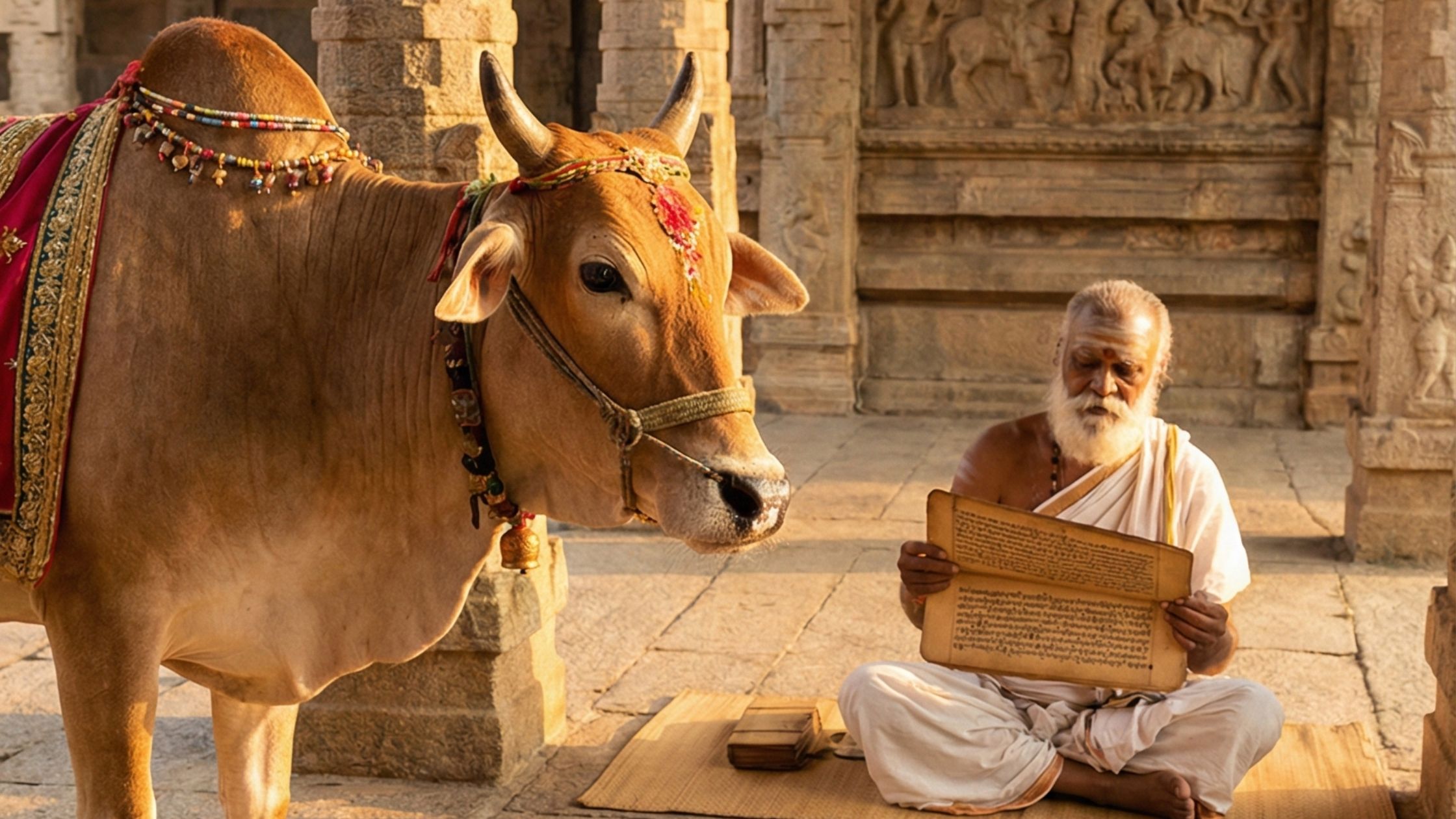
Why Is the Cow Called Mother in Hindu Dharma? The Theological, Historical, and Civilizational Basis Watch the full video explanation https://youtube.com/shorts/cYWXXVXly-g Why “Gau Mata”? The Real Reason Cows Are Called Mothers in Hinduism Introduction: Beyond Sentiment Into Systems “Cow is a mother? Seriously?” That’s the reaction. People laugh. Some find it quaint. Others find it backward. Most assume it’s either: Superstition Excessive sentimentality Convenient religious dogma Cultural quirk without rational basis But let’s go deeper. Because in Sanātana Dharma, the word “mother” (mātā) is not casual language. It is a theological category. And the cow’s inclusion in that category—as Gau Mātā (गौ माता)—is not arbitrary reverence. It’s documented recognition of a specific functional relationship between the cow and civilization, rooted in: Śāstra (scripture) Itihāsa (historical epic) Veda (revealed knowledge) Practical civilizational reality The cow is called “mother” for the same reason the Earth is called mother. Not because of emotion—because of sustained nourishment and life-support. Part I: The Concept of Sapta Mātā—The Seven Mothers Motherhood as a Theological Function In Hindu Dharma, motherhood is not limited to biological gestation. Mātā (माता) is a theological designation for that which sustains life through continuous nourishment. The tradition recognizes Sapta Mātā (सप्त माता) — Seven Mothers: 1. Janani Mātā (जननी माता) – The Biological Mother The woman who gave birth Provides initial nourishment through pregnancy and breastfeeding Primary caregiver during formative years 2. Guru Patnī (गुरु पत्नी) – The Teacher’s Wife Supports the guru’s household Creates conducive environment for learning Nourishes the student indirectly through her service 3. Rāja Patnī (राज पत्नी) – The King’s Wife / Queen Symbol of the state’s nurturing function Represents collective maternal care of citizens Embodies welfare aspect of governance 4. Deśa Mātā (देश माता) – The Motherland The nation that protects and provides identity Source of cultural and civilizational belonging Sustains community through shared values 5. Dhenu / Gau Mātā (धेनु / गौ माता) – The Cow Provides milk (primary nourishment) Bull powers agriculture (food production) Yields multiple products sustaining life 6. Pṛthvī Mātā (पृथ्वी माता) – The Earth Ground that sustains all life Yields crops, water, minerals Supports all beings without discrimination 7. Vedamātā (वेदमाता) – Mother Veda / Knowledge as Mother Sacred knowledge that guides life Reveals dharma and sustains cosmic order Nourishes the spirit The Common Principle All seven share one defining characteristic: Sustained nourishment without requiring destruction of the source. The cow is included deliberately. The reason is documented in śāstra. Part II: The Scriptural Foundation The Mahābhārata Declaration 📖 Mahābhārata, Anuśāsana Parva 75.19 Sanskrit (Devanāgarī): गावो विश्वस्य मातरः ॥ Sanskrit (IAST Transliteration): Gāvo viśvasya mātaraḥ Translation: “The cows are the mothers of the universe.” The Context: Bhīṣma Instructs Yudhiṣṭhira Who is speaking? Bhīṣma (भीष्म) — the eldest Kuru, lying on a bed of arrows after the Kurukshetra war, is imparting his final teachings on Dharma to King Yudhiṣṭhira. What is Anuśāsana Parva? The 13th book of the Mahābhārata, also called the “Book of Instructions” or “Book of Precepts.” After 18 days of catastrophic war, Yudhiṣṭhira is king—but devastated by the destruction. Bhīṣma, waiting for the auspicious uttarāyaṇa (northward journey of the sun) to leave his body, uses these final days to transmit comprehensive knowledge of: Rājadharma (duties of kings) Dānadharma (duties of giving) Mokṣadharma (path to liberation) Ethics, governance, social organization What does Anuśāsana Parva say about cows? According to the Parva, “several chapters are dedicated to cows, their importance to household’s food security, agriculture and wealth”. Bhīṣma explains: Why cows must be protected The merits of gifting cows The civilizational centrality of cattle Specific instructions on cow care The declaration “Gāvo viśvasya mātaraḥ” comes in this context—not as poetic hyperbole, but as dharmic principle. Additional Scriptural Support Mahābhārata, Anuśāsana Parva (Various Sections): “A vaishya should protect all animals especially the cow and the bull. These two are the mother and father of all mankind.” Why “mother” AND “father”? Cow (Dhenu) = Mother (provides milk/nourishment) Bull (Vṛṣabha) = Father (provides labor/agriculture) Together, they sustain civilization. Part III: The Vedic Basis—Aghnyā (The Unslayable) The Rigvedic Term Throughout the Ṛgveda (ऋग्वेद), cows are repeatedly called Aghnyā (अघ्न्या). Etymology: A (अ) = negation (not) Ghnya (घ्न्या) = from root han (हन्) = to kill/strike Meaning: “Not to be killed” / “Unslayable” / “Inviolable” Rigveda References: Ṛgveda 1.164.27: अघ्न्येयं सा वर्धतां महते सौभगाय “May this Aghnyā cow thrive for great prosperity.” Ṛgveda 5.83.8: सुप्रपाणं भवत्वघ्न्यायाः “There should be excellent facility for pure water for the Aghnyā cow.” Ṛgveda 10.87.16: यः पौरुषेयेण क्रविषा समङ्क्ते योऽश्वेन पशुना यातुधानः । योऽघ्न्यायाः भरति क्षीरमग्ने तेषां शीर्षाणि हरसापि वृश्च ॥ “Those who feed on human, horse, or animal flesh, and those who destroy the milk-giving Aghnyā cows—O Agni, sever their heads.” What This Establishes The Rigveda—humanity’s oldest surviving text—explicitly: ✓ Designates cows as protected beings (aghnyā) ✓ Associates cow protection with prosperity (saubhāgya) ✓ Prescribes severe punishment for cow-killing ✓ Links cow welfare to civilizational health This isn’t later interpolation or medieval reform. This is Vedic foundation. Part IV: The Functional Basis—Why “Mother” Makes Sense Sustained Nourishment Without Destruction The key to understanding why the cow is called “mother” lies in how motherhood is defined in Dharmic thought: Mother = That which sustains life continuously without requiring its own destruction. Compare: The cow: Gives milk daily (sustained nourishment) Produces ghee (ritual/cooking fat) Yields dung (fuel, fertilizer, building material) Provides urine (medicinal, purification agent per Āyurveda) Continues giving while alive Animals typically used for meat: Require slaughter (one-time use) Cannot provide sustained daily nourishment Destruction of the source terminates benefit The cow provides more value alive than dead—and over years, not moments. This is sustainable resource management encoded in theological language. The Vedic Economic Reality In Vedic society (roughly 1500–500 BCE), civilization functioned through: 1. Agriculture (Kṛṣi – कृषि) Bulls plowed fields Enabled large-scale grain production Ox-carts transported goods 2. Yajna (यज्ञ – Ritual Fire Sacrifice) Ghee (clarified butter from milk) was the primary oblation Fire rituals sustained ṛta (ऋत – cosmic order) Without ghee, yajna
Did Krishna Really Have More Than 1,60,000 Children? Understanding the Dwarka Years Through Śāstra
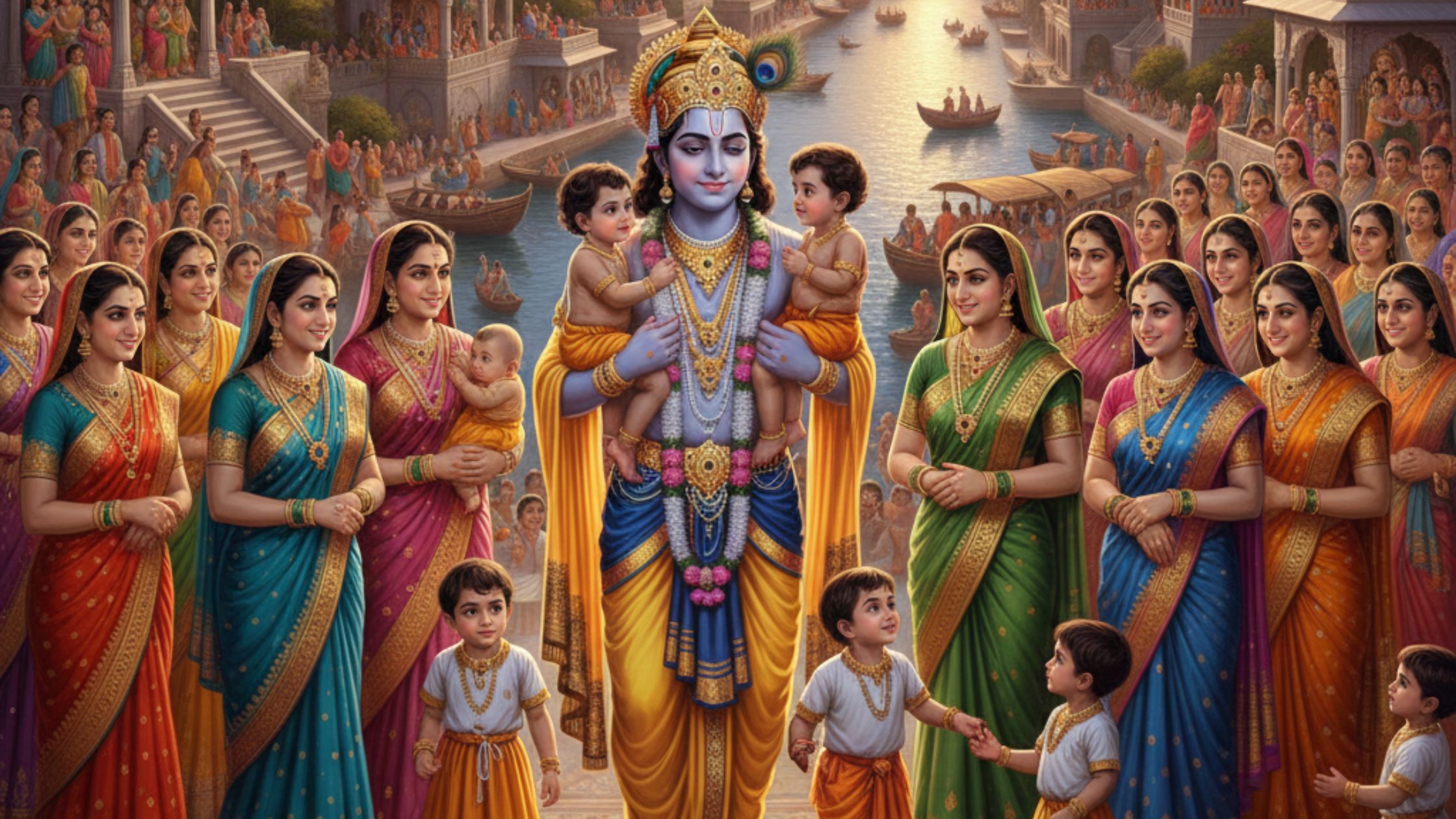
Did Krishna Have 1,60,000 Children? The Complete Story of Krishna’s Dvāraka Family Watch the full video explanation https://youtube.com/shorts/4X9KfitjzVI Did Krishna Have 1,60,000 Children? The Complete Story of Krishna’s Dvāraka Family Introduction: The Story Most People Don’t Know When people think of Krishna, they imagine the playful child stealing butter in Vrindavan, or the divine charioteer delivering the Bhagavad Gita on the battlefield of Kurukshetra. But between these two iconic moments lies an entire life—a life lived as a king, a householder, a husband, and a father. Most devotional literature focuses on Krishna’s childhood leelas (divine plays) or his role in the Mahabharata. But the decades Krishna spent ruling Dvāraka (द्वारका)—the golden city he established on the western coast of India—remain relatively unknown outside scholarly circles. And it’s in these Dvāraka years that we encounter one of the most extraordinary claims in Hindu scripture: Krishna had more than 1,60,000 children. Yes, that number comes directly from our texts—specifically the Śrīmad Bhāgavatam, one of the eighteen Mahāpurāṇas and perhaps the most authoritative source on Krishna’s complete life. This isn’t hyperbole. It’s not symbolic metaphor. It’s stated matter-of-factly in genealogical sections that treat Krishna’s household as a historical reality requiring documentation. But how do we understand this number? What does it mean? And what does it reveal about how the tradition views Krishna—not just as a divine avatar, but as someone who chose to live a complete human life? Let’s examine the texts. Part I: The Foundation—What the Bhāgavata Purāṇa Actually Says The Queens: 16,108 Wives To understand Krishna’s children, we must first understand his marriages. The Śrīmad Bhāgavatam (10th Canto, chapters 59-90) provides detailed accounts of Krishna’s marriages, which fall into two distinct categories: 1. The Aṣṭabharya (अष्टभार्या) – Eight Principal Queens The Bhāgavata Purāṇa lists eight principal queens: Rukmiṇī (रुक्मिणी) – Princess of Vidarbha, considered Lakshmi’s incarnation Satyabhāmā (सत्यभामा) – Daughter of King Satrajit Jāmbavatī (जाम्बवती) – Daughter of Jambavan (the bear-king) Kālindī (कालिन्दी) – Daughter of the Sun God, found near river Yamuna Mitravindā (मित्रविन्दा) – Princess of Avanti, Krishna’s cousin Nāgnajitī (नाग्नजिती) / Satyā – Princess of Kosala Bhadrā (भद्रा) – Princess of Kekeya, Krishna’s cousin Lakṣmaṇā (लक्ष्मणा) – Princess of Madra Each marriage has its own elaborate story—Rukmiṇī’s elopement, Jāmbavatī’s 28-day duel backstory, Satyabhāmā’s Syamantaka jewel narrative, and so on. These eight queens were Krishna’s principal consorts, living in grand palaces, participating in royal functions, and bearing children whose names and deeds are individually recorded. 2. The Junior Queens: 16,100 Women Rescued from Narakāsura But the Bhāgavatam doesn’t stop there. Bhāgavata Purāṇa 10.59.33 describes Krishna’s battle with Narakāsura (नरकासुर), a powerful demon-king who had: Terrorized the heavens and earth Stolen Aditi’s earrings (mother of the gods) Kidnapped and imprisoned 16,100 princesses from various kingdoms When Krishna defeated Narakāsura and liberated these women, they all requested to marry him. In ancient Indian society, women who had been kidnapped—even if they remained virtuous—faced social stigma and would struggle to find suitable husbands. Krishna’s marriage to all 16,100 women was an act of: Dharmic protection: Restoring their honor and social standing Compassion: Ensuring their security and dignity Divine grace: All 16,100 are identified in tradition as manifestations of Goddess Lakshmi, representing devoted souls seeking divine union Total Wives: 8 principal queens + 16,100 junior queens = 16,108 wives The Children: “Thousands of Sons” Now we arrive at the crucial verse about children: 📖 Śrīmad Bhāgavatam 10.90.27 Sanskrit (Devanāgarī): तासां पुत्रसहस्राणि बभूवुर् नृपनन्दन । Sanskrit (IAST Transliteration): tāsāṁ putra-sahasrāṇi babhūvur nṛpa-nandana Word-by-Word Breakdown: tāsām (तासाम्) = of them (genitive plural feminine – referring to the queens) putra (पुत्र) = sons, children sahasrāṇi (सहस्राणि) = thousands (nominative plural neuter) babhūvuḥ (बभूवुः) = were born, came into being (perfect tense, 3rd person plural) nṛpa-nandana (नृपनन्दन) = O joy of the king (vocative, addressing King Parīkṣit) Translation: “From these queens, O descendant of kings, there were born thousands of sons.” What the Text Actually Says—and Doesn’t Say Notice what the verse does: ✓ Confirms: Krishna had children from his queens ✓ Quantifies: Uses the term “thousands” (sahasrāṇi) ✓ Establishes scale: This wasn’t a small family Notice what it doesn’t do: ✗ List individual names: Beyond the children of the eight principal queens, most names aren’t recorded ✗ Describe individual lives: No detailed biographies for most children ✗ Provide exact count: The text says “thousands,” tradition later calculates the specific number The Bhāgavatam is doing something interesting here: it establishes genealogical scope without getting lost in exhaustive detail. Why? Because the point isn’t to catalog every individual—it’s to demonstrate that Krishna lived a complete householder life at unprecedented scale, fulfilling his role as king and family patriarch during his time in Dvāraka. Part II: The Traditional Calculation—How We Arrive at 1,61,080 Later genealogical traditions and commentaries on the Bhāgavatam provide the specific calculation: The Formula Each of the 16,108 queens had 10 sons. 16,108 queens × 10 sons each = 1,61,080 children Sources for This Calculation While the base text (Bhāgavatam 10.90.27) doesn’t give this exact formula, later texts and traditions elaborate: 1. Commentarial Traditions Vaishnava commentaries drawing from Visvanatha Chakravarti Thakura’s interpretations provide additional genealogical details about Krishna’s extensive family. 2. Harivaṁśa Purāṇa The Harivaṁśa (हरिवंश), literally “The Genealogy of Hari,” serves as a supplement to the Mahabharata. It consists of sections describing Krishna’s ancestors and progeny, extending the genealogical record beyond what the Bhāgavatam provides. The Harivaṁśa tracks: Krishna’s immediate children (especially from the eight principal queens) Grandchildren and great-grandchildren The continuation of the Yadu dynasty even after Krishna’s departure In its final sections, it enumerates the genealogy of the Hari dynasty up through many subsequent generations 3. Named Children of the Aṣṭabharya From the eight principal queens, specific children are named and their stories told: From Rukmiṇī: Pradyumna (प्रद्युम्न) – eldest son, considered the reincarnation of Kāmadeva (god of love), described in the Mahabharata as a portion of Sanat Kumara Multiple other sons (10 total) From Jāmbavatī: Sāmba (साम्ब) – famous for his beauty and his role in events leading