Have you ever wondered why we touch that ārati flame and then place that warmth on our eyes and forehead?
Most of us do it—in temples, at home shrines, during festivals. The priest waves the camphor flame before the deity, then brings it to us. We cup our hands over the light, draw that warmth toward ourselves, and touch our eyes and forehead in a gesture so automatic it feels instinctive.
But almost no one knows why.
Is it superstition? A cultural habit passed down without meaning? A symbolic gesture emptied of significance?
The answer is far more profound. What appears as a simple ritual gesture reveals itself as a sophisticated theological transaction—a carefully designed system for transmitting divine grace from deity to devotee through the medium of consecrated light.
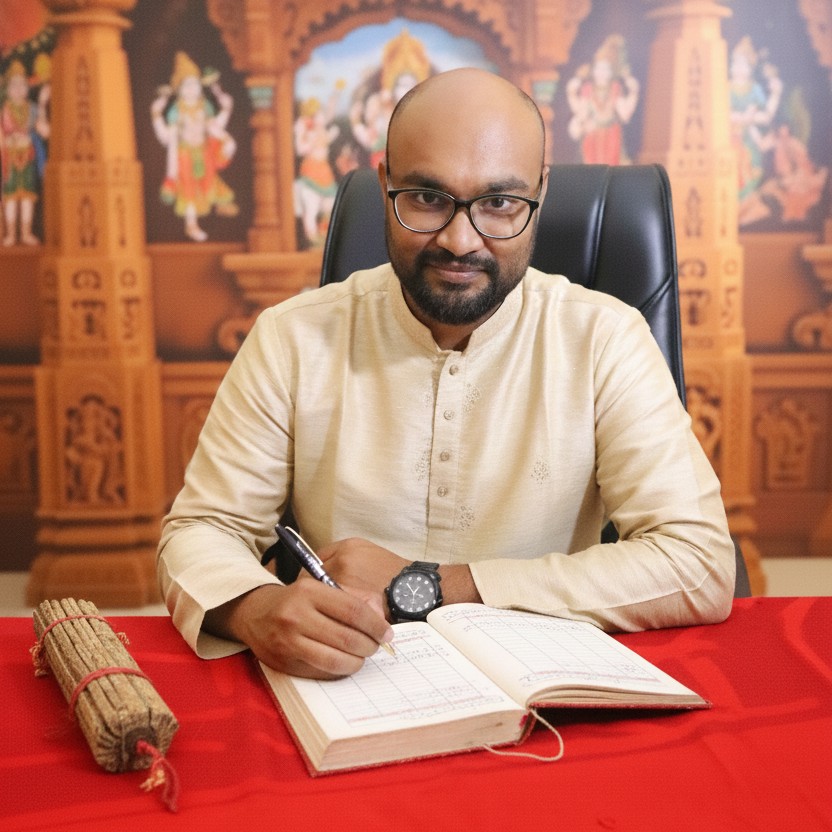
I am Jayanth Dev, author of Dhantasura. And today, we’re examining what scripture actually says about this universal Hindu practice.
To understand the ārati flame, we must first understand Agni (अग्नि)—the Vedic deity of fire.
The Ṛg Veda (ऋग्वेद), humanity’s oldest continuously used religious text (composed approximately 1500-1200 BCE), begins not with praise of Indra, Varuṇa, or any of the celestial deities—but with Agni.
Ṛg Veda 1.1.1:
Sanskrit (Devanāgarī):
अग्निमीळे पुरोहितं यज्ञस्य देवमृत्विजम् ।
होतारं रत्नधातमम् ॥
Sanskrit (IAST Transliteration):
agnim īḷe purohitaṁ yajñasya devam ṛtvijam
hotāraṁ ratna-dhātamam
Word-by-Word Breakdown:
Translation:
“I praise Agni, the purohita (priest placed in front), the divine priest of the sacrifice, the invoker who is the best bestower of treasures.”
This opening verse is theologically significant. The Ṛg Veda contains over 1,000 hymns to various deities—Indra (god of rain/thunder), Varuṇa (cosmic order), Sūrya (sun), Uṣas (dawn), and others. Yet it begins with Agni.
Why?
Because Agni occupies a unique mediating role in Vedic cosmology:
1. Agni is Purohita—The Foremost Priest
The term purohita (पुरोहित) literally means “placed in front” (puras = in front, hita = placed). Agni is the priest who sits before the deity on behalf of humans, performing the sacrifice that we cannot perform directly.
2. Agni is Ṛtvij—The Divine Officiant
He is both human fire (the flame we light) and divine fire (the sacred power that connects earth to heaven). He operates in both realms simultaneously.
3. Agni is Hotār—The Invoker
The term hotār (होतार्) comes from the root hu (हु) = “to offer, to invoke.” Agni calls the gods to the sacrifice. When offerings are placed in fire, Agni carries them upward to the devas.
4. Agni is the Messenger
Ṛg Veda 1.1.5:
“Agni is the messenger between gods and men.”
He is the carrier of offerings from humans to deities and the carrier of blessings from deities to humans.
This is critical:
Agni is not just fire. Agni is the medium of divine transaction.
In Vedic times (1500-500 BCE):
Worship centered on yajña—elaborate fire rituals performed outdoors with mantras, offerings of ghee, grains, and soma.
The structure:
The closing of the yajña involved presenting the flame to all participants, who would “take the light to fill the heart and mind.”
This is the original form of what we now call ārati.
As Hinduism evolved from Vedic yajña-centered worship to Purāṇic temple-centered worship (approximately 400 CE onwards), the grand outdoor fire sacrifice was ritualized into the temple lamp ceremony:
Vedic Yajña → Temple Ārati
The core principle remained: Fire as the medium of divine transaction.
The word ārati (आरती) comes from Sanskrit ā-rāti (आ-राति):
Meaning: “The offering brought near”—specifically, the offering of light brought close to the deity.
Traditional ārati represents an offering of the Pañca-mahābhūta (पञ्चमहाभूत)—the five great elements that constitute material creation:
1. Pṛthvī (पृथ्वी) – Earth
2. Jala (जल) – Water
3. Agni (अग्नि) – Fire
4. Vāyu (वायु) – Air
5. Ākāśa (आकाश) – Space/Ether
When all five elements are offered in ārati, the worshipper symbolically offers the entirety of material creation back to its source—the Divine.
Step 1: Preparation
The priest (pūjāri) prepares the ārati plate with:
Step 2: Lighting and Consecration
The flame is lit with accompanying mantras. The priest may chant:
agnaye namaḥ - Salutations to Agni
brahma-jyotiḥ namaḥ - Salutations to the Divine Light
Step 3: Waving Before the Deity
The priest waves the flame before the mūrti in specific circular patterns:
During this, the bell rings continuously, and devotees sing ārati songs.
Step 4: Distribution to Devotees
After the flame has been waved before the deity, the priest brings it to the assembled devotees.
This is the critical transition we’re examining.
According to Agni Purāṇa and traditional Āgamic texts (temple worship manuals):
Before ārati:
During ārati (waving before deity):
After ārati:
This transformation is not metaphorical—it is theological doctrine.
Prasāda (प्रसाद) comes from:
Meaning: “Grace that has settled” or “that which has received favor”
In temple theology:
Prasāda is anything that:
Examples of prasāda:
The theological principle:
When something ordinary is offered to the Divine with devotion, returned by the Divine as grace, it becomes extraordinary—charged with divine power.
The ārati flame you touch is not “just fire” anymore. It is prasāda—fire that has absorbed the deity’s śakti.
When the priest brings the ārati flame to you:
Step 1: Cupping Hands
You extend both hands, palms facing the flame, and cup them above the flame (not touching the fire itself—just feeling the warmth and light).
Step 2: Drawing the Light
You make a gentle scooping motion, as if gathering the light/warmth into your hands.
Step 3: Touching Specific Body Parts
You bring your hands to your face and touch:
a) The eyes (cakṣu – चक्षु)
b) The forehead (lalāṭa – ललाट)
c) Sometimes the top of the head (mūrdhā – मूर्धा)
This is not random. Each location has theological significance:
1. The Eyes—Purification of Perception
The Prayer:
“May my vision be purified. May I see beyond surface appearances to underlying truth. May I see the Divine in all beings.”
Vedantic Philosophy:
The eyes (netra – नेत्र) are our windows to perceive reality. In normal consciousness, we see:
By bringing sanctified light to the eyes, we symbolically request:
This echoes Bhagavad Gītā 11.8:
“na tu māṁ śakyase draṣṭum anenaiva sva-cakṣuṣā divyaṁ dadāmi te cakṣuḥ paśya me yogam aiśvaram”
“But you cannot see Me with your present eyes. Therefore I give you divine eyes (divya-cakṣu). Behold My mystic opulence.”
The ārati gesture is a prayer for such divine vision.
2. The Forehead—Purification of Thought
The Prayer:
“May my thoughts be purified. May my mind be illuminated. May my intellect (buddhi) be sharp and clear.”
Yogic Physiology:
The ājñā-cakra (आज्ञाचक्र), located between the eyebrows, is associated with:
By bringing light to this location, we invoke:
3. The Crown—Illumination of Consciousness
When the light is touched to the crown of the head (sahasrāra-cakra):
The Prayer:
“May divine consciousness descend into me. May I realize my true nature as Ātman (Self). May ignorance be dispelled.”
This is the highest blessing—the opening of the crown center, associated with enlightenment (mokṣa, kaivalya, bodhi).
Vedic and Yogic texts describe three types of Agni within the human body:
1. Jāṭharāgni (जाठराग्नि)—Digestive Fire
Located in the abdomen, this is the biological fire that:
When malfunctioning: Disease, weakness, indigestion
2. Kāmāgni (कामाग्नि)—Fire of Desire
Located in the heart/mind region, this is the emotional/psychological fire of:
When malfunctioning: Greed, lust, obsession, suffering
3. Jñānāgni (ज्ञानाग्नि)—Fire of Knowledge
Located in the head/consciousness, this is the spiritual fire of:
When malfunctioning: Delusion, confusion, spiritual ignorance
When we touch the ārati flame and bring it to our eyes and forehead, we are symbolically invoking these internal fires to burn away impurities:
✓ Jāṭharāgni → “May I digest experiences properly, assimilate lessons, maintain vitality”
✓ Kāmāgni → “May my desires be purified, attachments loosened, passions channeled properly”
✓ Jñānāgni → “May the fire of knowledge burn away my ignorance, illuminate my consciousness”
The gesture becomes a prayer for internal transformation.
There is a profound theological logic here:
Offering Without Return is Incomplete
In Vedic yajña and temple pūjā, the ritual follows a complete circuit:
1. Devotee offers to Deity
2. Deity accepts the offering
3. Deity returns grace/blessing
If step 3 is missing, the circuit is broken.
The ārati flame distribution is this return flow—the deity giving back to the devotee.
This echoes Bhagavad Gītā 3.11:
“devān bhāvayatānena te devā bhāvayantu vaḥ parasparaṁ bhāvayantaḥ śreyaḥ param avāpsyatha”
“The devas, nourished by sacrifice, will nourish you in return. Thus nourishing one another, you shall attain the supreme good.”
The principle:
✓ Humans offer to devas → Devas accept → Devas bless humans → Humans offer again…
This is not transactional commerce—it’s sacred reciprocity, an ongoing relationship.
The ārati flame you receive is the deity’s response to your presence, your devotion, your participation in worship.
Many people treat ārati as a performance to observe:
This misses the core purpose.
Ārati is not a spectacle. Ārati is a sacrament.
A sacrament (in religious studies terminology) is an outward ritual that confers an inward grace.
In Hindu theology: Ārati is a moment of transmission—where divine śakti flows from deity to devotee through the medium of consecrated light.
To participate fully, you must:
✓ Be present with attention (not distracted, checking phone, talking) ✓ Receive consciously when the flame comes to you ✓ Make the gesture with intention (eyes, forehead, crown) ✓ Hold a brief internal prayer while touching the light to your body
Then—and only then—have you received the blessing.
Some modern Hindus (especially Western-educated, scientifically-minded ones) struggle with ritual that requires theological belief.
The beautiful thing: The practice works even without literal belief.
From a psychological/spiritual perspective:
1. Somatic Anchoring
The physical act of cupping hands, feeling warmth, touching face creates a body-based anchor for:
2. Intention Setting
Even without believing the flame literally carries divine power, the gesture sets powerful psychological intentions:
Setting intentions through ritual is neurologically powerful.
3. Community Participation
Participating in ārati creates saṅgha—spiritual community bonding through shared ritual.
Collective rituals strengthen social cohesion, create belonging, and reinforce shared values.
4. Aesthetic/Sensory Immersion
The ārati experience engages all five senses:
This multi-sensory immersion creates states of consciousness that transcend intellectual analysis.
Let’s return to where we started.
You’re in a temple. The priest has just completed pūjā. He waves the camphor flame before the deity while devotees sing. Then he brings the flame to you.
You now understand:
✓ The flame is Agni—the Vedic deity who is the messenger between humans and gods
✓ The flame was offered to the deity with mantras and devotion
✓ The deity’s presence infused the flame—it absorbed divine śakti
✓ It is now prasāda—a gracious gift carrying blessings
✓ When you touch it to your eyes: You pray for purified vision, divine sight
✓ When you touch it to your forehead: You pray for an illuminated mind, wisdom
✓ When you touch it to your crown: You pray for enlightenment, Self-realization
This is not superstition.
This is a carefully designed theological system for transmitting divine grace from deity to devotee.
This is why every temple, every tradition, follows the same gesture.
Ārati is not something you watch.
Ārati is something you receive.
The flame you touch is not just fire.
It is Agni, carrying the deity’s grace back to you.
Jayanth Dev is an author writing on Hindu scriptures, Sanatana Dharma, and mythological narratives through books, long-form articles, and explanatory talks.
His work focuses on examining scriptural ideas in context—drawing from the Vedas, Upanishads, and Puranas to clarify commonly misunderstood concepts and traditions. Across both fiction and non-fiction, he approaches Sanatana thought as a living framework rather than a static belief system.
Jayanth is the author of I Met Parashurama, Escaping the Unknown, and the Dhantasura series.
Copyright © 2026 Jayanth Dev. Built with 💡 by Popupster.in — The Creative Marketing Company