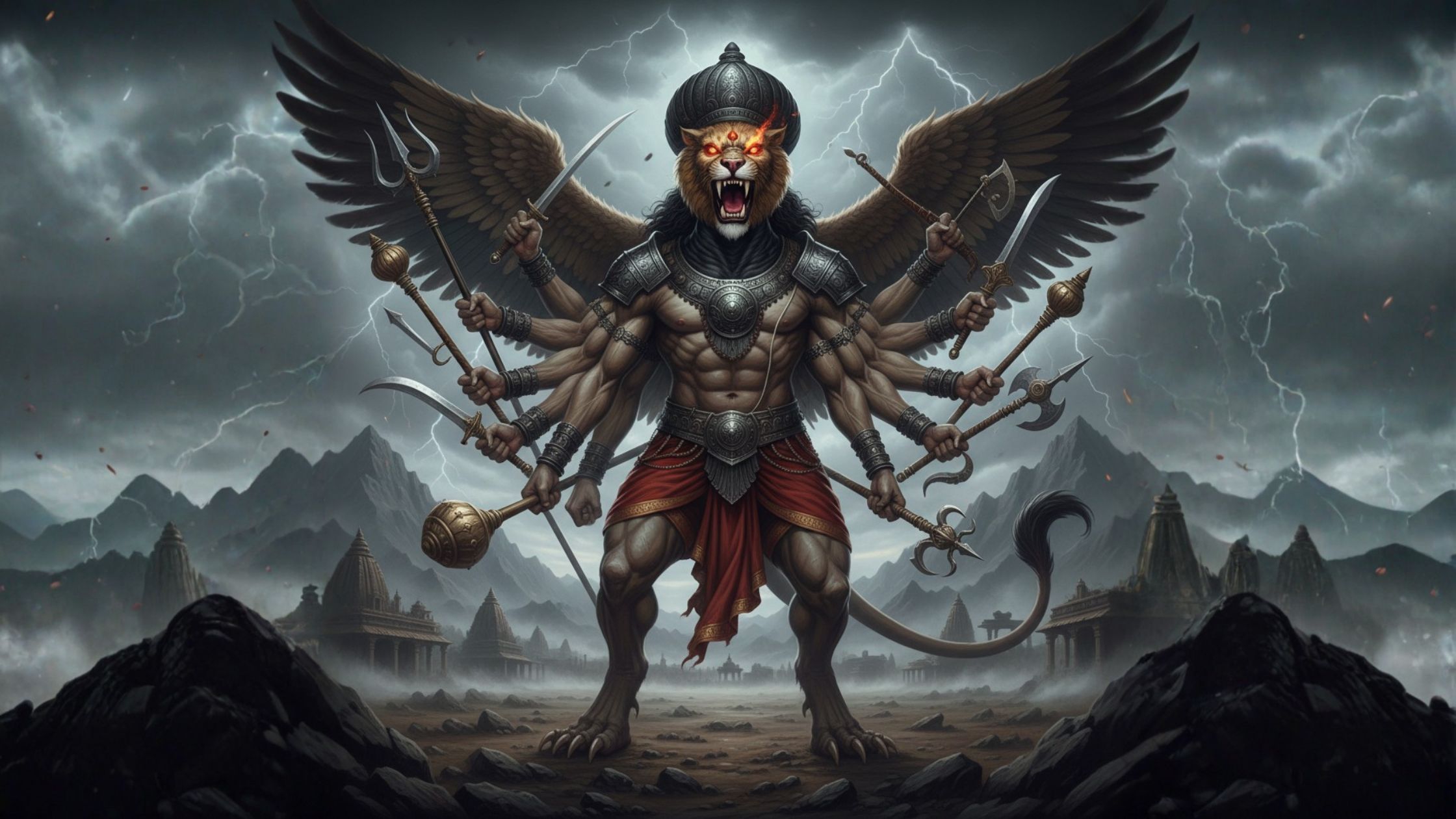
The Sharabha Upanishad: A Forensic Examination of a Medieval Sectarian Text Watch the full video explanation Why the Sharabha–Narasimha conflict narrative fails scriptural, linguistic, and historical tests In the age of viral WhatsApp forwards and YouTube shorts, few controversies have divided Hindu communities as sharply as the Sharabha story. The narrative is dramatic: Lord Shiva, witnessing Narasimha’s uncontrollable rage after slaying Hiranyakashipu, transforms into Sharabha—a terrifying bird-beast hybrid—and proceeds to defeat, kill, and even wear Narasimha’s skin as a garment. This story has been shared millions of times as “authentic ancient scripture.” But what if I told you this narrative isn’t ancient wisdom—it’s medieval propaganda created during one of the darkest periods of sectarian warfare in Hindu history? Today, we’re conducting a forensic analysis of the Sharabha Upanishad using manuscript evidence, linguistic forensics, historical documentation, and scriptural authentication protocols that would stand in any academic court. Part I: The Text That Doesn’t Exist (Where It Should) The Silence of the Giants Let’s begin with the most damning piece of evidence: scholarly silence. Between the 8th and 13th centuries CE, three towering intellectual giants systematically preserved, commented upon, and transmitted authentic Vedic literature: Adi Shankaracharya (c. 700-750 CE) Wrote comprehensive commentaries (bhashyas) on 10-11 principal Upanishads These include: Isha, Kena, Katha, Mundaka, Mandukya, Aitareya, Prashna, Taittiriya, Brihadaranyaka, Chandogya, and possibly Shvetashvatara Also commented on the Brahma Sutras and Bhagavad Gita Never once mentioned the Sharabha Upanishad Sri Ramanujacharya (1017-1137 CE) Founded Vishishtadvaita (qualified non-dualism) philosophy Wrote extensive commentaries on Vedantic texts Established the philosophical foundation for Vaishnavism Complete silence on Sharabha Sri Madhvacharya (1238-1317 CE) Established Dvaita (dualistic) Vedanta Wrote commentaries on principal Upanishads, Brahma Sutras, and Bhagavad Gita Systematically refuted various philosophical positions Never addressed the Sharabha narrative Why This Silence Matters These weren’t casual readers—they were professional philosophers whose life’s work was preserving and transmitting authentic Vedic knowledge. They lived during the precise period when sectarian conflicts intensified (8th-13th centuries), yet none of them found the Sharabha Upanishad worthy of mention. If this text were genuinely ancient and authoritative, it would be impossible for all three Acharyas to ignore it. They commented on texts far more obscure than a dramatic story about divine conflict. Their collective silence screams one conclusion: The text didn’t exist during their lifetimes. Part II: Manuscript Forensics—The Paper Trail Doesn’t Lie The 1400 CE Barrier Modern manuscript studies employ sophisticated dating techniques combining: Paleography (script analysis) Material science (paper/palm leaf aging) Linguistic analysis (language evolution patterns) Transmission patterns (copying lineages) The verdict on Sharabha Upanishad manuscripts is unequivocal: NO manuscripts predating 1400 CE have been discovered. For context, consider authentic texts: Text Oldest Manuscripts Approximate Composition Brihadaranyaka Upanishad c. 1000 CE manuscripts c. 700-600 BCE Chandogya Upanishad c. 1000 CE manuscripts c. 700-600 BCE Bhagavad Gita c. 400-500 CE manuscripts c. 200 BCE-200 CE Bhagavata Purana c. 1030 CE (mentioned by Al-Biruni) c. 500-1000 CE Sharabha Upanishad c. 1400 CE (earliest) c. 1200-1500 CE The Textual Instability Problem Authentic texts preserved through the guru-shishya (teacher-student) tradition show remarkable textual stability. Variations exist, but the core content remains consistent across regions and centuries. The Sharabha Upanishad shows the opposite pattern: Multiple contradictory versions exist No consistent transmission lineage can be traced Regional variations suggest independent composition rather than faithful transmission Narrative inconsistencies between versions This is the signature of a late composition that never underwent the rigorous preservation process of authentic Vedic texts. Part III: Linguistic Forensics—The Language Betrays the Fraud Sanskrit: A Language with a Documented Evolution Sanskrit, perhaps more than any ancient language, has a meticulously documented evolution thanks to Panini’s Ashtadhyayi (c. 4th century BCE) and centuries of grammatical scholarship. Classical Sanskrit (c. 500 BCE – 500 CE): Strict adherence to Panini’s grammatical rules Simple, direct compound formations (e.g., rajaputra = king’s son) Direct Vedic terminology (yajna, soma, brahman) Complex, highly systematized sentence construction Minimal regional linguistic influence Medieval Sanskrit (c. 1000-1500 CE): Simplified grammatical patterns, less rigid Paninian adherence Elaborate, decorative compound formations Heavy sectarian theological terminology Influence from regional Prakrits and early vernacular languages More accessible but less precise grammatical structures The Sharabha Upanishad’s Linguistic Signature A detailed analysis of the Sharabha Upanishad reveals: Compound word formations typical of medieval texts Sectarian theological vocabulary developed during Shaiva-Vaishnava conflicts Grammatical patterns showing post-Paninian simplification Regional linguistic influences (Tamil, Kannada markers) Prose style matching 12th-14th century compositions This is equivalent to finding a “Shakespeare” play written in modern American English slang—the language itself exposes the anachronism. Part IV: What Ancient Texts Actually Say About Narasimha Bhagavata Purana: The Authentic Account The Bhagavata Purana (Srimad Bhagavatam), composed between 500-1000 CE and universally recognized as authentic, provides the authoritative Narasimha narrative. Bhagavata Purana 7.8-9 describes: Narasimha’s appearance to protect Prahlada The slaying of Hiranyakashipu at twilight on a threshold Narasimha’s fierce form causing fear among the demigods Prahlada’s prayers calming Narasimha Narasimha blessing Prahlada and departing peacefully NO mention of: Uncontrollable rage threatening creation Shiva appearing as Sharabha Any conflict between Narasimha and Shiva Narasimha’s skin being worn as a garment The Fundamental Verse: Krishna as Supreme Bhagavata Purana 1.3.28: एते चांशकलाः पुंसः कृष्णस्तु भगवान् स्वयम् इन्द्रारिव्याकुलं लोकं मृडयन्ति युगे युगे Transliteration: ete cāṁśa-kalāḥ puṁsaḥ kṛṣṇas tu bhagavān svayamindrāri-vyākulaṁ lokaṁ mṛḍayanti yuge yuge Translation: “All these incarnations are either plenary portions or parts of plenary portions of the Supreme Personality of Godhead, but Krishna is the original Personality of Godhead Himself. All of them appear on the earth whenever there is a disturbance created by the demons.” This verse establishes: Krishna (Vishnu) as the original Supreme Being (bhagavan svayam) All other devas, including manifestations of Shiva, as secondary The Narasimha avatar as a plenary portion of this Supreme Lord A text claiming Shiva defeats and kills Narasimha contradicts this foundational verse of an authentic Purana. Vishnu Purana’s Clear Statement The Vishnu Purana, another Mahapurana with established antiquity, describes Vishnu as: The source from which Brahma and Shiva emerge The ultimate reality underlying all existence The goal of all spiritual practice Vishnu Purana 1.22.20: “From