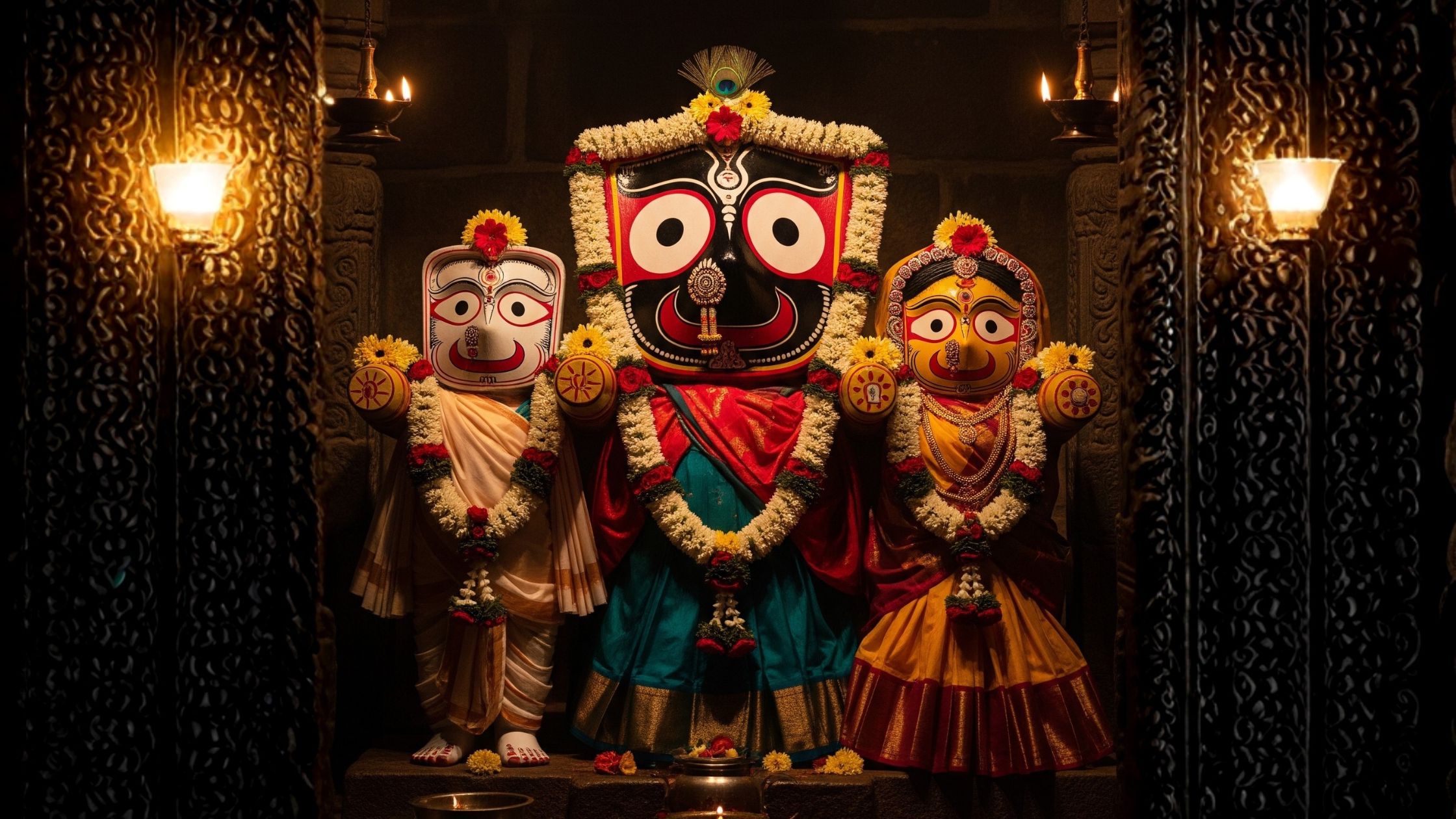
The Living Deity: Why Jagannath’s Body Is Recreated Through Time Watch the full video explanation Why Jagannath’s Body Is Recreated: The Nabakalebara Ritual Explained Most temple traditions seek permanence through material—stone that endures centuries, bronze that withstands millennia. But in Puri, Odisha, the Jagannath Temple follows a radically different logic. Here, the deity is not meant to resist time. The deity participates in time. The wooden form of Jagannath is recreated according to a precise ritual cycle. This process—called Nabakalebara (New Embodiment)—is not frequent. It occurs only when an additional lunar month appears during Ashadha (June-July), creating a rare calendrical alignment that happens every 8, 12, or 19 years. Understanding this ritual changes how we understand body, continuity, and presence in Sanātana tradition. This is not about preservation. This is about transformation as design. Part I: The Choice of Wood—Accepting Impermanence Why Daru Brahma? The Jagannath deity is made of Daru Brahma—sacred neem wood. This choice is intentional and philosophical. Wood responds to climate. Wood carries age within it. Wood reflects time passing through visible transformation—grain deepening, surface wearing, material gradually returning to earth. Stone resists. Metal endures. Wood participates. By choosing wood, the tradition accepts—no, integrates—impermanence into the system. The deity’s body is not meant to transcend decay. It is meant to move through it with structure and dignity. This is not weakness. This is sophistication. The Conceptual Foundation According to temple texts dealing with the principles of image construction, idols made of jewels have a lifespan of 10,000 years, metal images 1,000 years, wooden images between 12-18 years, and clay images only one year. The Jagannath tradition knows this. And instead of choosing permanence through material, it chooses continuity through ritual. The form may change. The presence remains. Part II: The Trigger—When Time Creates Space Adhikamasa: The Astronomical Alignment Nabakalebara is not arbitrary. It follows cosmic rhythm. The ritual is performed when an intercalary month (Adhikamasa) occurs in Ashadha, meaning two lunar months of Ashadha fall in one year. This creates an extended period—three fortnights instead of two. The extra time is not incidental. It’s essential for the 12-step process: Search for sacred trees (Banajaga Yatra) Identification and consecration Transport to Puri Carving of new forms Transfer of continuity (Brahma Parivartana) Burial of previous bodies In the 20th century alone, Nabakalebara was celebrated in 1912, 1931, 1950, 1969, 1977, and 1996. The most recent occurred in 2015, and the next is expected in the 2030s. This is not superstition. This is a calendar system that creates liturgical space within astronomical cycles. Part III: Banajaga Yatra—The Search for Daru Criteria Beyond the Visible When Adhikamasa approaches, a team of Daitapati servitors—descendants of the tribal chief Vishwavasu who originally worshipped Nila Madhava—undertake the Banajaga Yatra, a ritual journey to locate suitable neem trees. The criteria are exacting: For Lord Sudarshana’s Daru: The tree must have three branches For Lord Jagannath’s Daru: The tree should be dark or dark-red in color, with a straight trunk and four clear branches. It should be away from human settlement. An anthill with snakes should be at the foot For all Darus: No bird’s nest should be present Natural markings (conch, disc symbols) should be visible The tree must meet specific age and height requirements This search is led by Daitapatis who receive signs through dreams and meditative insights. This is not random selection. This is ritual botany—a system where natural signs are read as indices of sacred suitability. The Moment of Designation Once identified, the trees are not simply cut. They are transformed in status. A yaga (fire sacrifice) is performed for three days. The trees are then touched with axes made of gold, then silver, and finally cut with an iron axe. This sequence—gold, silver, iron—marks a transition from the purely sacred to the materially functional. The tree enters a new identity. It becomes the future body of the deity. From this point, the tree carries responsibility. Part IV: Return and Preparation The Public Journey The logs are placed on newly constructed wooden carts and brought back to Puri in a ceremonial procession. This journey is slow. It is watched. It is public. The arrival is not private. The wood is received with the same attention given to arriving royalty. The logs are kept near Koili Baikunt ha (also called Koili Vrindavan), a sacred space that functions as a ritual threshold. The temple doors close. Movement is restricted. What follows happens in concealment. The Carving: Duty, Not Art Hereditary artisans called Biswakarma Maharanas—belonging to families entrusted with this role for generations—begin carving the new forms. The work is done over 21 days, by approximately 50 carpenters, all working in complete secrecy. This activity is not treated as artistic creation. It is treated as ritual manufacture. Measurements are fixed. Proportions are preserved. Despite centuries passing and multiple cycles of Nabakalebara, the deities are always recreated exactly as they were—with rounded arms, no visible legs, and the same wide, cosmic eyes. There is no innovation. There is no stylistic evolution. Continuity governs every decision. Why? Because it is believed that Jagannath himself commanded King Indradyumna: “In this form, beyond human standards of perfection, I shall accept the devotion of my devotees until the end of Kali Yuga”. The form is fixed. What changes is only the material vessel. Part V: Brahma Parivartana—The Transfer of Continuity The Midnight Rite When the new bodies are complete, a night-time rite called Brahma Parivartana takes place on Chaturdashi (the 14th day of the dark fortnight) at midnight. This is the ritual’s conceptual core. The old and new deities are placed facing each other. The Brahma Padartha—the divine essence embedded in the old forms—is transferred to the new ones in total secrecy. The Protocol of Secrecy Even the priests who perform this task are blindfolded, their hands and feet wrapped in thick silk cloth. The entire town of Puri experiences a blackout. No one except authorized Daitapati servitors can witness the process. It is believed that anyone watching
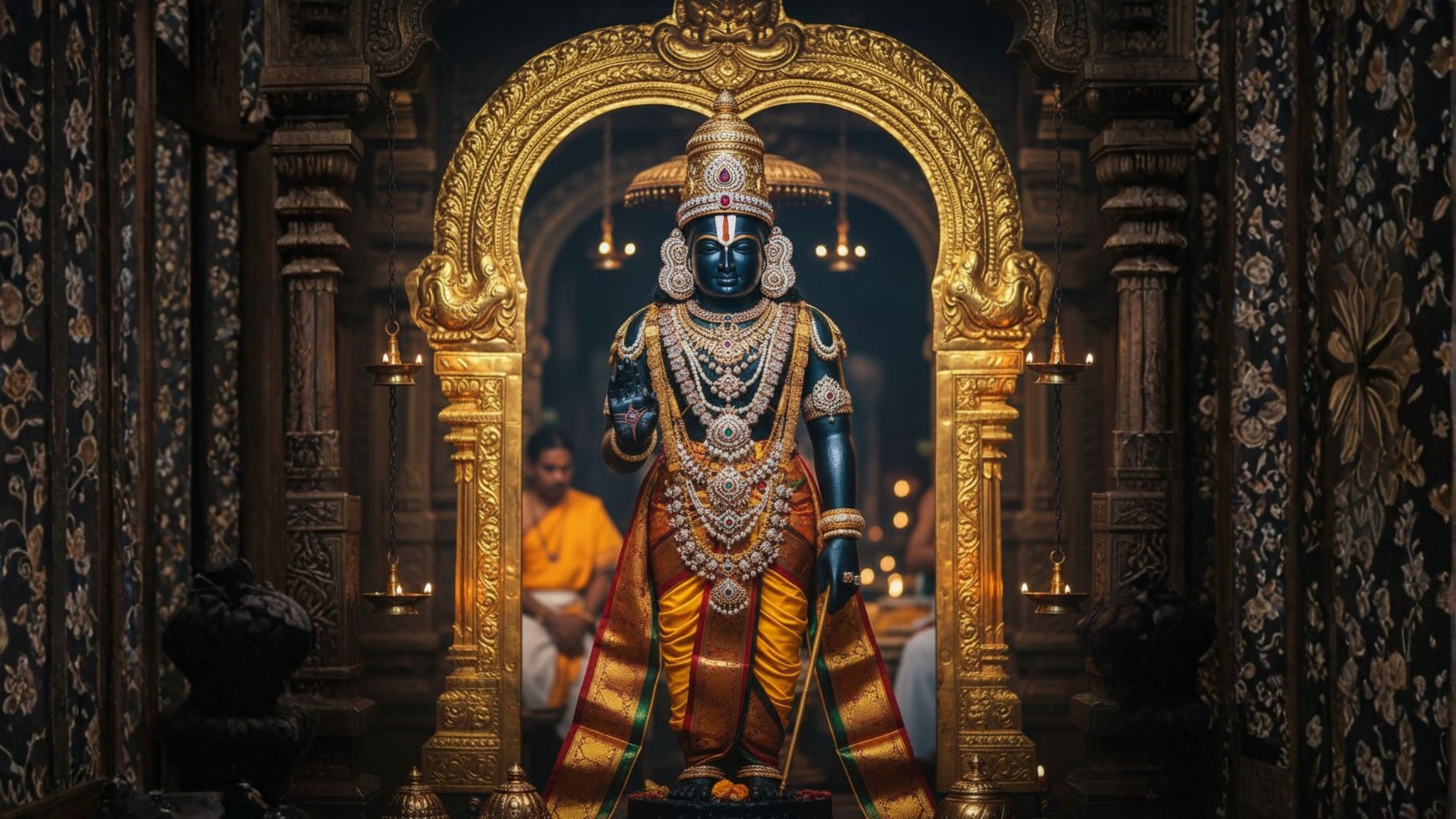
How Lord Venkateswara Came to Tirumala: The Sacred Story of Divine Love, Separation, and Reunion
How Lord Venkateswara Came to Tirumala: The Complete Sacred Story Watch the full video explanation https://youtube.com/shorts/Fq-hLcuK4ok How Lord Venkateswara Came to Tirumala: The Complete Sacred Story Every year, over 50-80 million pilgrims climb the seven hills of Tirumala to stand before Lord Venkateswara—making the Tirumala Venkateswara Temple the most visited religious site on Earth, surpassing even Vatican City and Mecca. But why? Why does Vishnu—who resides eternally in Vaikuntha, the supreme spiritual abode—choose to remain on earth in stone form at Tirumala? Why did He take a massive loan from Kubera that devotees are still repaying? Why does He stand with both Lakshmi and Padmavati on His chest? The answers lie in one of the most profound love stories in Hindu tradition—a narrative that begins with an insult in heaven and culminates in an eternal commitment to humanity during Kali Yuga. This isn’t just temple legend. It’s a story encoded in multiple Puranas (Padma, Varaha, Skanda, Brahma, Bhavishyottara) and celebrated through centuries of devotion. Today, we’re unraveling every layer. Part I: The Question That Changed Everything The Great Debate at Mount Mandara The story begins not on earth, but in the celestial realm during a grand Yajna (sacrificial ritual) on Mount Mandara, where the greatest sages of creation had assembled. The Participants: Sage Bhrigu (one of the Saptarishis, the seven great sages) Numerous other rishis and celestial beings Purpose: To determine the ultimate beneficiary of sacred offerings The Question: After the yajna concluded, a theological debate arose: “Among the Trimurti—Brahma (Creator), Vishnu (Preserver), and Shiva (Destroyer)—who embodies the highest principle? Who is most worthy of receiving the fruits of yajna?” Centuries of scholarly dispute had failed to resolve this. The sages finally turned to Sage Bhrigu, renowned for his wisdom and unique qualification—he possessed an extra eye in the sole of his foot, symbolizing his ability to see truth even in the lowest places. The Mission: “O Sage Bhrigu, you must visit each of the Trimurti and test them. Determine who demonstrates the greatest qualities of patience, humility, and divine perfection. That deity shall be declared supreme.” The First Test: Lord Brahma Bhrigu first approached Lord Brahma in his celestial abode, Brahmaloka. What he found: Brahma was simultaneously: Chanting the Vedas Creating new worlds Meditating on cosmic principles Engaged in divine contemplation with Saraswati So absorbed in the act of creation was Brahma that he did not immediately acknowledge Bhrigu’s arrival. Bhrigu’s Response: Feeling slighted, Bhrigu cursed Brahma: “You are so consumed with your own creative power that you ignore a sage seeking truth. For this ego, you shall have no temples dedicated exclusively to your worship on earth.” (This curse explains why Brahma temples are extremely rare—the most famous being in Pushkar, Rajasthan.) The Second Test: Lord Shiva Next, Bhrigu traveled to Mount Kailash, Shiva’s abode. What he found: Lord Shiva was engaged in intimate privacy with Goddess Parvati, absorbed in divine union (maithuna). Again, Bhrigu’s arrival went unnoticed. Bhrigu’s Response: Enraged by what he perceived as disrespect, Bhrigu cursed Shiva: “You are so lost in worldly enjoyment that you ignore a seeker of truth. For this, you shall be worshipped primarily in linga form (symbolic form) rather than anthropomorphic form on earth.” (This explains the prevalence of Shiva Lingas in temples rather than full idol depictions.) The Third Test: Lord Vishnu—The Kick That Changed Cosmic History Finally, Bhrigu reached Vaikuntha, the eternal abode of Lord Vishnu. What he found: Vishnu was reclining on Ananta Shesha (the cosmic serpent), in Yoga Nidra (divine yogic sleep), with Goddess Lakshmi massaging his feet. Once again, Bhrigu’s arrival was not immediately acknowledged. But this time, Bhrigu’s response was different. The Fateful Kick: Overcome with rage at being ignored by all three gods, Bhrigu kicked Lord Vishnu on the chest—specifically on the Srivatsa mark, the divine spot where Goddess Lakshmi eternally resides. Vishnu’s Astonishing Response: Instead of anger, Vishnu: Rose immediately and bowed to Bhrigu Apologized profusely: “O great sage, forgive me for not noticing your arrival. My sleep must have caused you pain.” Began massaging Bhrigu’s feet, saying: “Your blessed foot that touched my chest must surely be hurting. Please allow me to relieve your pain.” While massaging, Vishnu pressed the extra eye on Bhrigu’s sole, destroying it The Symbolism: That extra eye represented Bhrigu’s ego—his pride in his own spiritual accomplishment. By destroying it, Vishnu was: Teaching the ultimate lesson in humility Showing that true divinity responds to insult with compassion Demonstrating perfect equanimity Bhrigu’s Realization: Overcome with emotion, Bhrigu fell at Vishnu’s feet: “You are indeed the Supreme! Only you possess infinite patience, boundless compassion, and complete freedom from ego. The yajna offerings belong to you.” But there was an unintended consequence. Part II: The Separation—When Lakshmi Left Heaven Lakshmi’s Justified Anger While Vishnu’s response was divinely perfect, Goddess Lakshmi was devastated. Her Perspective: The chest where Bhrigu’s foot struck was her eternal abode—the Srivatsa mark symbolizing her presence. The kick was not just an insult to Vishnu; it was a violation of her sacred space. Yet Vishnu had: Not defended her honor Apologized to the offender Even massaged the feet that kicked her dwelling Lakshmi’s Heartbreak: “If my Lord values the ego of a sage more than my dignity, then I have no place in Vaikuntha.” Different Puranic Accounts: Version 1 (Padma Purana): Lakshmi silently left Vaikuntha and descended to Kolhapur (ancient Karavira) in Maharashtra, where she began deep meditation. Version 2 (Skanda Purana): Lakshmi cursed Sage Bhrigu before leaving, declaring that his descendants would face hardship. She then took rebirth on earth. The Cosmic Consequence: When Lakshmi left, Vaikuntha lost its completeness. Lakshmi represents: Sri (prosperity, grace, beauty) Completeness (pūrṇatva) Divine feminine energy (śakti) Without her, even the highest heaven felt empty. Vishnu’s Decision Vishnu, realizing the depth of separation, made a choice: “I shall not remain in Vaikuntha without my beloved consort. I too shall descend to earth.” But this wasn’t a temporary visit—it was a permanent commitment. The Destination: The Venkata Hills (Seshachalam, meaning “Hills