
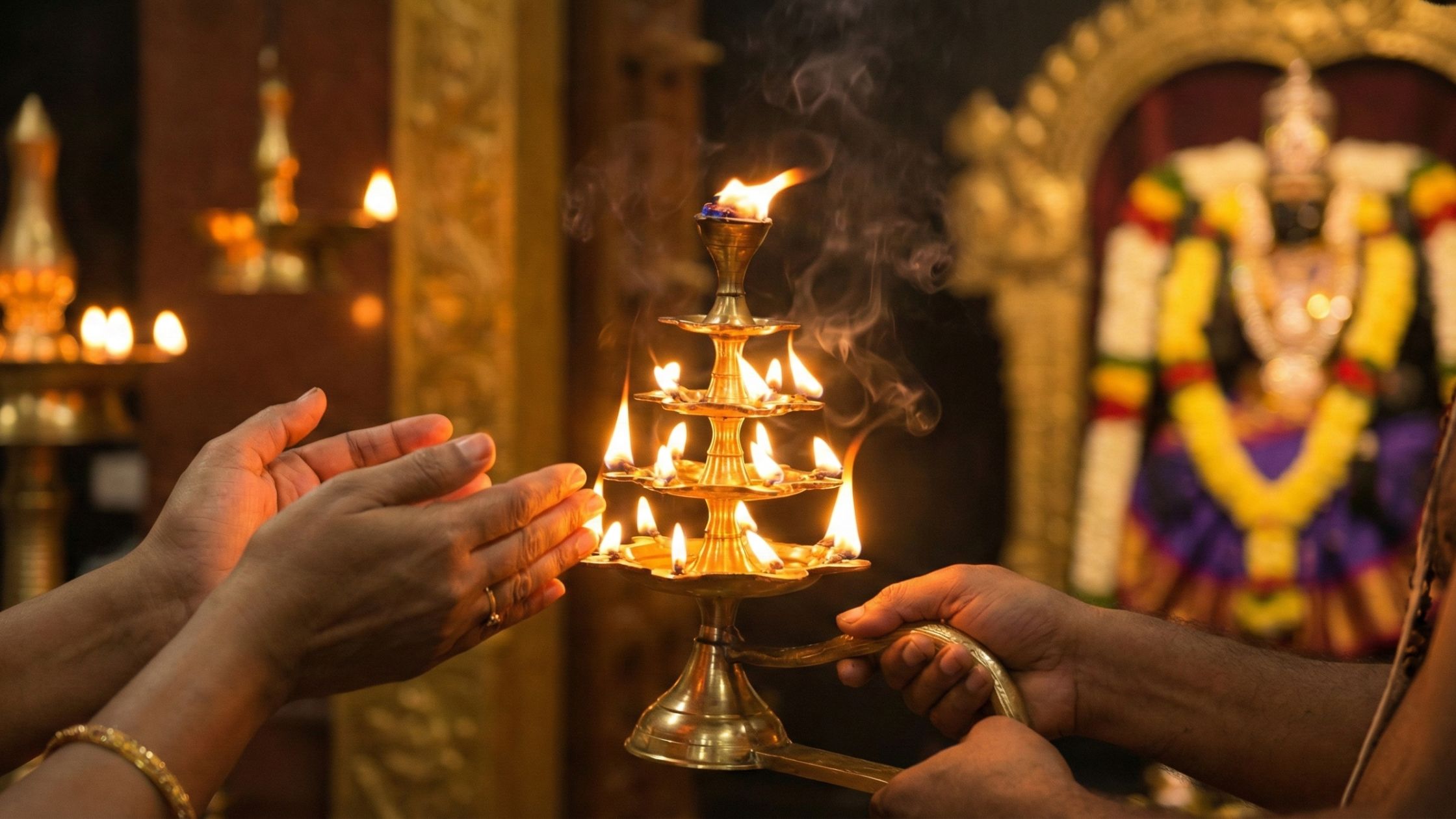
hy Do We Touch the Ārati Flame? The Sacred Science of Receiving Divine Light Watch the full video explanation https://youtube.com/shorts/io9EpnNA6Ow Why Do We Touch the Ārati Flame? The Sacred Science of Receiving Divine Light Agni, Prasāda & Temple Worship Explained Have you ever wondered why we touch that ārati flame and then place that warmth on our eyes and forehead? Most of us do it—in temples, at home shrines, during festivals. The priest waves the camphor flame before the deity, then brings it to us. We cup our hands over the light, draw that warmth toward ourselves, and touch our eyes and forehead in a gesture so automatic it feels instinctive. But almost no one knows why. Is it superstition? A cultural habit passed down without meaning? A symbolic gesture emptied of significance? The answer is far more profound. What appears as a simple ritual gesture reveals itself as a sophisticated theological transaction—a carefully designed system for transmitting divine grace from deity to devotee through the medium of consecrated light. I am Jayanth Dev, author of Dhantasura. And today, we’re examining what scripture actually says about this universal Hindu practice. Part I: Agni—The Divine Messenger The First Hymn of the Ṛg Veda To understand the ārati flame, we must first understand Agni (अग्नि)—the Vedic deity of fire. The Ṛg Veda (ऋग्वेद), humanity’s oldest continuously used religious text (composed approximately 1500-1200 BCE), begins not with praise of Indra, Varuṇa, or any of the celestial deities—but with Agni. Ṛg Veda 1.1.1: Sanskrit (Devanāgarī): अग्निमीळे पुरोहितं यज्ञस्य देवमृत्विजम् । होतारं रत्नधातमम् ॥ Sanskrit (IAST Transliteration): agnim īḷe purohitaṁ yajñasya devam ṛtvijam hotāraṁ ratna-dhātamam Word-by-Word Breakdown: agnim (अग्निम्) = Agni (accusative—Agni as object of praise) īḷe (ईळे) = I praise, I worship purohitam (पुरोहितम्) = the priest who sits in front, the foremost priest yajñasya (यज्ञस्य) = of the sacrifice devam (देवम्) = divine, god ṛtvijam (ऋत्विजम्) = the officiant, the ritual priest hotāram (होतारम्) = the invoker, the one who calls the gods ratna-dhātamam (रत्नधातमम्) = the best bestower of treasures/gems Translation: “I praise Agni, the purohita (priest placed in front), the divine priest of the sacrifice, the invoker who is the best bestower of treasures.” What This Establishes: Agni’s Unique Role This opening verse is theologically significant. The Ṛg Veda contains over 1,000 hymns to various deities—Indra (god of rain/thunder), Varuṇa (cosmic order), Sūrya (sun), Uṣas (dawn), and others. Yet it begins with Agni. Why? Because Agni occupies a unique mediating role in Vedic cosmology: 1. Agni is Purohita—The Foremost Priest The term purohita (पुरोहित) literally means “placed in front” (puras = in front, hita = placed). Agni is the priest who sits before the deity on behalf of humans, performing the sacrifice that we cannot perform directly. 2. Agni is Ṛtvij—The Divine Officiant He is both human fire (the flame we light) and divine fire (the sacred power that connects earth to heaven). He operates in both realms simultaneously. 3. Agni is Hotār—The Invoker The term hotār (होतार्) comes from the root hu (हु) = “to offer, to invoke.” Agni calls the gods to the sacrifice. When offerings are placed in fire, Agni carries them upward to the devas. 4. Agni is the Messenger Ṛg Veda 1.1.5: “Agni is the messenger between gods and men.” He is the carrier of offerings from humans to deities and the carrier of blessings from deities to humans. This is critical: Agni is not just fire. Agni is the medium of divine transaction. Part II: From Vedic Yajña to Temple Ārati The Evolution of Fire Worship In Vedic times (1500-500 BCE): Worship centered on yajña—elaborate fire rituals performed outdoors with mantras, offerings of ghee, grains, and soma. The structure: A sacred fire (yajña-agni) is established Offerings are made into the fire with specific mantras Agni carries these offerings to the appropriate deities The ritual concludes with participants receiving blessings The closing of the yajña involved presenting the flame to all participants, who would “take the light to fill the heart and mind.” This is the original form of what we now call ārati. The Temple Transformation As Hinduism evolved from Vedic yajña-centered worship to Purāṇic temple-centered worship (approximately 400 CE onwards), the grand outdoor fire sacrifice was ritualized into the temple lamp ceremony: Vedic Yajña → Temple Ārati Large fire pit → Small camphor/oil lamp Outdoor ritual space → Enclosed temple sanctum Direct offerings into fire → Flame waved before mūrti (deity form) Yajña participants → Temple devotees Final blessing with fire → Ārati distribution The core principle remained: Fire as the medium of divine transaction. Part III: The Ārati Ceremony—A Structured Ritual What Actually Happens During Ārati The word ārati (आरती) comes from Sanskrit ā-rāti (आ-राति): Ā (आ) = towards, near Rāti (राति) = to give, to offer (from root rā) Meaning: “The offering brought near”—specifically, the offering of light brought close to the deity. The Five-Element Offering Traditional ārati represents an offering of the Pañca-mahābhūta (पञ्चमहाभूत)—the five great elements that constitute material creation: 1. Pṛthvī (पृथ्वी) – Earth Represented by flowers, rice, sandalwood paste The solid, stable foundation 2. Jala (जल) – Water Represented by water in the conch shell (śaṅkha) The fluid, purifying element 3. Agni (अग्नि) – Fire Represented by the flame itself (camphor, ghee lamp, oil lamp) The transformative, illuminating element 4. Vāyu (वायु) – Air Represented by the fan (cāmara) waved before the deity The dynamic, life-giving breath 5. Ākāśa (आकाश) – Space/Ether Represented by the sound of bells, conch, and singing The subtle medium carrying vibration When all five elements are offered in ārati, the worshipper symbolically offers the entirety of material creation back to its source—the Divine. The Ārati Sequence Step 1: Preparation The priest (pūjāri) prepares the ārati plate with: A lamp with wicks soaked in ghee or pure camphor Sometimes flowers, incense, water A bell (ghaṇṭā) Step 2: Lighting and Consecration The flame is lit with accompanying mantras. The priest may chant: agnaye namaḥ – Salutations to Agni brahma-jyotiḥ namaḥ – Salutations to the

Why Break Coconut at Temples? Hindu Spiritual Science Explained
Why We Break Coconuts at Temples? The Ancient Science of Ego Dissolution Watch the full video explanation https://youtube.com/shorts/l9afxAbC9ZQ Why is a coconut broken before temple worship, vows, or auspicious beginnings? Stand at the entrance of any Hindu temple in India, and you’ll witness a ritual performed thousands of times daily: devotees breaking coconuts before entering the sanctum. The sharp crack echoes, water spills, and the broken halves are offered with folded hands. But have you ever paused to ask: Why? Is this merely tradition? A superstitious habit passed down through generations? Or does this simple act encode profound spiritual, psychological, and symbolic wisdom? Today, we’re embarking on a deep exploration of one of Hinduism’s most ubiquitous yet least understood rituals—the breaking of the coconut. We’ll examine its scriptural foundations, symbolic layers, historical evolution, psychological impact, and even the neuroscience behind why this physical act creates measurable shifts in consciousness. Śrīphala: The Only Fruit Named After God Before we understand why we break coconuts, we must understand what the coconut represents in Hindu sacred literature. The Sacred Etymology In Sanskrit, the coconut is called by several names, each revealing a different dimension of its significance: नारिकेल (Nārikela) The common Sanskrit term Etymology: Nīra (water) + Kela (vessel) = “vessel of water” Emphasizes its liquid-bearing nature श्रीफल (Śrīphala) Śrī = Divine grace, prosperity, goddess Lakshmi Phala = Fruit Translation: “The God’s Fruit” or “The Auspicious Fruit” This is extraordinary. The coconut is the only fruit in Hindu tradition given the prefix “Śrī”—explicitly associating it with the divine. महाफल (Mahāphala) Mahā = Great, supreme Phala = Fruit Translation: “The Great Fruit” worthy of being offered to deities Historical Evidence: When Did Coconuts Enter Hindu Ritual? Interestingly, there is no reference to coconuts in the Vedas (composed c. 1500-500 BCE). This tells us that coconuts were not part of the earliest Vedic fire rituals (yajñas). First references appear in: Mahabharata (compiled c. 400 BCE – 400 CE) Ramayana (composed c. 500 BCE – 100 CE) Puranas (composed c. 300-1000 CE) Buddhist Jataka Stories (300 BCE – 400 CE) Mahawamsa (the historical chronicle of Sri Lanka, 2nd-1st century BCE) mentions coconuts, confirming their presence and significance by that period. The coconut palm (Cocos nucifera) likely originated in the Indo-Pacific region and became prevalent in South India and Sri Lanka before gradually spreading northward. As it became more available, it was incorporated into Hindu ritual practice—eventually becoming central to temple worship. The Scriptural Foundation: What Do The Texts Say? While specific verses about coconut breaking appear in later Puranic literature rather than the earliest Vedas, the philosophical framework for the practice is well-established. Shiva Purana Reference Shiva Purana 2.1.14 states: […] पूजायां रुद्रस्य प्रथमं कार्यं सुसुन्दर-वस्त्रं प्रसार्य लिंगे। तण्डुलं वस्त्रोपरि पूजाकाले स्थापयेत्। पूजायां समाप्तौ श्रीफलं गन्धपुष्पादिभिः सह स्थापयेत्॥ Translation: “[…] In the worship of Rudra, first a fine cloth should be spread over the linga. Rice grains shall be placed on the cloth during worship. At the end of worship, the Śrīphala (coconut) shall be placed along with fragrances and flowers, and fumigated with incense. The devotee shall attain the benefit of worship.” This establishes the coconut as a culminating offering in Shiva worship—the final gift that completes the ritual sequence. Puranic Principle of Offering Though the specific verse mentioned in your script may represent traditional oral teaching rather than a directly traceable Puranic line, the philosophical principle it expresses is well-documented across texts: Core Teaching: नारिकेलफलं दद्यात् देवाय विनिवेदयेत्। अहंकारस्य नाशार्थं पूर्णत्वप्रतिपत्तये॥ Transliteration: Nārikelaphalaṁ dadyāt devāya vinivedayetAhaṅkārasya nāśārthaṁ pūrṇatva-pratipattaye Translation: “The coconut fruit should be given and offered to the deityFor the destruction of ego (ahaṅkāra)And for the realization of inner completeness (pūrṇatva).“ Understanding Ahaṅkāra: What Is Ego in Hindu Philosophy? The concept of Ahaṅkāra (अहंकार) is central to understanding this ritual. Etymology: Aham (अहम्) = “I” Kāra (कार) = “making” or “doing” Ahaṅkāra = “I-making” or “the sense of I-ness” In Sāṅkhya Philosophy: Ahaṅkāra is one of the 25 tattvas (fundamental principles of reality). It emerges from Buddhi (intellect) and creates the sense of individual identity separate from universal consciousness. Three Modes of Ahaṅkāra: Sāttvika Ahaṅkāra (pure ego) Identification with higher consciousness “I am pure consciousness” Rājasika Ahaṅkāra (passionate ego) Identification with action and achievement “I am the doer” Tāmasika Ahaṅkāra (ignorant ego) Identification with the physical body and material possessions “I am this body,” “This is mine” Spiritual practice aims to transcend all three forms of ego-identification to realize one’s true nature as pure consciousness (Ātman). The Symbolic Architecture: Coconut as Human Microcosm The coconut’s structure provides a perfect symbolic representation of the human being: Layer-by-Layer Symbolism 1. The Outer Fibrous Husk (Coir) Represents: Accumulated impressions (saṃskāras), karmic residues, social conditioning Spiritual Meaning: The layers of identity we accumulate through experiences and societal programming Why It’s Removed: In most rituals, the coir is stripped before offering, symbolizing removal of surface-level conditioning 2. The Hard Shell Represents: The rigid ego structure (ahaṅkāra), the sense of separation Physical Quality: Hard, resistant, protective Spiritual Meaning: The defensive mechanism that creates the illusion of being separate from others and the divine The Breaking Point: This must be cracked open—not gently opened, but decisively shattered 3. The Inner Water Represents: Internal tendencies (vāsanās), emotional patterns, subconscious drives Why It’s Discarded: The water is typically poured out before offering the coconut, symbolizing the release of deep-seated desires and emotional attachments Purification: Just as the water drains away, we release our inner compulsions 4. The White Kernel (Flesh) Represents: Pure consciousness, the true self (Ātman), inner divinity Physical Quality: White, pure, nourishing Spiritual Meaning: The essence that remains after ego-structures are dissolved The Offering: This pure essence is what we present to the deity—our true self surrendered The Three Eyes of Shiva The coconut has three natural markings (germination pores) on its top, which tradition associates with Lord Shiva’s three eyes: Two physical eyes = Perception of duality (subject-object, me-you) Third eye = Transcendent perception beyond duality Breaking the coconut before Shiva is thus offering our limited dualistic perception
The Sacred Science of Aarti: Why We Touch the Flame and Bring It to Our Eyes
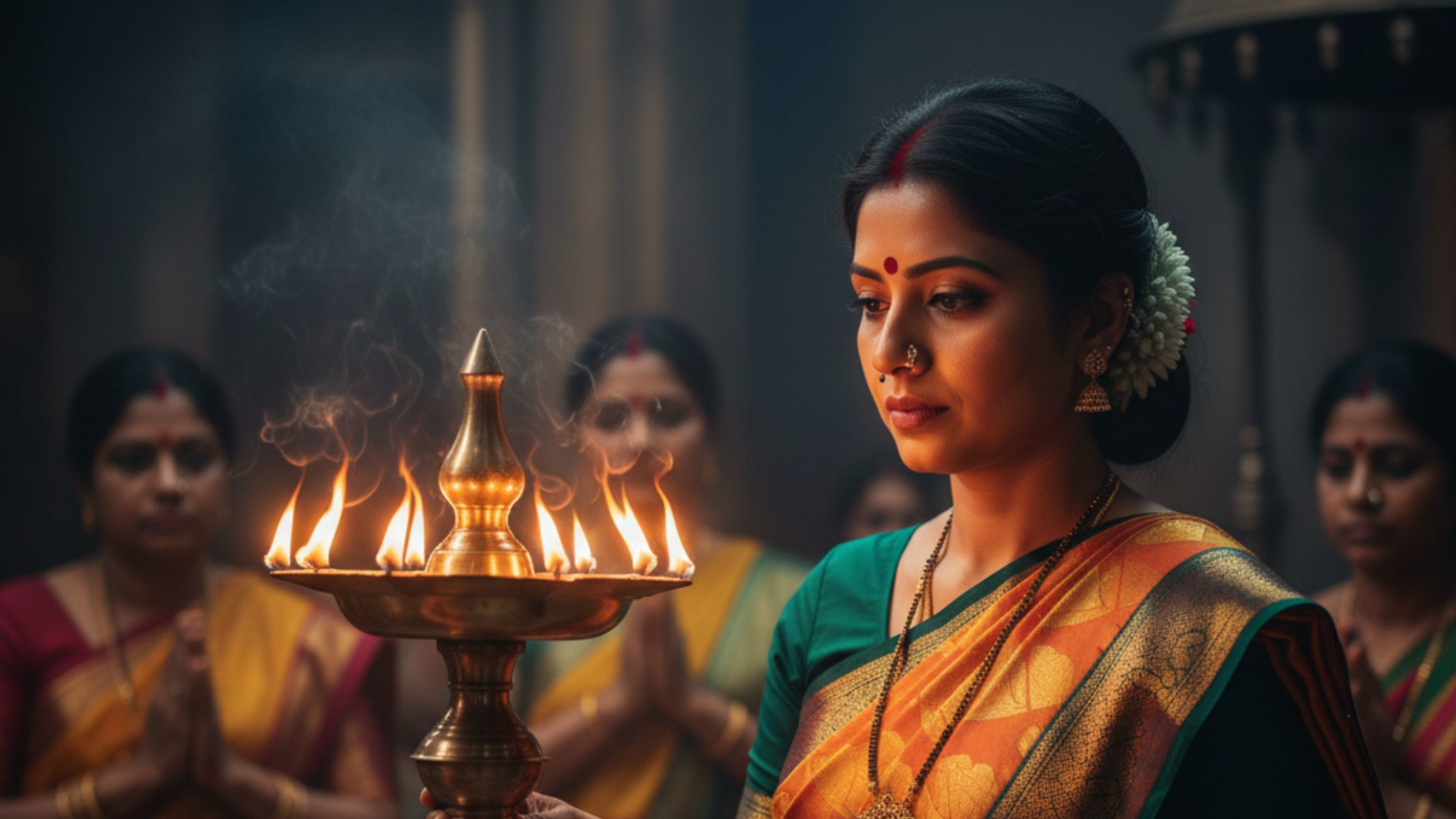
The Sacred Science of Aarti: Why We Touch the Flame and Bring It to Our Eyes Watch the full video explanation https://youtube.com/shorts/CFvy13EADDM The Sacred Science of Aarti: Why We Touch the Flame and Bring It to Our Eyes Every evening in temples across India and around the world, a timeless ritual unfolds. Priests wave lamps before deities in circular motions while devotional songs fill the air. Then comes the moment millions participate in without fully understanding: the flame is brought to devotees, who cup their hands over it and bring that warmth to their eyes and forehead. Why do we do this? What ancient wisdom encoded in this gesture has been preserved for thousands of years? Today, we’re exploring the profound spiritual science behind this practice—a ritual that transforms fire into a carrier of divine grace, and a simple gesture into an act of profound transformation. The First Word: When The Vedas Begin With Fire To understand the significance of Agni (fire) in Hindu worship, we must journey to the very beginning—not just of ritual, but of the oldest continuously preserved spiritual literature in human history. Rig Veda 1.1.1: The Opening Invocation The Rig Veda, composed approximately 3,500 years ago, begins not with a cosmological creation myth or philosophical abstraction, but with a hymn to Agni—the divine fire: अग्निमीळे पुरोहितं यज्ञस्य देवमृत्विजम् होतारं रत्नधातमम् Transliteration: Agnim īḷe purohitaṁ yajñasya devam ṛtvijamHotāraṁ ratnadhātamam Translation: “I praise Agni, the chosen priest, the divine minister of sacrifice,The invoker, the one who bestows the jewel of divine wealth.” This opening verse of the Rig Veda—the first word of humanity’s oldest scripture—is Agnim (Agni). This is no accident. The ancient rishis understood something profound: Agni is the medium through which the human reaches the divine, and the divine reaches the human. Why Agni? The Three-Level Reality The Vedas describe Agni as existing simultaneously on three planes: On Earth: As physical fire (bhū-loka-agni) In the Atmosphere: As lightning (antarikṣa-agni) In the Heavens: As the sun (dyuloka-agni) Agni is thus the connecting principle—the transformer that carries offerings from the material plane to the divine realm. When we understand this, the Aarti ritual suddenly reveals its deeper significance. Etymology: What Does “Aarti” Actually Mean? The word Aarti (or Arati) is derived from the Sanskrit term आरात्रिक (ārātrika). Sanskrit Breakdown: आ (ā): complete, total, fully रात्रि (rātri): night, darkness क (-ka): suffix indicating the action or instrument Literal Meaning: “That which removes darkness” or “that which dispels the night” But here’s where it gets profound: This isn’t just about physical darkness. In Vedantic philosophy, rātri (night) symbolises: Ignorance (avidyā) Material identification (dehātma-buddhi) Spiritual unconsciousness Therefore, Aarti is the ceremony that dispels the night of our material sojourn with the light of divine consciousness. Alternative Etymology Another interpretation breaks down “arti” as: आ (ā): complete रति (rati): love Thus, Ārati = “complete love” or “unconditional devotion” offered to the deity through the medium of light. The Ritual Architecture: Five Elements, One Offering A traditional Aarti ceremony is a magnificent offering of the entire material creation to the deity. The items used represent the Pañcamahābhūta—the five great elements: Aarti Element Sanskrit Represents Cosmic Element Flame/Lamp दीप (dīpa) Light, Energy Fire (Agni) Peacock Fan मयूरमुख (mayūramukha) Movement, Breath Air (Vāyu) Water in Vessel जल (jala) Fluidity, Life Water (Ap) Flowers पुष्प (puṣpa) Solid Form, Beauty Earth (Pṛthvī) Yak-tail Fan चामर (cāmara) Subtle Space, Sound Ether (Ākāśa) When all five elements are offered in Aarti, the worshipper symbolically offers the entirety of material creation back to its source—the divine. The Science of the Circling Motion The priest circles the flame before the deity in a specific pattern—always clockwise (pradakṣiṇa direction). Why Clockwise? In Vedic cosmology: The Sun moves from East to West (clockwise when facing North) This is the direction of cosmic order (Ṛta) Moving clockwise aligns human action with cosmic movement It represents moving forward in spiritual evolution, not backwards into ignorance The circular motion itself has significance: Circles represent infinity, completion, the eternal The circle of flame creates a maṇḍala—a sacred geometric space This sanctifies the deity’s image and the surrounding space Agni: The Divine Messenger In over 200 hymns of the Rig Veda, Agni is described with specific epithets that reveal his unique role: Ṛtvij – The Divine Priest ऋत्विजम् Ṛtvijam – “The one who officiates at the sacrifice at the right time” Agni is not just fire—he is the cosmic priest who performs the sacrifice on our behalf. Hotā – The Invoker होतारम् Hotāram – “The summoner, the caller of the gods” Agni calls the gods to partake of the offerings. He is the messenger who carries our prayers upward and brings divine blessings downward. Vaiśvānara – The Universal Fire One name for Agni is Vaiśvānara (वैश्वानर), meaning “belonging to all people” or “universal.” This Agni is not just the ritual fire, but the fire of consciousness present in all beings—the divine spark within. The Moment of Transformation: When Light Becomes Prasāda Here’s the crucial understanding that most people miss: When the flame is waved before the deity, it transforms. The Scriptural Principle According to Agni Purāṇa and traditional Āgamic texts: Physical flame is offered to the deity with mantras and devotion The deity’s divine presence (sannidhya) infuses the flame The light that was merely physical now carries divine śakti (power/grace) It becomes Prasāda—a “gracious gift” charged with blessings This is why the same flame that illuminated the deity is then brought to devotees. It’s not just fire anymore—it’s consecrated light carrying the deity’s blessings. The Sacred Gesture: Why We Touch Eyes and Forehead Now we reach the heart of the mystery: Why do we cup our hands over the flame and bring that warmth to specific parts of our body? The Physical Action After Aarti, devotees: Cup both palms slightly above the flame (not touching it directly) Feel the warmth gathering in their hands Bring palms to the eyes (touching closed eyelids gently) Bring palms to the forehead (at the ājñā chakra location) Sometimes, also touch the