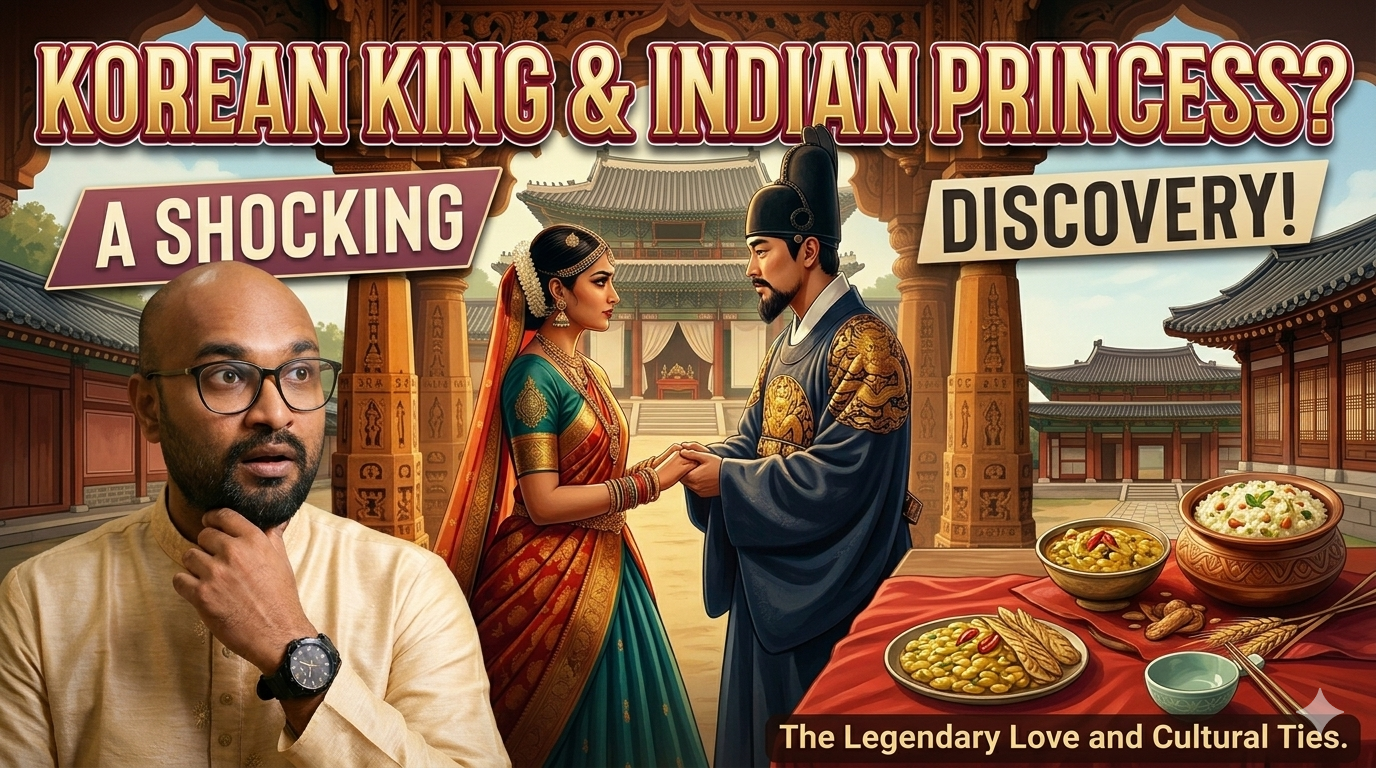
Why Korean and Tamil Share Hundreds of Similar Words — The 2,000-Year-Old Story Nobody Taught You Watch the full video explanation https://youtube.com/shorts/15cwZ590IOk Every Name of a Hindu Deity Is a Mantra — The Sanskrit Science Behind Shiva vs. Shiv, Rama vs. Ram The Word That Started It All In Korean, a child calls her father Appa. Her mother is Omma. Rice is ssal. Grass is pol. Day is nal. In Tamil, a child calls his father Appa. His mother is Amma. Cooked rice is soru. Grass is pul. Day is naal. Two languages geographically separated by over 5,000 kilometres of ocean. No shared empire, no recorded colonial encounter, no common ancestor language family that mainstream linguistics acknowledges. And yet the words for the most fundamental things — parent, food, earth, time — arrive in both languages wearing the same sound. This is either an extraordinary coincidence or the faint echo of a contact so ancient it left its mark in language before it was even recognized as history. The story that may explain it begins around 48 CE, in the court of a Korean king who refused to marry anyone his ministers chose for him — because, he said, the heavens would bring his queen to him across the sea. The Ay Kingdom: The Buffer State That Bridged the World To understand what happened, you need to know about a kingdom that most Indian history syllabuses skip entirely. Between the powerful Pandya, Chola, and Chera kingdoms of ancient Tamilakam, there existed a smaller, strategically significant territory called the Ay Kingdom (also spelled Ayi, Aai, or Ai). The name derives from the early Tamil word ay — meaning cowherd — because the people of this region were predominantly a pastoral, cattle-herding community. Their leaders held the Tamil title Ayar, and the community is the same that later Tamil Sangam literature and Puranic texts would call Aayar — the cowherd class from which, notably, the Krishna-Gopal tradition of the Yadavas also drew its cultural vocabulary. The Ay kingdom occupied the southernmost tip of the Indian subcontinent — the region encompassing present-day Kanyakumari district and the areas that would later become Venad and ultimately Travancore (Thiruvananthapuram). It was not a military superpower. It was something more strategically important: a maritime trading kingdom, positioned at the exact point where the Indian Ocean’s east-west trade routes converged. Ancient Tamil Nadu’s maritime capabilities during the Sangam period (roughly 3rd century BCE to 3rd century CE) are among the most underappreciated facts in world history. Tamil kings sent trade missions to Rome, Southeast Asia, and the Gulf of Aden. Tamil merchants are documented in Egyptian papyri. Pepper, pearls, ivory, and cotton from Tamilakam reached Mediterranean markets directly. The Ay kingdom, sitting at the tip of this oceanic highway, was not a backwater — it was a departure point. And around 48 CE, according to the oldest surviving Korean chronicle, something arrived from this direction that would change Korean history. The Samguk Yusa: The Korean Text That Records It All The Samguk Yusa (三國遺事 — “Memorabilia of the Three Kingdoms”) is a 13th-century CE Korean historical chronicle compiled by the Buddhist monk Iryeon (also written as Il-yeon), who lived from 1206 to 1289. It is housed today as National Treasure No. 306-3 of Korea. Iryeon compiled the text at Ingak Temple, drawing on multiple earlier sources — including court records, Buddhist monastery archives, Chinese annals, and most crucially, a lost text called the Garakgukgi (the Record of Garak Kingdom), which contained the foundation history of Geumgwan Gaya. The Samguk Yusa is not a simple historical record. It is, as its name implies, supplementary material — stories, legends, myths and oral traditions that the more officially-oriented Samguk Sagi did not include. Iryeon was meticulous: he visited sites personally, recorded local traditions, tested physical relics, and noted when sources conflicted. He did not claim everything he recorded was literal history. The Samguk Yusa functions more like what we might today call a cultural archive — a repository of what the Korean people remembered about themselves. Within this archive, in the section on Geumgwan Gaya, is the founding legend of the kingdom. And within that founding legend is one of the most remarkable cross-cultural stories in ancient Asian history. Kim Suro, the King Born from a Golden Egg According to the Samguk Yusa, the kingdom of Geumgwan Gaya was founded around 42 CE in what is now Gimhae, South Gyeongsang Province, in southeastern Korea near the modern city of Busan. The founding myth describes nine clan chiefs (gan) gathering at a mountain peak called Gujibong, where they sang a ritual song and were commanded by a heavenly voice. A golden bowl wrapped in red cloth descended from the sky. Inside were six golden eggs. Twelve days later, six boys emerged from the eggs. The first and most radiant of these was Suro — later known as Kim Suro — who was chosen as king. Kim Suro is not a minor figure in Korean history. He is the legendary progenitor of the Gimhae Kim clan — today one of the most common surnames in South Korea. His descendants, and those of the queen he would marry, include tens of millions of living Koreans. An archaeological site in modern Gimhae preserves tombs attributed to Kim Suro and his queen. He is the acknowledged founding figure of Geumgwan Gaya, the most powerful of the six city-states of the Gaya Confederacy, which controlled the iron trade of the Korean Peninsula from the 1st to the 6th century CE. In the seventh year of his reign, the court ministers urged him to choose a queen from among the maidens they presented to him. Suro refused. He declared that his queen would be sent by heaven, and that he would wait. He did not wait long. The Princess from Ayuta: Heo Hwang-Ok Arrives The Samguk Yusa records that in 48 CE, a 16-year-old princess from a distant kingdom called Ayuta (阿踰陁) set sail across the sea.