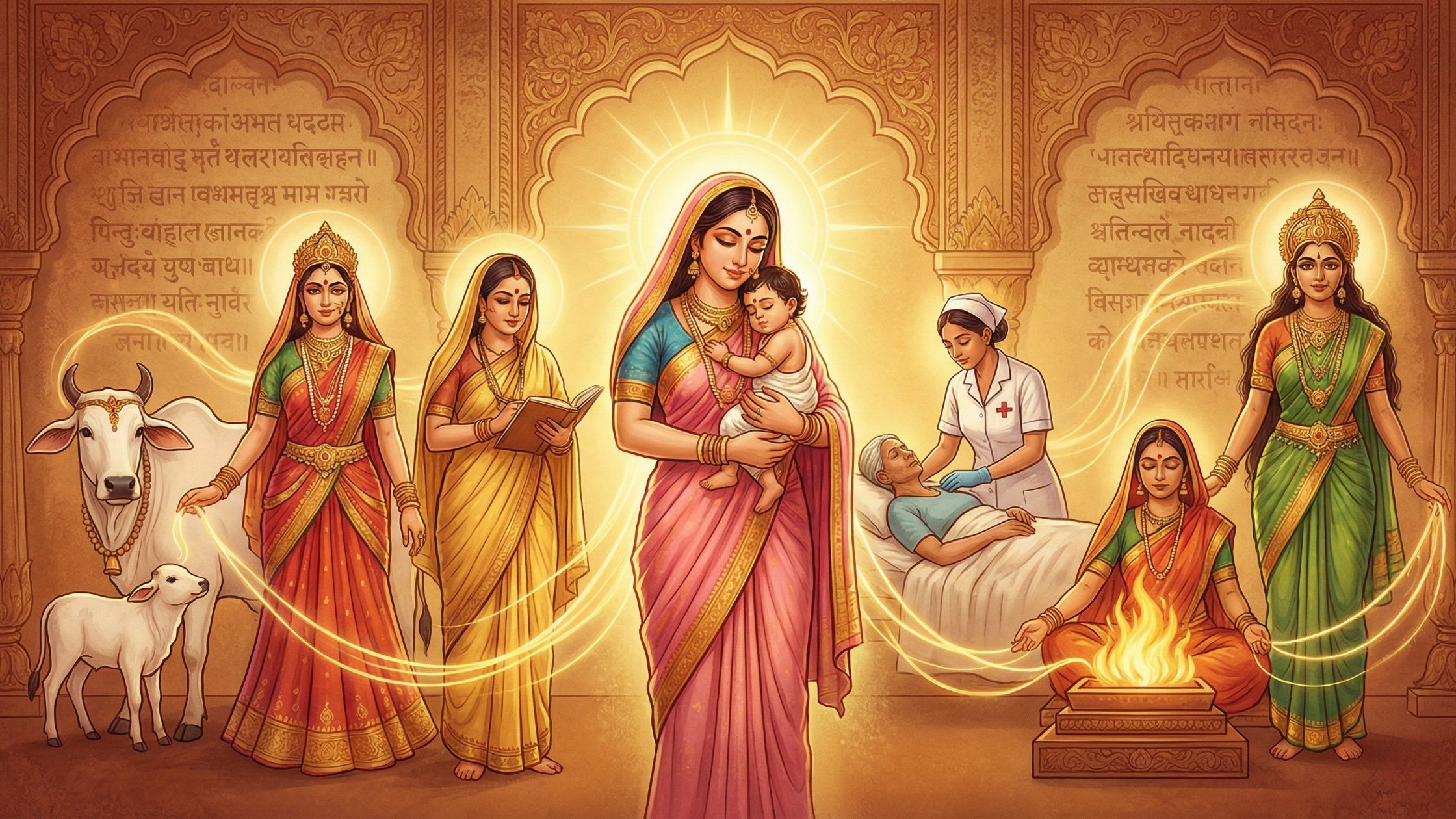
Seven Mothers in Sanatana Dharma: The Sacred Principle of Saptamatrika Explained | Vedic Wisdom Watch the full video explanation https://youtube.com/shorts/r0munFBd1t4 The Seven Mothers: Understanding Saptamatrika in Sanatana Dharma You were born with seven mothers. Not metaphorically. Not poetically. But according to the precise taxonomical framework of Sanatana Dharma—the eternal philosophical order that underpins what is commonly called Hinduism. This isn’t sentiment. This is structure. Because in the Vedic worldview, motherhood was never confined to biological birth alone. It was recognized as a fundamental principle—the essence of nurturing, protection, and sustenance that operates at multiple levels of existence simultaneously. This concept is encoded in the tradition as Saptamatrika (सप्तमातृका)—the Seven Mothers—and understanding it reveals something profound about how ancient Indian civilization understood the architecture of care, duty, and social order. The Seven Mothers: A Complete Framework According to classical Dharmashastra texts, particularly the Manusmriti and various Puranas, seven types of relationships carry the sacred designation of “mother” (मातृ – matri): 1. Janani Mata (जननी माता) — The Birth Mother Function: Biological creation and primary nurturing Your birth mother—the woman who carried you, delivered you, and provided your first sustenance—holds the primary position not because other mothers are lesser, but because she is the biological origin point. The Vedic texts are explicit: “Janani janmabhumischa svargadapi gariyasi” (जननी जन्मभूमिश्च स्वर्गादपि गरीयसी) — “Mother and motherland are greater than even heaven.” This isn’t hyperbole. It’s a hierarchy of gratitude. Heaven is abstract; mother is immediate. Heaven is possible; mother is actual. Everything you experience flows through the gateway she provided. Scientific Parallel: Modern developmental psychology confirms that the mother-child bond formed in gestation and early infancy creates the neurological template for all future attachments, emotional regulation, and social bonding. 2. Guru Patni (गुरु पत्नी) — The Guru’s Wife Function: Intellectual and spiritual nurturing In the Gurukula system (ancient India’s residential education model), students didn’t just receive instruction from the Guru—they lived as family members in the Guru’s household, often for years or decades. The Guru’s wife—Guru Patni or Guru Mata—managed the household that sustained this education. She ensured students were fed, clothed, and emotionally supported while they underwent intensive intellectual and spiritual training. She wasn’t a passive figure. In many traditions, she had teaching authority herself, particularly in: Practical dharma (daily ritual practice) Behavioral refinement (sadachara) Household management (grihasta duties) Specific knowledge transmissions when she was accomplished in certain arts or sciences Historical Example: Gargi Vachaknavi and Maitreyi weren’t just wives of sages—they were formidable philosophers in their own right, participating in the highest-level metaphysical debates recorded in the Upanishads. The Guru’s wife represents the principle: Wisdom requires nurturing environments. Intellectual growth doesn’t happen in isolation—it happens in sustained, supportive contexts. 3. Brahmani (ब्राह्मणी) — The Brahmin Woman Function: Preservation of sacred knowledge and ritual purity In Vedic civilization, Brahmin women weren’t merely wives of priests—they were custodians of civilizational memory. They maintained: Oral tradition transmission (passing Vedic chants to the next generation) Ritual precision (ensuring ceremonies were performed correctly) Cultural continuity (preserving festivals, customs, and sacred calendars) Dharmic education (teaching children foundational values) The Brahmani represents collective motherhood—nurturing not just individual children but the civilization’s intellectual and spiritual inheritance itself. Anthropological Insight: In societies without writing (or where writing was restricted), women’s role as primary socializers of children meant they were the actual transmission mechanism for cultural knowledge. The Brahmani is the institutionalization of this function. 4. Rajni (राज्ञी) — The Queen Function: Protection and governance The queen (or the wife of the king/ruler) was considered mother because she participated in the protection function of sovereignty. In Dharmashastra, the king’s primary duty was rakshana (protection)—defending the realm from external threats, maintaining internal order, and ensuring justice. The queen participated in this duty, especially in: Administering justice to women (cases involving women’s welfare, family disputes) Managing royal charities (food distribution, hospital patronage, educational endowments) Diplomatic functions (representing the kingdom, negotiating alliances) Succession and stability (ensuring legitimate heirs, maintaining royal continuity) Historical Examples: Rani Ahilyabai Holkar (1725-1795) ruled Malwa kingdom with legendary administrative competence and justice Rani Chennamma of Kittur (1778-1829) led armed resistance against British colonial expansion Rani Durgavati (1524-1564) ruled Gondwana and died defending her kingdom in battle The Rajni represents: Motherhood as protection at scale. Just as a mother protects her child, the queen protects the realm’s children. 5. Dhenu/Go Mata (धेनु/गो माता) — The Cow Function: Nourishment and sustenance The designation of the cow as mother—Go Mata—is perhaps the most misunderstood aspect of Hindu philosophy, reduced to caricature or dismissed as superstition. But the logic is precise and agrarian-economic: In pre-industrial agricultural societies, the cow provided: Milk (complete protein source for vegetarian populations) Dairy products (ghee, yogurt, butter—essential fats and nutrients) Draft power (oxen for plowing, transportation) Fertilizer (cow dung for enriching soil, fuel for cooking) Building material (cow dung plaster for homes) Ritual essentials (ghee for yajnas, panchagavya for purification) A single cow could sustain multiple families across generations. Her offspring continued this sustenance cycle. She was, quite literally, a renewable resource system. Ecological Note: Modern regenerative agriculture is rediscovering what Vedic civilization encoded—integrated crop-livestock systems are more sustainable, productive, and resilient than monoculture farming. The cow represents: Motherhood as continuous nourishment. She gives without depletion, sustains without exhaustion—the ideal of nurturing itself. 6. Dhatri/Dhaya (धात्री/धाय) — The Nurse/Wet Nurse Function: Caretaking and healing In ancient India, Dhatri referred to any woman who provided care—particularly wet nurses (women who breastfed others’ children), midwives, healers, and caretakers. This recognition is profound because it acknowledges: Care work is sacred work. In royal and wealthy families, children were often nursed by Dhatri Mata (nurse mothers) who became lifelong members of the household, honored and provided for. They weren’t servants—they were family. Mythological Example: In the Mahabharata, Kunti’s nurse is mentioned with respect and affection. In the Ramayana, Urmila’s companions who cared for her during Lakshmana’s 14-year absence are honored figures. The Dhatri represents: Motherhood through chosen service. Biology isn’t the only bond—dedicated care creates maternal relationship. Modern Parallel: Foster mothers, adoptive mothers,
Vishnu Sahasranama: A Structural Language of Reality Beyond Devotion
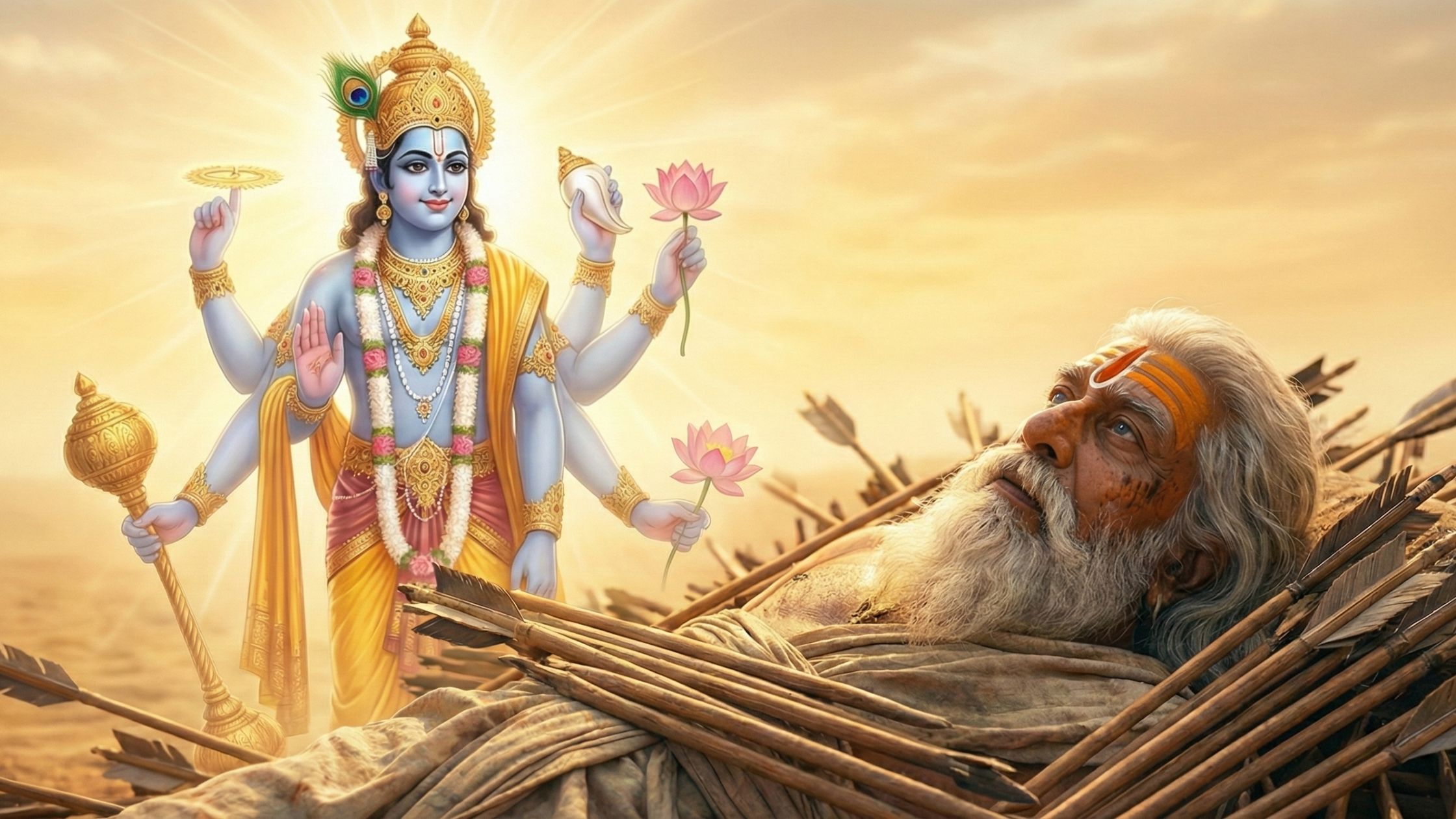
Vishnu Sahasranama Decoded: A Structural Language of Reality Beyond Devotion | Ancient Wisdom Watch the full video explanation Vishnu Sahasranama: A Structural Language of Reality Beyond Devotion Most people approach the Vishnu Sahasranama as a devotional recitation—a sacred list of 1,000 names praising Lord Vishnu. While this understanding is valid, it barely scratches the surface of what this ancient text actually represents. What if the Vishnu Sahasranama isn’t primarily poetry or praise, but rather a structural language describing the fundamental principles by which reality sustains itself? That reframing changes everything. The Context That Changes Everything: Bhishma’s Final Transmission The Vishnu Sahasranama appears in the Mahabharata’s Anushasana Parva, spoken by one of the epic’s most pivotal characters: Bhishma Pitamaha. This context is not incidental—it’s everything. Bhishma wasn’t performing a routine ritual or delivering a sermon. He was dying. Lying on a bed of arrows (sharashayana), his body pierced through, voluntarily waiting for the auspicious uttarayana (the sun’s northward journey) to release his life force, Bhishma chose this liminal moment—suspended between life and death—to transmit his final wisdom. When Yudhishthira, the eldest Pandava, approached him seeking guidance on dharma, governance, and the ultimate reality, Bhishma responded with the Vishnu Sahasranama. Why This Matters In the Indian knowledge tradition, deathbed transmissions carry extraordinary weight. When someone with Bhishma’s stature—a man who had witnessed multiple generations, possessed unparalleled strategic insight, and held voluntary control over his own death—chooses to speak in his final moments, those words represent the distilled essence of a lifetime of understanding. Bhishma didn’t offer complex philosophical discourses. He offered names—1,000 of them. This editorial choice is itself profound. Names as Functional Descriptors, Not Labels In Sanatana Dharma (the eternal philosophical framework often called Hinduism), a nama (name) is never merely decorative. Names describe function, essence, and operational reality. Consider these examples from Vedic nomenclature: Agni (fire) comes from the root ag- meaning “to drive upward”—fire’s natural movement Vayu (wind) derives from va- meaning “to blow, to pervade”—air’s expansive nature Surya (sun) relates to sur- indicating “to shine, to generate”—the sun’s sustaining radiance Each name captures what something does, not just what it is called. Now consider the name Vishnu itself. The Root Meaning of Vishnu: Viś Vishnu derives from the Sanskrit root viś (विश्), which means: To pervade To enter To permeate To sustain from within This immediately tells us something crucial: Vishnu is not primarily a personality but a principle—the pervading intelligence that enters, sustains, and maintains existence itself. The Vishnu Sahasranama is therefore not a collection of attributes describing a deity’s preferences or powers. It’s a systematic cataloging of sustaining functions observable in reality. Opening Names: The Structural Foundation The Vishnu Sahasranama begins with precision: विश्वं विष्णुः वषट्कारः भूतभव्यभवत्प्रभुःViśvaṁ Viṣṇuḥ Vaṣaṭkāraḥ Bhūta-bhavya-bhavat-prabhuḥ Let’s decode these opening names: 1. Viśvam (विश्वम्) — Totality The universe in its entirety; not parts, but the whole integrated system. 2. Viṣṇuḥ (विष्णुः) — The Pervader That which enters and sustains every aspect of existence from within. 3. Vaṣaṭkāraḥ (वषट्कारः) — The Sustaining Force Behind Action The enabler of all sacrificial action; the principle that allows transformation and exchange. 4. Bhūta-bhavya-bhavat-prabhuḥ (भूतभव्यभवत्प्रभुः) — Governor of Past, Present, and Future The regulating intelligence across the temporal dimension. Notice what’s happening here: These aren’t personality traits. They’re descriptions of structural operations. The text opens by establishing: WHAT is being sustained (totality) HOW it’s sustained (pervading presence) The MECHANISM of sustaining (transformative force) The SCOPE of sustaining (across all time) Governance Language: The Adhyaksha Pattern As the Sahasranama progresses, we encounter a striking pattern—the repeated use of adhyaksha (अध्यक्ष), meaning “overseer” or “regulator”: लोकाध्यक्षः सुराध्यक्षो धर्माध्यक्षः कृताकृतःLokādhyakṣaḥ Surādhyakṣo Dharmādhyakṣaḥ Kṛtākṛtaḥ Lokadhyaksha — Overseer of worlds/realms Suradhyaksha — Overseer of cosmic forces (devas) Dharmadhyaksha — Overseer of natural law and moral order Kritakritha — Knower of all that is done and undone This is governance language, not devotional poetry. Every stable system—whether biological, ecological, mechanical, or cosmic—requires regulation, feedback loops, and self-correcting mechanisms. Without oversight, systems decay into entropy. The Scientific Parallel Modern science has different names for this sustaining intelligence: Biology calls it homeostasis—the body’s ability to maintain stable internal conditions despite external changes Physics calls it equilibrium—systems naturally moving toward stable states Cybernetics calls it negative feedback—self-regulating systems that maintain balance The Vishnu Sahasranama calls it Vishnu Different terminologies. Same foundational principle. Systems that persist do so through intelligent regulation. Why a Thousand Names? The Resolution Problem A legitimate question arises: If we’re describing one principle, why 1,000 names? The answer lies in how omnipresent principles express themselves. Reality doesn’t manifest the sustaining principle once or in one way. It expresses it: In matter (as physical laws) In life (as biological regulation) In consciousness (as awareness) In time (as continuity) In space (as omnipresence) In causality (as consequence) Each expression requires its own descriptor because context changes function. Water sustains life differently than fire sustains transformation, yet both are sustaining functions. The Sahasranama doesn’t explain this in essays—it lists with precision. This is why the text can feel repetitive to a casual reader. But it’s not repetition—it’s progressive resolution, like adjusting a microscope to see different levels of the same reality. Consider These Name Clusters: Temporal Sustaining: Bhutakrit (Creator of beings) Bhutabhrit (Sustainer of beings) Bhava (Pure existence) Bhutabhavana (That which causes beings to flourish) Perceptual Sustaining: Chakshuh (The eye of all) Sarvadarshi (The all-seer) Anantadrishti (Of infinite vision) Foundational Sustaining: Adharah (The support) Adhishthanam (The substratum) Apramatta (The ever-vigilant) Each cluster isolates one operational aspect of the same pervading intelligence. Why Sound? The Technology of Preservation The Vishnu Sahasranama wasn’t written first—it was recited, chanted, and preserved as sound for centuries before being committed to writing. This transmission method is deliberate. Sound Survives Interpretation Written language degrades through: Translation errors Scribal mistakes Interpretive drift Cultural context loss But phonetic patterns, when embedded in oral tradition, survive with remarkable fidelity. The Vedas themselves were preserved for millennia through precisely calibrated oral recitation before writing systems became widespread. Structural Alignment Through Repetition There’s another dimension: sound
The Forgotten Purpose of Wealth in Dharma: How the Bhagavad Gita Reconciles Financial Success with Ethical Living
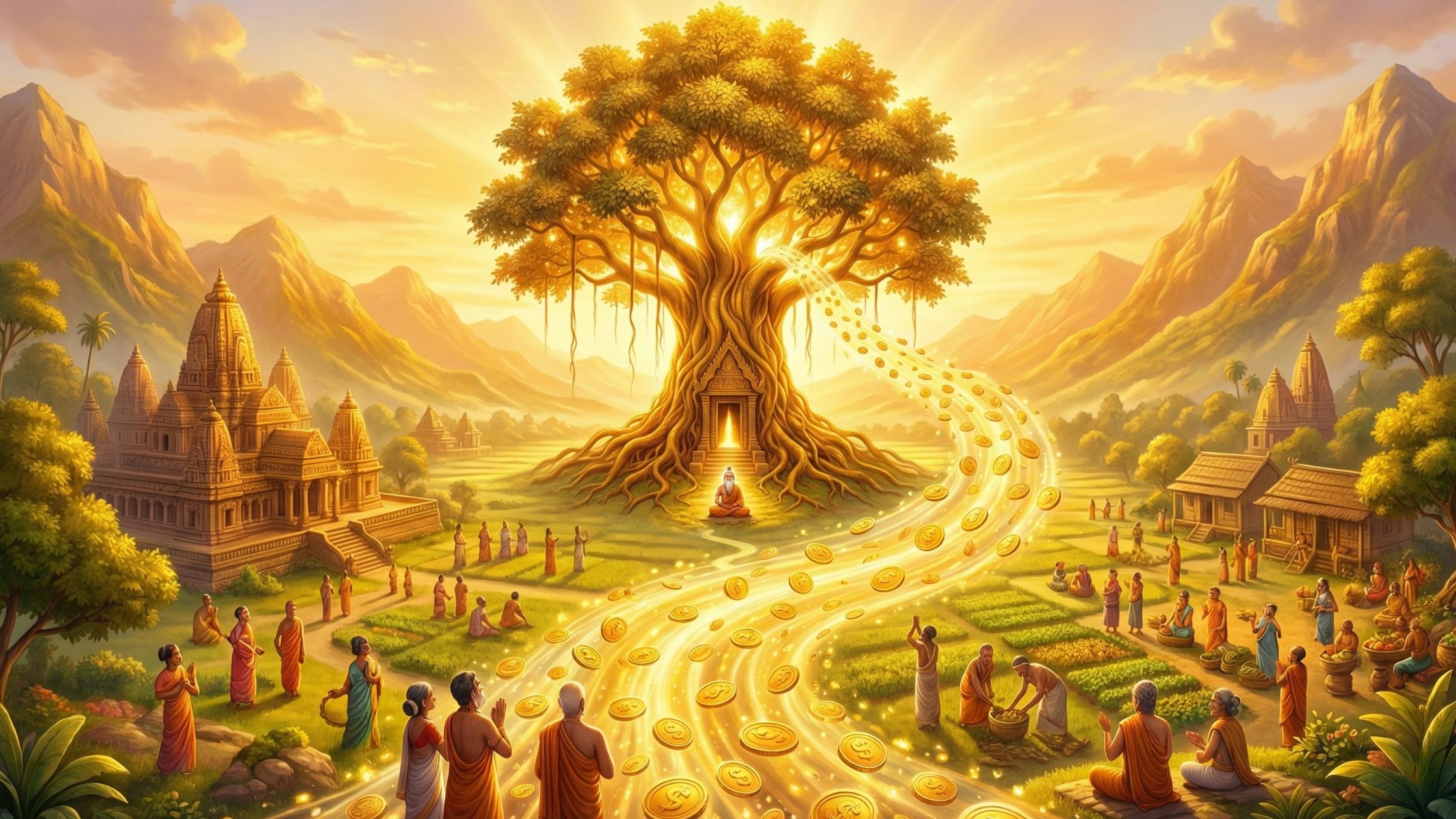
The Forgotten Purpose of Wealth in Dharma: How the Bhagavad Gita Reconciles Financial Success with Ethical Living Watch the full video explanation Bhagavad Gita on Money: 3 Duties of Ethical Wealth (Artha Dharma) Every financial guru, business coach, and wealth mentor will tell you the same thing: true success requires ruthlessness. To get ahead, you must cut corners. To accumulate wealth, you must prioritize profit over people. To build an empire, you must occasionally—or frequently—violate your own ethics. But here’s the paradox: If this is true, why is Artha (the pursuit of wealth, resources, and security) listed as one of the four essential goals of human life in Hindu philosophy? Why would ancient sages who gave us the Vedas, Upanishads, and Bhagavad Gita—texts that emphasize truth, compassion, and selflessness—celebrate material success as a legitimate life goal? The answer is simple: They had a radically different definition of wealth. The Bhagavad Gita doesn’t teach you how to become rich at any cost. It teaches you how to make your wealth a source of strength, not bondage. It shows you how financial success and ethical integrity are not opposing forces—they’re complementary. This is the forgotten law of Dharma-bound Artha: wealth pursued within the framework of righteousness. Today, we’re reclaiming this ancient wisdom and discovering the three duties of ethical wealth that can transform your relationship with money, success, and purpose. Part I: The Four Purusharthas—A Complete Life Philosophy What Are the Purusharthas? Purushartha (पुरुषार्थ) is a Sanskrit compound: Purusha (पुरुष) = “person,” “soul,” “human being” Artha (अर्थ) = “purpose,” “goal,” “meaning” Translation: “The objectives of human existence” or “the goals of life.” Hindu philosophy identifies four Purusharthas that together constitute a complete, balanced life: 1. Dharma (धर्म) – Righteous Living Definition: Moral duty, ethical conduct, living in alignment with cosmic and social order. Core Principle: Your actions should uphold truth (satya), non-violence (ahimsa), compassion (karuna), and righteousness. In Practice: Fulfilling your role in family, society, profession with integrity Acting according to your svadharma (individual duty based on your nature, stage of life, circumstances) Contributing to societal well-being Dharma is the foundation—all other pursuits must be built upon it. 2. Artha (अर्थ) – Material Prosperity Definition: The pursuit of wealth, resources, security, and the means to live a meaningful life. Not Just Money: Artha includes: Financial resources Professional skills and knowledge Social connections and influence Health and physical security Power and status Core Principle: Prosperity is not evil—it’s necessary. But it must be pursued within Dharma’s boundaries. The Misunderstanding: Modern society detaches Artha from Dharma, treating wealth as: An end in itself A measure of personal worth Something to be hoarded Legitimate regardless of how it’s acquired The Correct Understanding: Artha is the fuel for your Dharma. You need resources to: Fulfill family responsibilities Contribute to society Support spiritual growth Live with dignity and freedom from anxiety 3. Kama (काम) – Desire and Pleasure Definition: The legitimate pursuit of desires, pleasures, love, beauty, art, enjoyment. Not Just Sensual: Kama includes: Sexual intimacy within marriage Aesthetic enjoyment (music, art, nature) Emotional fulfillment and relationships Creative expression Culinary pleasures Core Principle: Desire is natural and should be fulfilled—but within ethical boundaries (Dharma) and without compromising security (Artha). The Balance: Kama pursued without Dharma = destructive hedonismKama pursued without Artha = unstable pleasureKama within Dharma + Artha = sustainable happiness 4. Moksha (मोक्ष) – Liberation Definition: Spiritual freedom, liberation from the cycle of birth and death (samsara), self-realization. The Ultimate Goal: While Dharma, Artha, and Kama are legitimate worldly pursuits, Moksha is the ultimate destination—freedom from all bondage, including material attachment. The Journey: Youth (Brahmacharya): Focus on learning DharmaHouseholder (Grihastha): Actively pursue Artha and Kama within DharmaRetirement (Vanaprastha): Gradual detachment, increased spiritual focusRenunciation (Sannyasa): Complete focus on Moksha Part II: The Modern Conflict—Why We’ve Lost the Balance The Detachment of Artha from Dharma In contemporary society—especially capitalist, globalized economies—we’ve made a catastrophic philosophical error: We’ve separated wealth from ethics. The result: Corporate greed: Profit maximization at any cost Environmental destruction: Resources exploited without regard for sustainability Social inequality: Wealth concentrated in fewer hands Psychological suffering: Even the wealthy experience anxiety, emptiness, fear of loss The Bhagavad Gita diagnosed this problem 5,000 years ago: Chapter 16, Verses 13-15 (describing the Asura or demonic mindset): इदमद्य मया लब्धमिमं प्राप्स्ये मनोरथम्। इदमस्तीदमपि मे भविष्यति पुनर्धनम्॥ अस मया हतः शत्रुर्हनिष्ये चापरानपि। ईश्वरोऽहमहं भोगी सिद्धोऽहं बलवान्सुखी॥ आढ्योऽभिजनवानस्मि कोऽन्योऽस्ति सदृशो मया। यक्ष्ये दास्यामि मोदिष्य इत्यज्ञानविमोहिताः॥ Translation: “‘I have gained this wealth today; I will fulfill this desire next. This is mine now; this wealth also will be mine in future. That enemy has been slain by me, and I shall slay others too. I am the lord, I am the enjoyer, I am successful, powerful, and happy. I am rich and high-born. Who is equal to me? I will sacrifice, I will give charity, I will rejoice’—thus deluded by ignorance.” The Asura mindset: Wealth for personal accumulation Power for ego gratification Success measured by domination over others No ethical constraints Sound familiar? This is modern corporate culture. Part III: The Bhagavad Gita’s Solution—Yajna as the Key What Is Yajna? Yajna (यज्ञ) is often translated as “sacrifice” or “offering,” but its meaning is much deeper. Root: यज् (yaj) = to worship, to offer, to give Philosophical Definition: Any action performed with the consciousness of: Contribution (not just consumption) Service (not just self-interest) Offering (giving back to the cosmic/social order) Yajna is the principle that transforms selfish action into dharmic action. The Crucial Verse: Bhagavad Gita 3.13 Sanskrit: यज्ञशिष्टाशिनः सन्तो मुच्यन्ते सर्वकिल्बिषैः। भुञ्जते ते त्वघं पापा ये पचन्त्यात्मकारणात्॥ Transliteration: Yajña-śhiṣhṭāśhinaḥ santo muchyante sarva-kilbiṣhaiḥBhuñjate te tvaghaṁ pāpā ye pachantyātma-kāraṇāt Word-by-Word: Yajña-śhiṣhṭa = remnants of sacrifice/offering Āśhinaḥ = those who eat Santaḥ = the saintly, the wise Muchyante = are freed Sarva-kilbiṣhaiḥ = from all sins Bhuñjate = eat/enjoy Te = they Tu = but Agham = sin Pāpāḥ = sinners Ye = those who Pachanti = cook/prepare Ātma-kāraṇāt = for themselves alone Translation: “The spiritually-minded, who eat food that is first offered in sacrifice,

When Every Civilization Tells the Same Story: The Great Flood Across Cultures
When Every Civilization Tells the Same Story: The Great Flood Across Cultures Watch the full video explanation Great Flood in Every Culture: Myth or Memory? Evidence Imagine discovering that completely separate civilizations—across oceans, separated by thousands of miles, with no contact with each other—all tell the same story. A catastrophic flood. A righteous man warned by the divine. A massive boat built to save life. Animals brought aboard in pairs. The vessel coming to rest on a mountain. The rebirth of civilization. This isn’t fiction. It’s documented historical fact. From ancient Mesopotamia to the Himalayas, from the Hebrew Bible to Hindu Puranas, from Chinese classics to Native American legends—over 200 distinct flood narratives exist across human cultures. Today, we’re examining this extraordinary convergence: Why do civilizations that never met tell the same story? Is this collective mythology, shared ancestral memory, or evidence that a catastrophic flood actually happened? And most importantly for our discussion: If every culture records it, how can it be dismissed as mere “myth”? The Remarkable Similarities: A Comparative Chart Before we dive deep into individual narratives, let’s examine just how similar these stories are: Element Hindu (Matsya) Mesopotamian (Gilgamesh) Biblical (Noah) Chinese (Gun-Yu) Hero Manu Vaivasvata Utnapishtim Noah Gun & Yu Divine Warning Matsya (fish/Vishnu) God Ea God (Yahweh) Heaven/Emperor Reason Cosmic cycle (Pralaya) Gods’ decision Human wickedness Natural disaster Instruction Build boat Build boat Build ark Control waters Cargo Seeds, sages, animals Family, artisans, animals Family, animals (pairs) — Duration — 6 days & 7 nights 40 days & nights Generational effort Landing Himalayas (North mountains) Mount Nisir Mount Ararat — Birds Released — Dove, swallow, raven Dove (x3), raven — Sacrifice After — Yes Yes — New Beginning Satya Yuga begins Eternal life granted Covenant, rainbow Xia Dynasty founded The pattern is undeniable. Part I: The Hindu Account – Matsya Avatar The Earliest Written Version: Shatapatha Brahmana The oldest textual reference to the Hindu flood narrative appears in the Shatapatha Brahmana (शतपथ ब्राह्मण), composed approximately 800-600 BCE—making it one of the most ancient flood accounts in world literature. Shatapatha Brahmana, Book 1, Section 8: The text describes how King Manu, while performing water ablutions, discovers a small fish (matsya) in his hands. The fish speaks: “Save me from the bigger fish who seek to devour me, and I will save you in return.” Manu protects the fish, transferring it from a jar to a tank, then to a river, and finally to the ocean as it grows impossibly large. The fish then warns: “In such and such a year, a deluge (pralaya) will come. Build a ship and embark upon it when the flood comes. I will save you.” When the floods arrive, the fish—now revealed as a divine being—tows Manu’s ship through the turbulent waters using a rope tied to its horn, eventually anchoring the vessel on a northern mountain (the Himalayas). The Puranic Elaborations Later texts—the Matsya Purana (c. 500 CE) and Bhagavata Purana (c. 500-1000 CE)—expand the narrative: Matsya Purana & Bhagavata Purana (7.8): The fish is now explicitly identified as Lord Vishnu’s first avatar (Matsya Avatar). Key additions: Manu (also called Satyavrata) is the king of Dravida (South India) He’s instructed to gather: Saptarishi (seven great sages) Seeds of all plants (sarva-bija) Pairs of all animals Medicinal herbs The boat is tied to Matsya’s horn using Vasuki (the cosmic serpent) as rope A demon named Hayagriva steals the Vedas; Matsya recovers them During the voyage, Matsya teaches highest spiritual knowledge to the sages After the flood, Manu becomes the progenitor of the new human race This marks the beginning of the next cosmic cycle (Satya Yuga) Bhagavata Purana 8.24.7: नावमारुह्य ते सर्वे यास्यन्ति विजिता मया। नापो भीतिः किचिद् एषां भवितेह कथञ्चन॥ “Embarking on the boat, all will proceed under My protection. No fear from the waters will befall them in any way.” The Philosophical Dimension Critically, the Hindu flood narrative differs from others in its cosmological framework: Not a punishment – The flood is Pralaya (cosmic dissolution), a natural cyclic event in Hindu cosmologyNot about sin – It’s the end of one Kalpa (cosmic day of Brahma, 4.32 billion years)Not final – Immediately followed by creation of new KalpaKnowledge preservation – Emphasis on saving the Vedas (sacred knowledge), not just biological life This places the flood within the cyclical view of time (yugas and kalpas) rather than linear history. Part II: The Mesopotamian Account – Epic of Gilgamesh The Oldest Written Flood Story The Epic of Gilgamesh contains the earliest written flood narrative in human history. Dating: Earliest Sumerian Gilgamesh poems: ~2100 BCE Old Babylonian version: ~1800 BCE Standard Babylonian version (Tablet XI with flood): ~1200 BCE Fragments date to 18th-17th century BCE The story precedes the Biblical account by at least 500-1000 years. Tablet XI: The Flood Story Setting: Gilgamesh, king of Uruk, seeks immortality and finds Utnapishtim—the only human who survived the great flood and was granted eternal life. Utnapishtim’s Account: The gods (Anu, Enlil, Ninurta, Ennugi) decided to destroy humanity with a flood. The god Ea (also Enki), god of wisdom, warns Utnapishtim—not directly (he’d sworn secrecy) but by “speaking to the reed walls” of his house: “O reed-house, reed-house! O wall, wall! Hear, O reed-house! Understand, O wall! Abandon your house, build a boat! Forsake your possessions and save life!” Instructions: Build a cube-shaped boat: 200 feet on all sides, six decks Bring aboard: His family Craftsmen All types of animals Gold and silver The Deluge: “Six days and seven nights came the wind and the flood, the storm flattening the land. When the seventh day arrived, the storm ceased… All of mankind had returned to clay.” (Tablet XI, lines 127-133) Landing on Mount Nisir: “The boat lodged on Mount Nisir. Mount Nisir held the boat, allowing no motion.” (Tablet XI, 141-142) Sending Birds: Utnapishtim releases three birds: Dove – returns (no dry land) Swallow – returns (no dry land) Raven – doesn’t return (found dry land) Sacrifice: “I offered incense in front of the
Why Southeast Asia Honors Our Gods While We Debate Them: The Forgotten Hindu Heritage Across Asia
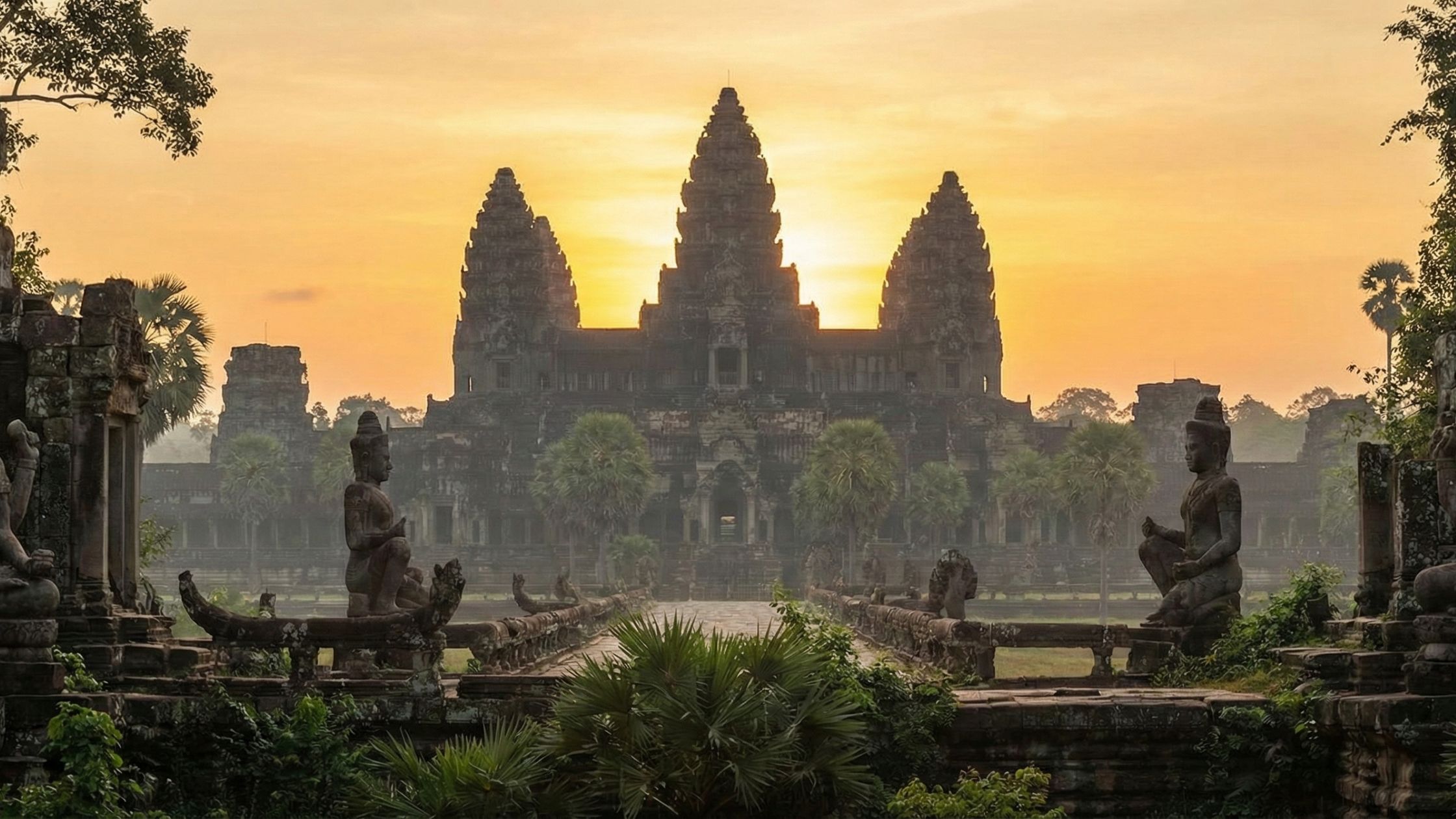
Why Southeast Asia Honors Our Gods While We Debate Them: The Forgotten Hindu Heritage Across Asia Watch the full video explanation Angkor Wat to Bali: Hindu Culture Thrives Outside India Stand in Cambodia’s Angkor Wat and you’ll find Ramayana carvings stretching across 400 acres of sacred stone—the world’s largest religious monument, dedicated to Lord Vishnu. Fly to Bali and watch Balinese Hindus chant Sanskrit mantras in daily prayers—in a country where 87% are Muslim. Visit Thailand and discover that their kings are ceremonially called “Rama”—Rama I through Rama X—honoring an Indian epic as the foundation of royal legitimacy. Board a flight in Indonesia and you’re traveling on Garuda Indonesia—named after Lord Vishnu’s divine eagle mount—in the world’s largest Muslim-majority nation. Yet back in India—the birthplace of these traditions—Ramayana is debated as mythology, Shiva dismissed as metaphor, Krishna questioned as unhistorical, and our temples controlled while other religions operate freely. How did this reversal happen? Why do nations thousands of kilometers away preserve our heritage with more pride than we do? Today, we’re uncovering the forgotten story of Sanatana Dharma’s organic spread across Asia—and the colonial project that made Indians ashamed of what the world still respects. Part I: The Evidence They Can’t Erase Angkor Wat: When Vishnu Became a World Wonder Location: Siem Reap, CambodiaBuilt: 1113-1150 CE (almost 900 years ago)Commissioned by: King Suryavarman II (whose name means “Protector of the Sun”)Dedicated to: Lord VishnuSize: 162.6 hectares (402 acres) – four times the size of Vatican City Angkor Wat isn’t just “a temple”—it’s the largest religious monument ever built by humanity. Its construction required: 50,000 workers laboring for 30 years 1.5 million cubic meters of sandstone A 190-meter-wide moat with 5.5 km perimeter symbolizing the cosmic ocean Five central towers representing the peaks of Mount Meru (the abode of gods in Hindu cosmology) What’s carved on its walls? Every square meter tells our stories: Samudra Manthan (Churning of the Cosmic Ocean) – the most famous bas-relief Scenes from the Ramayana – Rama’s journey, Hanuman’s heroism Episodes from the Mahabharata – the great war, Krishna’s teachings Depictions of Vishnu and his avatars The Original Name: According to scholars, Angkor Wat’s original name was likely “Vrah Viṣhṇuloka” (वृह विष्णुलोक) – “The Sacred Dwelling of Vishnu.” The Irony: Today, Angkor Wat appears on the Cambodian national flag. An entire nation—Buddhist-majority Cambodia—proudly displays a Hindu temple as their supreme national symbol. Meanwhile in India, textbooks teach children that Ramayana and Mahabharata are “mythology,” and archaeological evidence for Dwaraka, Ram Setu, and Kurukshetra is marginalized or debated endlessly. Indonesia: Where 87% Muslims Honor Hindu Symbols Indonesia is the world’s largest Muslim-majority country (87.2% Muslim population, ~240 million Muslims). Yet: 1. National Emblem: Garuda Pancasila The Indonesian coat of arms features Garuda—the divine eagle mount (vahana) of Lord Vishnu. Key Facts: Garuda (गरुड) is a Sanskrit word meaning the mythical king of birds Designed in 1950 by Sultan Hamid II (a descendant of Prophet Muhammad!) The Garuda holds in its talons the national motto: “Bhinneka Tunggal Ika” (Unity in Diversity) – a phrase from the Old Javanese poem Kakawin Sutasoma (14th century), based on Hindu-Buddhist philosophy On the Garuda’s chest is a shield with five symbols representing Pancasila (Indonesia’s state philosophy): Star – Belief in One God Chain – Just and civilized humanity Banyan tree – Unity of Indonesia Bull’s head – Democracy Rice and cotton – Social justice 2. Garuda Indonesia: The National Airline Founded January 26, 1949, Indonesia’s flag carrier was named Garuda on the suggestion of President Sukarno. From the airline’s founding documents: “The name Garuda is taken from the Hindu tradition: it is the name of Lord Vishnu’s mount (vahana).” Modern fleet: 140+ aircraft serving 96 destinations 5-star Skytrax rating Named “World’s Best Cabin Crew” multiple times Every plane bears the Garuda logo—Hindu mythology displayed proudly worldwide Think about this: When was the last time you saw an Indian airline or institution prominently featuring Vedic symbols with such pride? 3. Indonesian Currency Features Ganesha Various Indonesian banknotes and coins have featured Lord Ganesha, Hanuman, and scenes from the Ramayana and Mahabharata—despite being a Muslim-majority nation. 4. Bali: The Last Hindu Kingdom Bali (83% Hindu) preserves Sanatan Dharma more authentically than many parts of India: Daily Rituals: Sanskrit mantras chanted in homes and temples Nyepi (Day of Silence) – Hindu New Year based on the Saka calendar Galungan festival celebrating dharma’s victory over adharma Daily offerings (canang sari) at home shrines Major Monuments: Garuda Wisnu Kencana statue – 75-meter (246-foot) statue of Lord Vishnu riding Garuda Tanah Lot Temple – sea temple to Lord Baruna Besakih Temple – the “Mother Temple,” dedicated to Trimurti Shadow Puppetry (Wayang Kulit): Indonesia’s UNESCO-recognized traditional art form tells stories exclusively from the Ramayana and Mahabharata. Performances in Java and Bali feature: Rama and Sita’s story Krishna’s life and teachings Bhima’s adventures Arjuna’s dilemmas Muslim-majority Java watches these Hindu epics performed regularly—no one questions whether Rama existed or Krishna was real. They simply honor the wisdom. Thailand: Where Kings Are Called Rama Thailand (93% Theravada Buddhist) has preserved Hindu culture with extraordinary devotion: 1. Royal Names Based on Ramayana Since the founding of the Chakri Dynasty in 1782, every Thai king has taken the title “Rama”: Rama I (1782-1809) – Founded Bangkok, commissioned Thai Ramakien Rama II (1809-1824) – Poet-king, refined Ramakien literature Rama III through Rama IX (King Bhumibol – the beloved modern king) Rama X (Current king – Maha Vajiralongkorn) This isn’t symbolic—it’s constitutional. Thai kings are considered manifestations of Vishnu, upholding dharma in the modern world. 2. The Ramakien: Thailand’s National Epic The Ramakien (รามเกียรติ์) is Thailand’s version of Valmiki’s Ramayana. Commissioned by: Rama I in 1797-1798Verses: Approximately 60,000 (longer than the original Valmiki Ramayana!)Status: Thailand’s national epic, taught in schools, performed in dance Key Adaptations: Setting moved to Thailand Characters given Thai names (Rama = Phra Ram, Sita = Nang Sida, Hanuman = Hanuman) Local cultural elements integrated But the core story and dharmic values remain identical 3. Bangkok’s Grand Palace: A Temple

Why Are Indian Epics Called “Mythology”? Reclaiming Itihasa from Colonial Frameworks
Why Are Indian Epics Called “Mythology”? Reclaiming Itihasa from Colonial Frameworks Watch the full video explanation Ramayana Not Myth: Archaeology Proves Itihasa Real “Greek mythology.” “Roman mythology.” “Norse mythology.” Now try: “Hindu mythology.” Notice anything? The first three refer to dead civilizations whose gods no one worships anymore. But Hinduism has over 1.2 billion living practitioners. Yet their epics, traditions, and sacred histories are routinely classified alongside Zeus and Thor—as “mythology.” Mythology: Stories that are fictional, legendary, or unproven.History: Events that actually happened, backed by evidence. When we accept the label “Hindu mythology,” we unconsciously accept that our civilizational memory is fictional—that Rama, Krishna, Hanuman, and the events of the Ramayana and Mahabharata never existed. This wasn’t accidental. It was intellectual colonization—a systematic project to delegitimize Indian civilization by reframing its foundational texts as “myths” while European and Abrahamic traditions were upheld as “history.” Today, we’re deconstructing this framework, examining its origins, presenting archaeological evidence, and reclaiming the Sanskrit concept of Itihasa (इतिहास) – “thus it happened.” Part I: The Power of Words – Why “Mythology” Matters Etymology Reveals Intent The word “mythology” comes from Greek: Mythos (μῦθος) = “story, speech, plot” Logos (λόγος) = “word, study” Original meaning: “Study of stories.” Modern connotation: “Study of fictional stories, legends, and folklore.” When “mythology” is applied to Greco-Roman traditions, it’s understood that these were once religions but are now historical curiosities. No one worships Zeus or Jupiter anymore, so calling them “mythology” is factually accurate—these are stories about gods no longer believed in. But when the same term is applied to living Hindu traditions, it carries an implicit judgment: “These aren’t real either.” The Double Standard Consider how different civilizations’ foundational texts are treated academically and educationally: Civilization Term Used Implication Greek/Roman “Classical Mythology” Dead religion, studied for literary/historical value Norse/Celtic “Norse/Celtic Mythology” Dead religion, pagan folklore Judeo-Christian “The Bible,” “Sacred Scripture,” “Biblical History” Living tradition, treated seriously Islamic “Quranic History,” “Islamic Tradition” Living tradition, respected as historical/theological Hindu “Hindu Mythology,” “Indian Myths” Living tradition treated as folklore The hypocrisy is stark: Abraham, Moses, Jesus = Historical figures (despite limited archaeological evidence for some) Muhammad = Historical figure (well-documented) Rama, Krishna, Hanuman = “Mythological characters” (despite archaeological, astronomical, and textual evidence) This isn’t mere academic categorization—it’s epistemic violence: the systematic devaluation of a civilization’s knowledge systems. Part II: The Colonial Project – Manufacturing “Hindu Mythology” Max Mueller and the East India Company To understand how this framework was established, we must examine the 19th-century Orientalist project, particularly the work of Friedrich Max Müller (1823-1900). Who Was Max Mueller? German-born philologist and Sanskrit scholar Hired by the British East India Company in 1847 to translate the Vedas First systematic translator of Rig Veda into English Hugely influential in shaping Western (and eventually Indian elite) understanding of Hinduism His Stated Agenda Max Mueller’s private correspondences reveal troubling motivations. In letters to his wife and colleagues, he expressed explicitly colonial and missionary intentions: Letter to his wife (December 9, 1867): “I feel convinced, though I shall not live to see it, that this edition of mine and the translation of the Veda will hereafter tell to a great extent on the fate of India, and on the growth of millions of souls in that country. It is the root of their religion, and to show them what the root is, I feel sure, is the only way of uprooting all that has sprung from it during the last 3,000 years.” Letter to Baron Christian von Bunsen (1856): “India is much riper for Christianity than Rome or Greece were at the time of St. Paul… The ancient religion of India is doomed, and if Christianity does not step in, whose fault will it be?” These weren’t casual observations—they were statements of strategic intent. Max Mueller saw his translation work as part of a larger colonial project: Undermine confidence in Vedic texts by presenting them as primitive, confusing, or barbaric Create an inferiority complex among Indian intellectual elites Prepare ground for Christian conversion The Translation Problem Sanskrit is not a dead language—it’s a sacred language with living interpretive traditions. For over 3,000 years, the Vedas were transmitted through oral tradition with extraordinary precision. Scholars like Sayanacharya (14th century) had written extensive Sanskrit commentaries explaining context, philosophy, and proper interpretation. Max Mueller’s approach: Never learned Sanskrit in India from traditional scholars Never studied under a guru in the traditional parampara (lineage) Relied on limited European academic understanding Translated texts out of context, often word-for-word without philosophical depth Admitted he viewed Vedic religion as “primitive sun and nature worship” German scholar Prof. Prodosh Aich (in his book Fundamentals of Indology) argues that Mueller and other early Indologists: Lacked command of Sanskrit sufficient for nuanced translation Worked from European manuscripts, not original Indian sources Projected European and Christian frameworks onto Hindu texts Created distorted interpretations that became “authoritative” The Aryan Invasion Theory Mueller also promoted the Aryan Invasion/Migration Theory: “Aryans” were a light-skinned race from Central Asia They invaded India around 1500 BCE Conquered darker-skinned “Dravidians” Imposed Sanskrit, Vedic culture, and caste system The political utility of this theory: Divided Indians by race (Aryan North vs. Dravidian South) Justified colonial rule: “India has always been conquered by outsiders; British rule is just the latest” Delegitimized indigenous culture: “Even your ‘indigenous’ culture is foreign” Modern scholarship has largely debunked this theory: Genetic studies show no evidence of a mass Aryan invasion Continuity between Indus Valley Civilization and Vedic culture Saraswati River (mentioned 72 times in Rig Veda) existed before 1900 BCE, suggesting Vedic composition predates proposed “invasion” Yet this theory continues to shape Indian textbooks and popular understanding even today. Macaulay’s Educational Agenda Max Mueller’s work was part of a larger colonial education project initiated by Thomas Babington Macaulay. Macaulay’s infamous Minute on Education (1835): “I have no knowledge of either Sanskrit or Arabic… But I have done what I could to form a correct estimate of their value… A single shelf of a good European library was worth

Why We Don’t Eat Grains on Ekadashi: The Authentic Puranic Explanation
Why We Don’t Eat Grains on Ekadashi: The Authentic Puranic Explanation Watch the full video explanation https://youtube.com/shorts/QZb1IbnigIY Ekadashi Fasting Rules: Why Grains Are Forbidden (Purana Story) Ask anyone observing Ekadashi why they avoid grains, and you’ll likely get vague answers: “It’s tradition,” “My grandmother did it,” “Everyone does it.” But few know the actual scriptural reasoning behind this ancient practice. Today, we’re diving deep into the Padma Purana, Skanda Purana, and other authoritative texts to uncover the fascinating story of how sin personified came to reside in grains on Ekadashi—and why this makes the 11th lunar day the most powerful fasting day in the Vedic calendar. What IS Ekadashi? Ekadashi (एकादशी) literally means “the eleventh” in Sanskrit. It refers to the 11th tithi (lunar day) in both the waxing (Shukla Paksha) and waning (Krishna Paksha) phases of the moon. Frequency: Occurs twice per month 24 Ekadashis per year (26 in leap years) Each Ekadashi has a specific name and significance Why the 11th day? The number 11 is significant in Vedic cosmology: Humans have 11 indriyas (sense organs): 5 organs of perception + 5 organs of action + 1 mind The 11th represents transcendence beyond the 10 material senses Ekadashi Devi is said to have emerged from Vishnu’s 11 senses The Origin Story: When Vishnu Fought the Demon Mura To understand why grains are forbidden on Ekadashi, we must journey to Satya Yuga (the first cosmic age) and witness an epic battle described in Padma Purana, Uttara Khanda, Chapter 38. The Demon Who Terrorized the Universe During Satya Yuga, a powerful demon named Mura (मुर) arose. He was the son of Taaljangh and surpassed even his father in strength and cruelty. Mura’s Reign of Terror: Defeated Indra (king of gods) and conquered Swargaloka (heaven) Drove all the Devas (celestial beings) into exile Terrorized the three worlds with his demonic army None could stand against his might The dispossessed Devas wandered in despair until they finally approached Lord Vishnu for help. The Thousand-Year Battle Lord Vishnu, moved by the Devas’ plight, agreed to confront Mura. Padma Purana describes: सहस्रं दिव्यं वर्षाणां युद्धं तेन कृतं प्रभो। “For one thousand divine years, the Lord battled with him.” The battle was ferocious. Vishnu’s divine weapons destroyed Mura’s vast army, but the demon himself proved extraordinarily resilient. After a thousand celestial years of continuous combat (equivalent to 360,000 human years), Lord Vishnu grew fatigued. Vishnu’s Strategic Rest Exhausted from the prolonged battle, Vishnu traveled to Badarikashrama (modern-day Badrinath in the Himalayas) and entered a beautiful cave called Himavati to rest in Yoga Nidra (divine yogic sleep). Mura, seething with rage, tracked Vishnu to the cave. Seeing his enemy sleeping, the demon thought: “Today I will kill this slayer of demons! He is vulnerable!” The Birth of Ekadashi Devi As Mura prepared to strike the sleeping Vishnu, something extraordinary happened. From Lord Vishnu’s transcendental body—specifically from his 11 senses—emerged a radiant divine feminine energy. Padma Purana describes her: तस्याः शरीरात् उद्भूता देवी दिव्यास्त्रधारिणी। तेजसा दिव्यरूपेण शोभमाना महाबला॥ “From His body emerged a goddess bearing divine weapons,Resplendent with divine radiance, possessing great power.” This magnificent goddess, armed with celestial weapons, stood between Mura and the sleeping Vishnu. The Battle: Ekadashi vs. Mura Mura, arrogant and lustful, saw the beautiful maiden and proposed marriage. She responded: “If you can defeat me in battle, I shall marry you. But if you lose, you forfeit your life.” The ensuing battle was swift and decisive. The goddess shattered all of Mura’s weapons with her divine power. She destroyed his chariot, killed his army, and finally—with one devastating blow—beheaded the demon Mura. Vishnu’s Blessing: The Creation of Ekadashi Vrata When Lord Vishnu awakened, He saw the slain demon and the victorious maiden standing before Him. Their conversation (Padma Purana): Vishnu: “Who are you, and how did you slay this terrible demon?” Goddess: “O Lord, I am Maha Shakti (Great Power), your internal potency, manifested from your eleven senses (ekadasha indriyas). I am your eternal servitor, and I have slain Mura to protect you.” Pleased beyond measure, Vishnu asked her to choose any boon. Her request: यदि तुष्टोऽसि मे स्वामिन् वरं देहि महाप्रभो। यो जनः मम वासरे उपवासं करिष्यति॥ स पापेभ्यो विमुच्येत मोक्षं च लभते परम्। “O Lord, if you are pleased with me, grant me this boon:Whoever fasts on my day (Ekadashi)Shall be freed from all sinsAnd attain supreme liberation (moksha).” Vishnu joyfully granted her wish and proclaimed: त्वां नामतः एकादशी इति ख्याता भविष्यति। एकादश्यां उपवासेन मम लोकं गमिष्यति॥ “You shall be known by the name Ekadashi (born from the eleventh).By fasting on Ekadashi, one shall attain My supreme abode.” From that day forward, Ekadashi became the most sacred fasting day, blessed by Vishnu Himself. Papa Purusha: Why Grains Are Forbidden The story doesn’t end with Mura’s death. There’s a crucial second chapter that explains why grains specifically are avoided on Ekadashi. The Personification of Sin According to Padma Purana (as narrated by Sage Vyasa to Jaimini Rishi), at the time of creation, Lord Brahma created Papa Purusha—the personification of all sins. Papa Purusha’s purpose: To punish sinful humans To create consequences for unrighteous actions To maintain karmic balance To control Papa Purusha and administer karmic justice, Yamaraja (god of death) and various hellish planetary systems were also created where sinful souls suffer. Papa Purusha’s Fear When Ekadashi Devi was created and blessed with the power to absolve all sins of those who fast on her day, Papa Purusha became terrified. His reasoning: “If people observe Ekadashi fasting, all their sins will be destroyed! My very existence will become meaningless! Where can I hide?” In desperation, Papa Purusha approached Lord Vishnu, fell at His feet, and pleaded: त्वत्कृतोऽहं महाभाग निवासं न लभे क्वचित्। एकादश्याः प्रभावेन जीवाः मुच्यन्ते सर्वतः॥ कुत्रापि तिष्ठामि तत्र न स्थातुं शक्नुवे प्रभो। “O Lord, I am Your creation, yet I find no place to reside.By the power of Ekadashi, souls are being liberated everywhere.Wherever I try to stay, I cannot remain there.Ekadashi’s power drives me away!” Vishnu’s Solution:
The Forgotten Poet-Saints: India’s Hidden Bhakti Masters
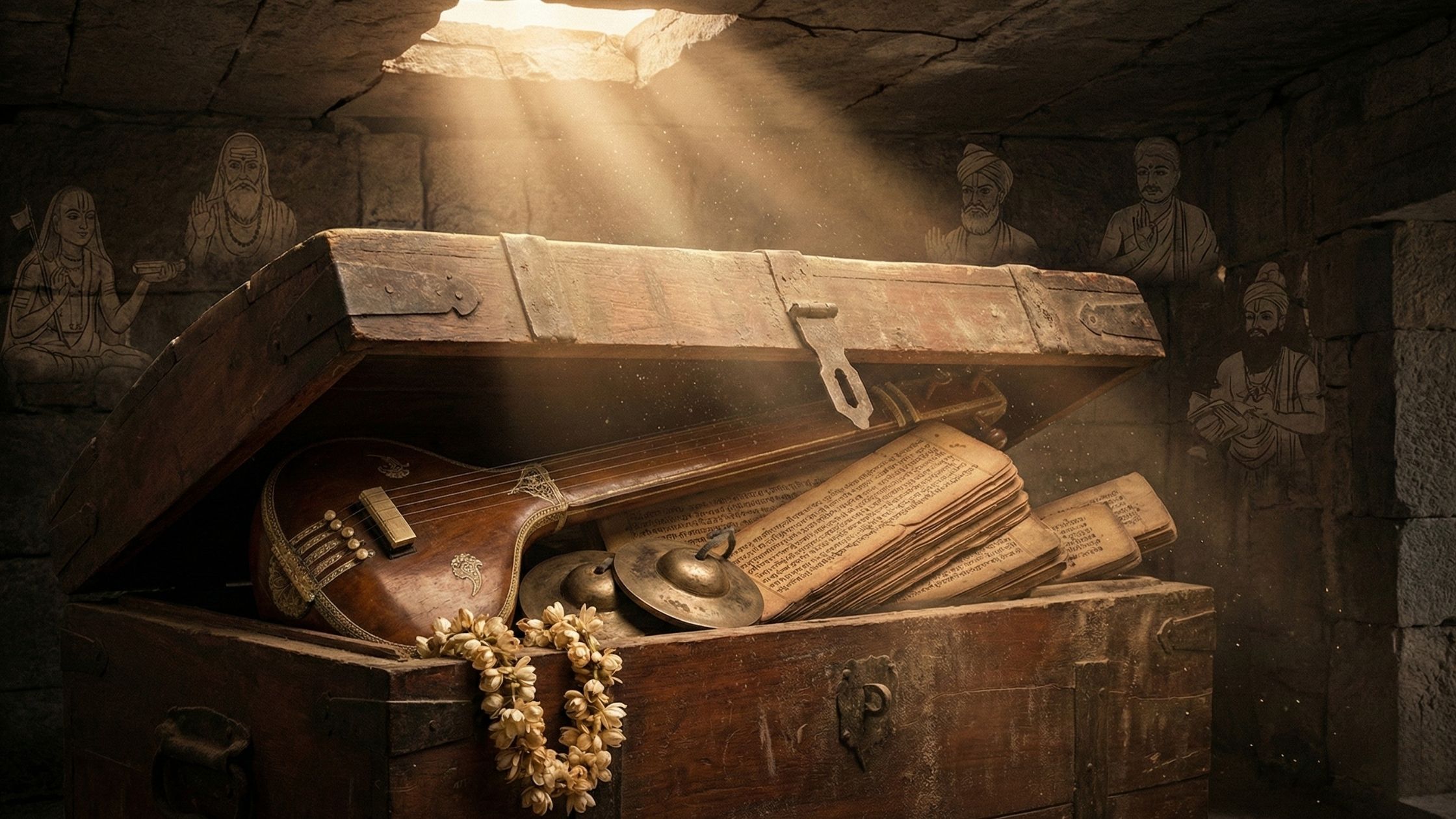
Forgotten Poet-Saints: India’s Hidden Bhakti Masters Revealed Watch the full video explanation Beyond Kabir: 4 Forgotten Indian Poet-Saints You Must Know Walk into any Indian school, and ask students to name a poet-saint. Most will instantly recall Tulsidas, Kabir, or Mirabai—names enshrined in textbooks, celebrated in curriculum, immortalized in collective memory. But here’s the uncomfortable truth: India’s Bhakti tradition produced hundreds of extraordinary poet-saints whose contributions rival or even surpass these familiar names—yet they remain virtually unknown outside their regional communities. Why? Because our education system, shaped by colonial-era standardization and post-independence centralization, created a narrow canon that privileged certain languages, regions, and traditions while systematically marginalizing others. Today, we’re recovering four such forgotten masters—saints whose devotional poetry transformed millions of lives, challenged oppressive social structures, and created musical and literary legacies that continue to resonate centuries later. The Problem: A Truncated Bhakti Canon The Bhakti movement (approximately 6th-17th centuries CE) was one of India’s most profound spiritual and social revolutions. It: Democratized worship by rejecting Brahminical monopoly over religious practice Elevated vernacular languages by composing in Tamil, Telugu, Kannada, Bengali, Hindi, Marathi (not just Sanskrit) Challenged caste hierarchy by proclaiming that devotion, not birth, determined spiritual worthiness Included women and marginalized castes as fully authorized spiritual authorities Yet when this vast, decentralized, multi-lingual movement was condensed into school textbooks, only a handful of saints survived the editorial process. The result? North Indian bias: Kabir, Tulsidas, Surdas, Mirabai dominate (all Hindi belt) South Indian erasure: Alwars, Nayanars, Kannada and Telugu saints largely absent Regional marginalization: Bengali, Assamese, Odia Bhakti traditions ignored Time period compression: Medieval saints favored over earlier or later figures This isn’t just historical amnesia—it’s cultural impoverishment. Let’s recover what was lost. 1. Kanakadasa (1509-1606): The Saint Who Made Krishna Turn Around The Warrior Who Became a Poet Born Veera Nayaka in the Kuruba community (traditionally shepherds and warriors) in Karnataka’s Baada village, Kanakadasa began life as a chieftain in the Vijayanagara Empire. After suffering defeat in battle and experiencing profound disillusionment with worldly glory, he underwent a spiritual transformation—abandoning military life to become a wandering devotee (dasa) singing songs of Krishna. His original name “Veera Nayaka” (Heroic Leader) was later changed to “Kanakadasa” (Servant of Gold) either because he discovered hidden treasure while digging and used it to build a temple, or because his compositions were considered golden in their devotional purity. The Udupi Incident: When Caste Met Divine Love The most famous episode in Kanakadasa’s life occurred when he visited the Udupi Krishna Temple, founded by the great Dvaita philosopher Madhvacharya in the 13th century. Despite being a renowned composer and devotee, Kanakadasa was denied entry to the temple due to his “lower” caste status. The Brahmin priests, clinging to notions of ritual purity, refused him darshan (visual communion) of the deity. Rather than protest or depart in anger, Kanakadasa stood outside the western wall of the temple and sang: “Bāgilanu teredu seveyanu kodu hariye”(“Open the door and please let me serve you, O Hari”) His composition continued, praising Krishna’s compassion toward devotees regardless of their social status, emphasizing that true purity lies in the heart, not in birth. The Miracle: Krishna Turns Westward According to tradition (documented by German scholar Hermann Friedrich Mogling in the 1860s, roughly 200 years after the events), the deity of Krishna—which had been facing east—miraculously turned to face west, toward Kanakadasa. The wall developed a crack (Kanakana Kindi – “Kanaka’s Window”), through which Kanakadasa received direct darshan of the Lord. To this day: The Krishna deity in Udupi faces west (unlike virtually all other Hindu temples where deities face east) Devotees receive darshan through the Kanakana Kindi before entering the temple proper The window stands as a testament to divine love transcending human prejudice His Literary Legacy Kanakadasa composed approximately 240 devotional songs (kirtanas) in Kannada, including: Ugabhogas (philosophical songs) Padas (devotional lyrics) Kirtanas (musical compositions) Major works: Narasimha Stotra – Hymns to Lord Narasimha Ramadhyana Mantra – Meditative verses on Rama Mohanatarangini – “Waves of Enchantment” Social Revolutionary in Verse Kanakadasa’s compositions contain powerful critiques of the caste system: “ಜಾತಿ! ಜಾತಿ! ಎಂದು ಕೂಗುತ್ತಾರೆ, ಭಕ್ತರಿಗೆ ಯಾವ ಜಾತಿ?”“They shout ‘caste! caste!’ but what caste is there for those who are pious?” In another composition, he writes: “ನಾವು ಕುರುಬರು ಮತ್ತು ನಮ್ಮ ದೇವರು ಬೀರಯ್ಯ”“We are Kurubas, and our God is Beerayya” This isn’t apologetic or supplicatory—it’s assertive pride in his community identity combined with confident devotion. Modern Recognition 1990: Government of India issued a postal stamp honoring Kanakadasa Kanakadasa Jayanti (his birthday) is celebrated annually in Karnataka Kaginele Kanaka Guru Peetha, a spiritual institution, perpetuates his teachings Bhakta Kanakadasa (1960 film) starring Dr. Rajkumar brought his story to millions 2. Annamacharya (1408-1503): The Grandfather of Telugu Song-Writing The Prodigious Composer Tallapaka Annamacharya (also known as Annamayya) was born in Tallapaka village, Kadapa district of present-day Andhra Pradesh. He lived an extraordinary 95 years, during which he accomplished something unprecedented in the history of devotional music: He composed approximately 32,000 devotional songs (sankirtanas) in praise of Lord Venkateswara (a form of Vishnu) at Tirumala-Tirupati. To put this in perspective: If you sang one Annamacharya composition every day, it would take 87 years to complete the entire collection He’s recorded in the Guinness Book as composing the most devotional songs to a single deity in history His output rivals the collected works of Shakespeare in volume The Vision That Changed Everything At age 16, Annamacharya had a profound spiritual vision of Lord Venkateswara that transformed his life. From that moment forward, he dedicated himself entirely to composing songs for the deity. His compositions weren’t mere literary exercises—they were offerings, considered “floral garlands” (pushpanjali) presented to the Lord with each verse. The Lost and Found Manuscripts Here’s the heartbreaking part: Of the original 32,000 compositions, only about 12,000-14,904 survive today. The rest were lost for over 300 years until a dramatic rediscovery in 1922. The Discovery: In a secret chamber (Sankirtana Bhandagaram) beside the hundi (donation box) in the main Tirupati temple, copper plates inscribed
Why Rama Chanted Aditya Hridaya Stotra? Ancient Neuroscience Explained
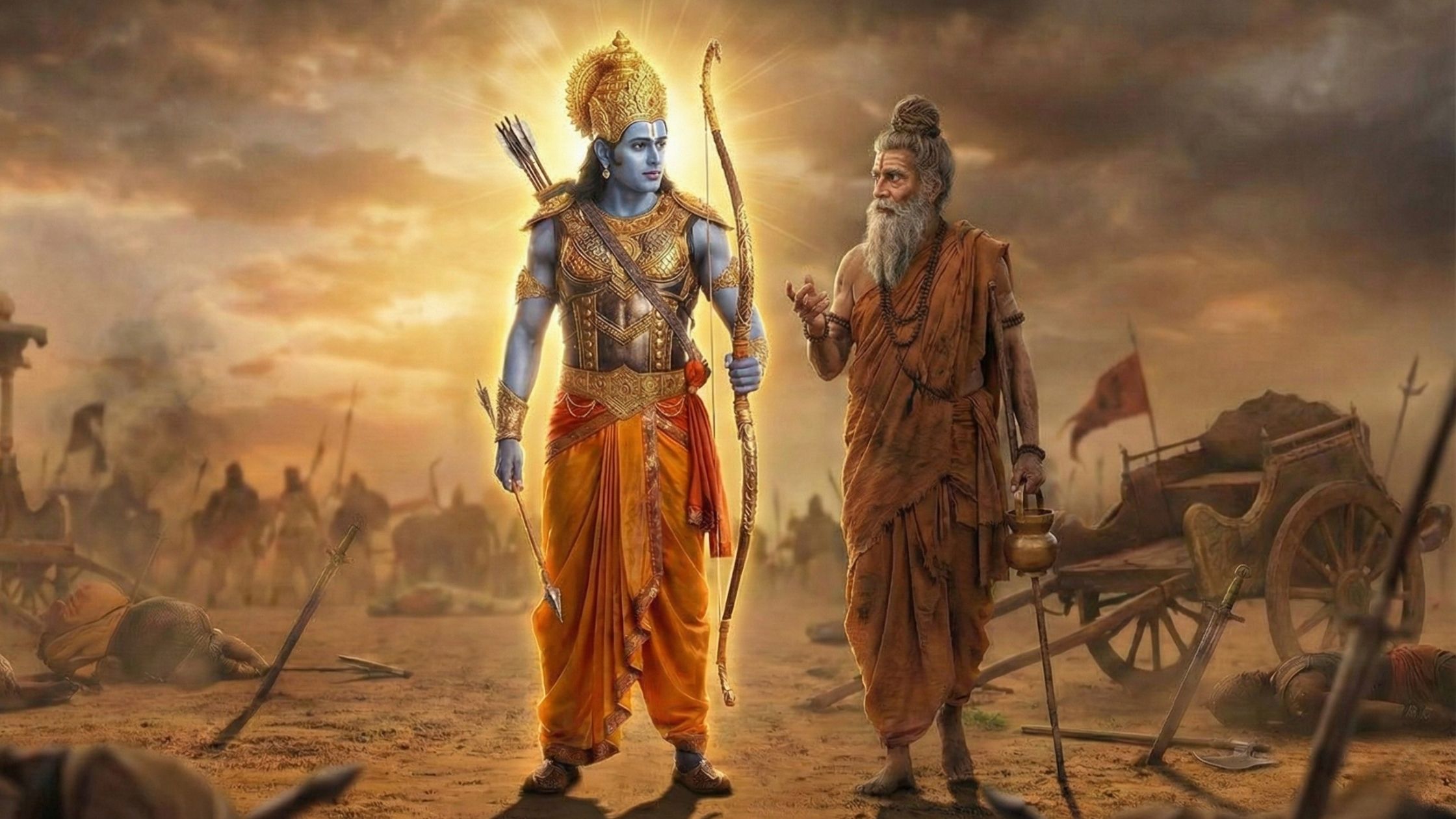
Why Rama Chanted Aditya Hridaya? The Biology of Solar Mantra Watch the full video explanation Aditya Hridaya Stotra: The Ancient Neuroscience of Solar Invocation On the blood-soaked battlefield of Lanka, surrounded by fallen warriors and the stench of death, Lord Rama stood frozen—not from fear, but from exhaustion. His muscles ached from days of relentless combat. His mind, burdened by the weight of dharma and the sight of countless casualties, struggled to maintain clarity. Before him stood Ravana, the ten-headed demon king, fresh and ready for another round of combat. This was the darkest moment before dawn. And it was precisely at this moment of complete physical depletion and mental fatigue that Sage Agastya appeared with a solution that would not only restore Rama’s strength within minutes but would encode one of the most sophisticated psycho-physiological technologies in human spiritual history. The Context: A Prescription for Biological Stress The Aditya Hridaya Stotra appears in Valmiki Ramayana, Yuddha Kanda, Sarga 105 (Chapter 105). This placement is critical—it’s not a devotional hymn composed for philosophical meditation or religious ritual. It’s a battlefield intervention prescribed at the apex of physiological stress. The Opening Verses Set the Stage Valmiki Ramayana, Yuddha Kanda 6.105.1-2: sanskrit ततो युद्धपरिश्रान्तं समरे चिन्तया स्थितम्। रावणं चाग्रतो दृष्ट्वा युद्धाय समुपस्थितम्॥१॥ दैवतैश्च समागम्य द्रष्टुमभ्यागतो रणम्। उपागम्याब्रवीद्रामं अगस्त्यो भगवान् ऋषिः॥२॥ Transliteration: Tato yuddha-pariśrāntaṁ samare cintayā sthitamRāvaṇaṁ cāgrato dṛṣṭvā yuddhāya samupasthitam Daivataiśca samāgamya draṣṭum abhyāgato raṇamUpāgamyābravīd rāmaṁ agastyo bhagavān ṛṣiḥ Translation: “Then, seeing Rama exhausted from battle (yuddha-pariśrāntam), standing absorbed in thought (cintayā sthitam) on the battlefield, and Ravana ready before him for combat— The blessed sage Agastya, who had come with the gods to witness the battle, approached Rama and spoke.” The Diagnosis: Multi-System Failure The Sanskrit terms are medically precise: युद्धपरिश्रान्तम् (yuddha-pariśrāntam) = “exhausted from battle” Not just tired, but experiencing complete fatigue collapse चिन्तया स्थितम् (cintayā sthitam) = “standing absorbed in anxious thought” Mental overwhelm, decision-making paralysis समरे (samare) = “in the midst of combat” Acute stress environment, no time for extended rest This is a crisis of: Physical stamina (muscular exhaustion) Mental clarity (cognitive overload) Emotional stability (facing overwhelming odds) Energetic depletion (prāṇa exhaustion) And Agastya’s response? Not a weapon. Not a military strategy. A hymn. The Prescription: Agastya’s Teaching Valmiki Ramayana, Yuddha Kanda 6.105.3-4: sanskrit राम राम महाबाहो शृणु गुह्यं सनातनम्। येन सर्वानरीन् वत्स समरे विजयिष्यसि॥३॥ आदित्यहृदयं पुण्यं सर्वशत्रुविनाशनम्। जयावहं जपेन्नित्यं अक्षय्यं परमं शिवम्॥४॥ Transliteration: Rāma rāma mahābāho śṛṇu guhyaṁ sanātanamYena sarvān arīn vatsa samare vijayiṣyasi Āditya-hṛdayaṁ puṇyaṁ sarva-śatru-vināśanamJayāvahaṁ japen nityaṁ akṣayyaṁ paramaṁ śivam Translation: “O Rama, O mighty-armed one, listen to this eternal secret (guhyaṁ sanātanam) by which, O dear one, you shall conquer all enemies in battle. The Aditya Hridayam is sacred (puṇyam), destroys all obstacles (sarva-śatru-vināśanam), brings victory when chanted (jayāvaham). It is inexhaustible (akṣayyam), supremely auspicious (paramaṁ śivam).” Key Terms Decoded गुह्यं सनातनम् (guhyaṁ sanātanam) = “eternal secret” Not publicly taught knowledge, requires transmission Sanātana = beyond time, always effective सर्वशत्रुविनाशनम् (sarva-śatru-vināśanam) = “destroyer of all enemies” Śatru = enemies (external and internal) Internal enemies: fatigue, fear, doubt, mental fog अक्षय्यम् (akṣayyam) = “inexhaustible” Unlike physical resources, this doesn’t deplete with use Can be accessed repeatedly without diminishment What IS the Aditya Hridaya? Decoding the Title आदित्यहृदयम् (Āditya-hṛdayam) breaks down as: आदित्य (Āditya) = Literally: “Son of Aditi” (the primordial mother) Commonly: The Sun, Surya Philosophically: The source of all energy and life हृदयम् (Hṛdayam) = Literally: “Heart” Root: hṛd (heart) + ayam (this) Meaning: “The essence,” “the core,” “that which goes to the heart” Complete Translation: “The Heart-Essence of the Sun” or “That which brings the Sun’s power to the heart“ This isn’t merely “a hymn to the sun.” It’s a technology for internalizing solar power—bringing the sun’s vitality, clarity, and life-giving energy directly into the practitioner’s physiological and energetic system. The Stotra’s Structure: 31 Verses of Systematic Activation The Aditya Hridaya contains 31 ślokas divided into six functional sections: 1. Introduction (Verses 1-4): Context and Instruction Agastya’s arrival and diagnosis The prescription to chant 2. Names and Attributes (Verses 5-14): Identity Establishment 108 names of Surya Each name activates a specific quality 3. Cosmic Function (Verses 15-21): Understanding Surya’s Role Surya as time-keeper, rhythm-regulator, life-sustainer 4. Method of Worship (Verses 22-24): Practical Application How to invoke, when to chant, mental attitude 5. Benefits (Verses 25-28): Expected Outcomes Immediate effects (energy, clarity, courage) Long-term effects (health, prosperity, victory) 6. Conclusion (Verses 29-31): Rama’s Response Immediate physiological transformation Victory in battle The Science: Why This Works Now let’s examine the mechanisms through which the Aditya Hridaya operates—mechanisms that modern neuroscience is only beginning to understand. Mechanism 1: Rhythmic Breathing and Vagus Nerve Activation The Aditya Hridaya’s meter (chandas) is Anuṣṭubh (8 syllables per quarter, 32 syllables total per verse). This creates a specific breathing pattern. Scientific Finding: A 2011 fMRI study published in the International Journal of Yoga demonstrated that chanting “Om” activates the vagus nerve through vibrations in the larynx and auricular (ear) regions. The Vagus Nerve: The 10th cranial nerve Longest nerve of the autonomic nervous system Runs from brainstem through throat, heart, lungs, digestive system Primary controller of the parasympathetic (“rest and digest”) response When chanting activates the vagus nerve: Heart rate decreases (cardio-protective) Blood pressure normalizes (vasodilation) Breathing deepens and slows (respiratory efficiency) Digestion improves (gut motility) Inflammatory markers decrease (immune modulation) Study Reference: Kalyani et al. (2011). Neurohemodynamic correlates of ‘OM’ chanting: A pilot functional magnetic resonance imaging study. International Journal of Yoga, 4(1), 3-6. Key Finding: “The neurohemodynamic correlates of ‘OM’ chanting indicate limbic deactivation. As similar observations have been recorded with vagus nerve stimulation treatment used in depression and epilepsy, the study findings argue for a potential role of this ‘OM’ chanting in clinical practice.” Mechanism 2: Limbic System Deactivation (Stress Reduction) The same study found that chanting produced significant deactivation in: Amygdala (fear and anxiety center) Hippocampus (stress memory consolidation) Anterior cingulate cortex (emotional conflict processing) Orbitofrontal cortex (decision-making under uncertainty) Thalamus (sensory gating) What This Means in Battle: When Rama

Why Break Coconut at Temples? Hindu Spiritual Science Explained
Why We Break Coconuts at Temples? The Ancient Science of Ego Dissolution Watch the full video explanation https://youtube.com/shorts/l9afxAbC9ZQ Why is a coconut broken before temple worship, vows, or auspicious beginnings? Stand at the entrance of any Hindu temple in India, and you’ll witness a ritual performed thousands of times daily: devotees breaking coconuts before entering the sanctum. The sharp crack echoes, water spills, and the broken halves are offered with folded hands. But have you ever paused to ask: Why? Is this merely tradition? A superstitious habit passed down through generations? Or does this simple act encode profound spiritual, psychological, and symbolic wisdom? Today, we’re embarking on a deep exploration of one of Hinduism’s most ubiquitous yet least understood rituals—the breaking of the coconut. We’ll examine its scriptural foundations, symbolic layers, historical evolution, psychological impact, and even the neuroscience behind why this physical act creates measurable shifts in consciousness. Śrīphala: The Only Fruit Named After God Before we understand why we break coconuts, we must understand what the coconut represents in Hindu sacred literature. The Sacred Etymology In Sanskrit, the coconut is called by several names, each revealing a different dimension of its significance: नारिकेल (Nārikela) The common Sanskrit term Etymology: Nīra (water) + Kela (vessel) = “vessel of water” Emphasizes its liquid-bearing nature श्रीफल (Śrīphala) Śrī = Divine grace, prosperity, goddess Lakshmi Phala = Fruit Translation: “The God’s Fruit” or “The Auspicious Fruit” This is extraordinary. The coconut is the only fruit in Hindu tradition given the prefix “Śrī”—explicitly associating it with the divine. महाफल (Mahāphala) Mahā = Great, supreme Phala = Fruit Translation: “The Great Fruit” worthy of being offered to deities Historical Evidence: When Did Coconuts Enter Hindu Ritual? Interestingly, there is no reference to coconuts in the Vedas (composed c. 1500-500 BCE). This tells us that coconuts were not part of the earliest Vedic fire rituals (yajñas). First references appear in: Mahabharata (compiled c. 400 BCE – 400 CE) Ramayana (composed c. 500 BCE – 100 CE) Puranas (composed c. 300-1000 CE) Buddhist Jataka Stories (300 BCE – 400 CE) Mahawamsa (the historical chronicle of Sri Lanka, 2nd-1st century BCE) mentions coconuts, confirming their presence and significance by that period. The coconut palm (Cocos nucifera) likely originated in the Indo-Pacific region and became prevalent in South India and Sri Lanka before gradually spreading northward. As it became more available, it was incorporated into Hindu ritual practice—eventually becoming central to temple worship. The Scriptural Foundation: What Do The Texts Say? While specific verses about coconut breaking appear in later Puranic literature rather than the earliest Vedas, the philosophical framework for the practice is well-established. Shiva Purana Reference Shiva Purana 2.1.14 states: […] पूजायां रुद्रस्य प्रथमं कार्यं सुसुन्दर-वस्त्रं प्रसार्य लिंगे। तण्डुलं वस्त्रोपरि पूजाकाले स्थापयेत्। पूजायां समाप्तौ श्रीफलं गन्धपुष्पादिभिः सह स्थापयेत्॥ Translation: “[…] In the worship of Rudra, first a fine cloth should be spread over the linga. Rice grains shall be placed on the cloth during worship. At the end of worship, the Śrīphala (coconut) shall be placed along with fragrances and flowers, and fumigated with incense. The devotee shall attain the benefit of worship.” This establishes the coconut as a culminating offering in Shiva worship—the final gift that completes the ritual sequence. Puranic Principle of Offering Though the specific verse mentioned in your script may represent traditional oral teaching rather than a directly traceable Puranic line, the philosophical principle it expresses is well-documented across texts: Core Teaching: नारिकेलफलं दद्यात् देवाय विनिवेदयेत्। अहंकारस्य नाशार्थं पूर्णत्वप्रतिपत्तये॥ Transliteration: Nārikelaphalaṁ dadyāt devāya vinivedayetAhaṅkārasya nāśārthaṁ pūrṇatva-pratipattaye Translation: “The coconut fruit should be given and offered to the deityFor the destruction of ego (ahaṅkāra)And for the realization of inner completeness (pūrṇatva).“ Understanding Ahaṅkāra: What Is Ego in Hindu Philosophy? The concept of Ahaṅkāra (अहंकार) is central to understanding this ritual. Etymology: Aham (अहम्) = “I” Kāra (कार) = “making” or “doing” Ahaṅkāra = “I-making” or “the sense of I-ness” In Sāṅkhya Philosophy: Ahaṅkāra is one of the 25 tattvas (fundamental principles of reality). It emerges from Buddhi (intellect) and creates the sense of individual identity separate from universal consciousness. Three Modes of Ahaṅkāra: Sāttvika Ahaṅkāra (pure ego) Identification with higher consciousness “I am pure consciousness” Rājasika Ahaṅkāra (passionate ego) Identification with action and achievement “I am the doer” Tāmasika Ahaṅkāra (ignorant ego) Identification with the physical body and material possessions “I am this body,” “This is mine” Spiritual practice aims to transcend all three forms of ego-identification to realize one’s true nature as pure consciousness (Ātman). The Symbolic Architecture: Coconut as Human Microcosm The coconut’s structure provides a perfect symbolic representation of the human being: Layer-by-Layer Symbolism 1. The Outer Fibrous Husk (Coir) Represents: Accumulated impressions (saṃskāras), karmic residues, social conditioning Spiritual Meaning: The layers of identity we accumulate through experiences and societal programming Why It’s Removed: In most rituals, the coir is stripped before offering, symbolizing removal of surface-level conditioning 2. The Hard Shell Represents: The rigid ego structure (ahaṅkāra), the sense of separation Physical Quality: Hard, resistant, protective Spiritual Meaning: The defensive mechanism that creates the illusion of being separate from others and the divine The Breaking Point: This must be cracked open—not gently opened, but decisively shattered 3. The Inner Water Represents: Internal tendencies (vāsanās), emotional patterns, subconscious drives Why It’s Discarded: The water is typically poured out before offering the coconut, symbolizing the release of deep-seated desires and emotional attachments Purification: Just as the water drains away, we release our inner compulsions 4. The White Kernel (Flesh) Represents: Pure consciousness, the true self (Ātman), inner divinity Physical Quality: White, pure, nourishing Spiritual Meaning: The essence that remains after ego-structures are dissolved The Offering: This pure essence is what we present to the deity—our true self surrendered The Three Eyes of Shiva The coconut has three natural markings (germination pores) on its top, which tradition associates with Lord Shiva’s three eyes: Two physical eyes = Perception of duality (subject-object, me-you) Third eye = Transcendent perception beyond duality Breaking the coconut before Shiva is thus offering our limited dualistic perception