
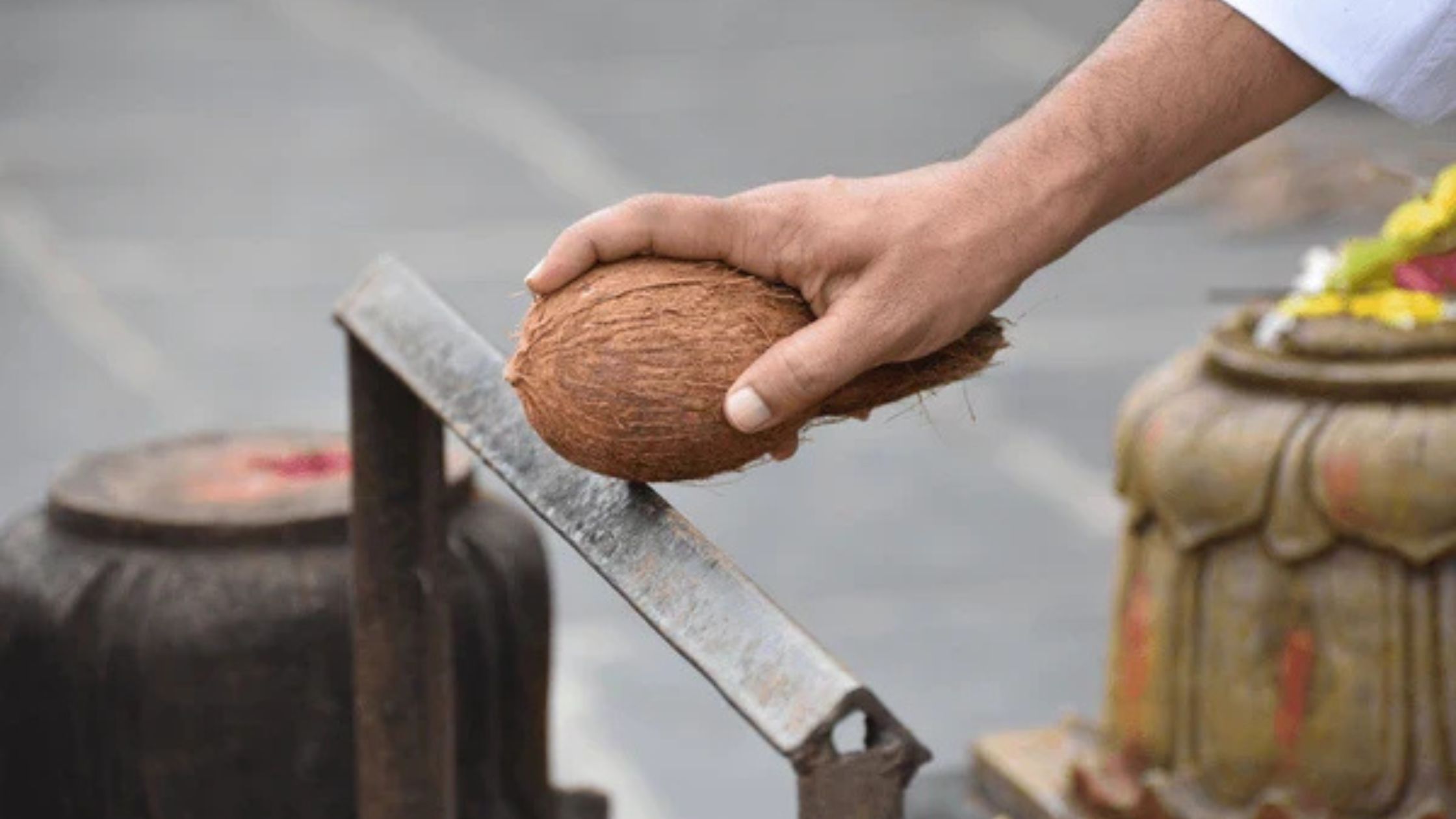
Why Do We Break a Coconut Before Pooja? Watch the full video explanation https://youtube.com/shorts/c-V7DCLVK9w The Hidden Science of Ego, Surrender, and Sacred Symbolism The Act Everyone Sees — And Almost Nobody Understands Walk into any Hindu ritual — a grihapravesham, a car puja, the beginning of a temple festival, the first day of a new business — and somewhere in the proceedings, a coconut will be raised and brought down hard against a stone floor or a sharp edge. It splits apart. Everyone moves on. The priest sprinkles the water. The flesh is distributed as prasad. The action is complete in seconds. But what has just happened? Most people, if you asked them, would say: it is an offering. Some might say it drives away negative energy. A few would recall hearing something about the three eyes resembling Shiva. These answers are not wrong. But they are surface readings of a text written in the language of symbol — and the actual meaning runs far deeper than any of these fragments. The breaking of the coconut, in classical Hindu understanding, is a reenactment of the single most important psychological event in spiritual life: the dissolution of ego. It is not something performed for the deity’s benefit. It is performed for yours. The Coconut in the Ancient World The Sanskrit name for the coconut is shrir-phala — the auspicious fruit, or the fruit of Shri (Lakshmi). It is also called narikela. Ayurvedic texts and Puranic literature consistently identify the coconut as the most complete offering available to a householder — because it contains everything. It has an outer shell, a layer of fibrous husk, cool water inside, and sweet flesh within. In botanical terms, the coconut is a three-layered drupe. In Vedic symbolic terms, this three-layered structure maps precisely onto the three-layered human being. The outer husk represents the gross physical body — the sthula sharira — the part of us most visible, most defended, and most easily mistaken for the self. The shell — the hard brown casing beneath — represents ahankara, the ego, the I-sense that insists on its own importance, its own separateness, its own centrality. The water within represents vasana — desire, the accumulated impressions and longings that flood the interior of the ego-self and make it feel alive. And the white flesh, hidden beneath all of this — that is the atman. The inner self. Pure, bright, nourishing, and completely invisible until everything else is removed. This is not a post-hoc interpretation. The Samkhya darshana — one of the six classical schools of Hindu philosophy — explicitly describes the human personality as layered in precisely this way, with the ego-self (ahankara) forming the protective but obstructive casing around the deeper self. The Three Eyes — And Why They Matter Look at a whole coconut before it is broken. At the top, you will always find three small markings — two dark spots and one slightly lighter depression. These are called the eyes of the coconut, and their theological resonance in the Hindu tradition is deliberate. The three eyes are consistently read as the three eyes of Shiva. The first two are ordinary sight — the eyes that see the world as it appears, filtered through desire and attachment. The third eye — placed at the center of Shiva’s forehead — is the eye of jnana, the eye of direct knowing. When Shiva opens his third eye, it burns not the world but the illusion overlaid on the world. The opening of the third eye represents the moment of transcendence from conditioned seeing to unconditioned awareness. When you hold the coconut before breaking it, you are holding a symbolic Shiva — an entity with the capacity for ordinary and transcendent perception simultaneously. The act of breaking it is, symbolically, the opening of the third eye. The explosion of the hard shell into pieces is the explosion of the conditioned ego-self into its component illusions, which then scatter and dissolve. This is extraordinary ritual theology, embedded inside an object small enough to hold in two hands. Ahankara: The Philosophical Precision of the Symbolism The word ahankara comes from two Sanskrit roots: aham — I — and kara — maker or doer. Ahankara literally means the maker of I. It is the part of the mind-apparatus that generates the sense of personal selfhood, the narrative of ‘me’ that runs continuously through every waking moment. In Vedantic philosophy, ahankara is not evil. It is necessary for embodied life. Without it, you cannot function — you cannot protect yourself, make decisions, or navigate relationships. But it becomes the primary obstacle to spiritual realization when it mistakes itself for the ultimate self. When the ego-self forgets it is a function and believes it is the source, it generates suffering — because everything built on mistaken identity must eventually collapse. The coconut ritual enacts the correct relationship between the ego and the self. The ego does not dissolve and cease to exist — the coconut, after all, does not vanish. Its components are received, distributed, consumed. But its hard, opaque enclosure — the thing that kept the light of the atman from shining through — is shattered deliberately, as an act of willingness. This is the genius of the gesture: it is not passive. The coconut does not crack by accident. Someone raises it and brings it down with force and intention. The ego does not surrender on its own. The aspirant must choose to break it — must raise their own constructed self and deliberately bring it into contact with something harder than pride. Water Within: The Vasana Teaching When the coconut breaks, the water inside — the coconut milk — spills out and is carefully collected. In ritual usage, this water is offered to the deity and sometimes sprinkled as purification. Its symbolic meaning is equally precise. Vasana in Sanskrit means ‘that which dwells within’ — specifically, the subtle impressions of desire, memory, and habit that accumulate through experience and
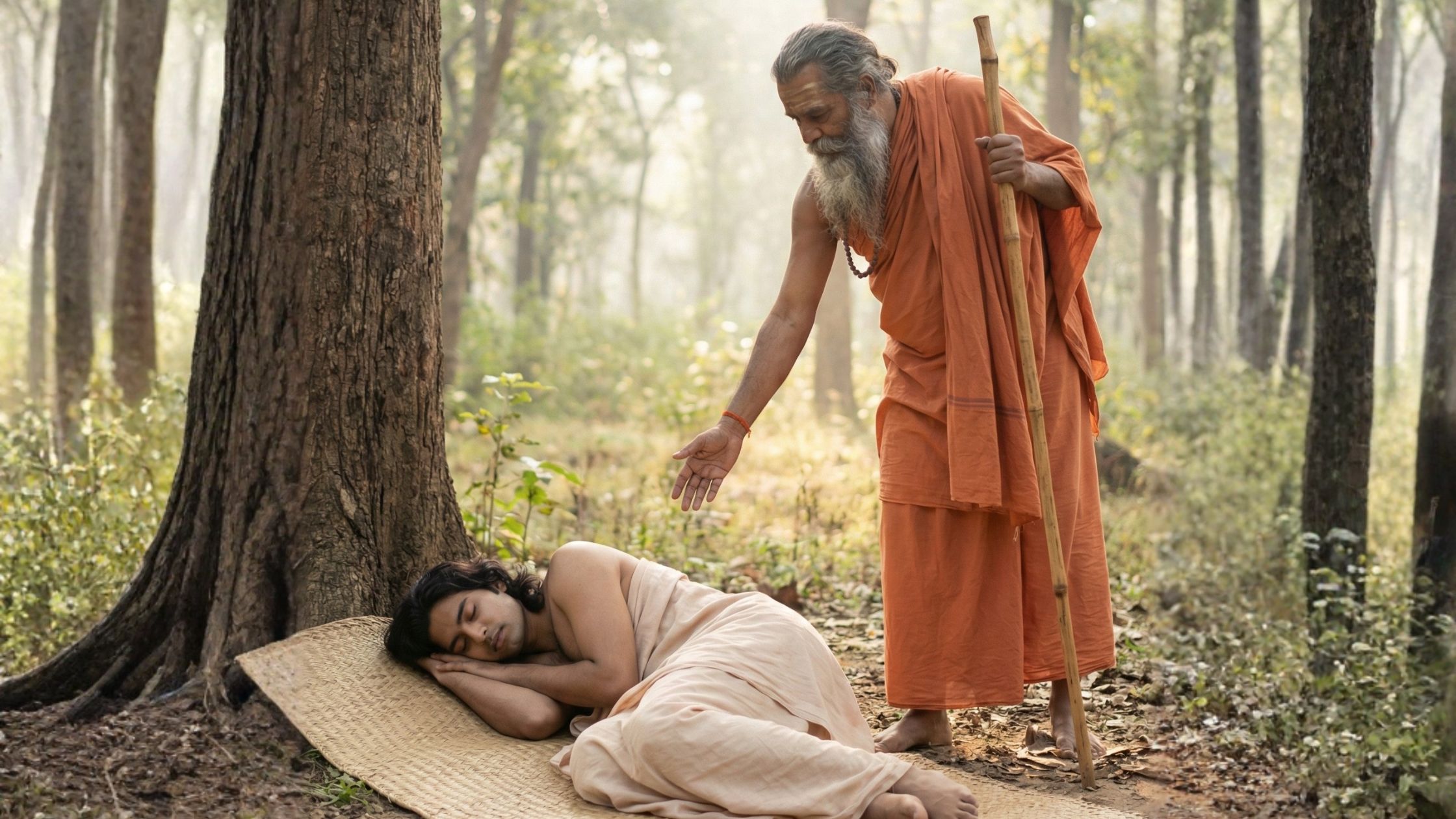
“Kausalyā Suprajā Rama” — This Śloka Isn’t Waking God. It’s Waking You.
“Kausalya Supraja Rama” — This Śloka Isn’t Waking God. It’s Waking You Vālmīki Rāmāyaṇa Origins Explained Watch the full video explanation https://www.youtube.com/shorts/QXh4gH7SCBk “Kausalyā Suprajā Rāma” — This Śloka Isn’t Waking God. It’s Waking You. Everyone thinks Kausalyā Suprajā Rāma is just the sweetest way to wake the god up. Every morning in Tirupati, in Śrī Raṅgam, in temples across India, this verse echoes through sanctums as devotees gather for Suprabhātam—the sacred morning wake-up service for the deity. The words sound devotional, almost like a lullaby in reverse—a gentle, reverential call to rouse the Divine from sacred sleep. But the truth is far deeper. This śloka is actually meant to wake YOU up. I am Jayanth Dev, author of Dhantasura. And today, we’re examining what most people don’t know about one of Hinduism’s most beloved verses. Part I: The Origin—Not Vaiṣṇava Poetry, But Rāmāyaṇa History The Misunderstanding Most people encounter this verse in the context of Śrī Veṅkaṭeśvara Suprabhātam—the famous dawn hymn sung at Tirupati to “wake” Lord Veṅkaṭeśvara (Viṣṇu). The complete Suprabhātam contains 29 verses composed by Prativādi Bhayaṅkaram Aṇṇan (also called Prativādi Bhayaṅkara Aṇṇāvarul), a 15th-century Śrī Vaiṣṇava scholar-saint, along with later additions. The opening verse: कौसल्या सुप्रजा राम पूर्वा सन्ध्या प्रवर्तते । उत्तिष्ठ नर शार्दूल कर्तव्यं दैवमाह्निकम् ॥ Because this appears at the start of the Suprabhātam, people assume: It’s Vaiṣṇava devotional poetry It was composed specifically for temple wake-up rituals It’s a sweet invocation to gently rouse sleeping Viṣṇu All of these assumptions are WRONG. The Actual Source: Vālmīki Rāmāyaṇa This verse doesn’t come from Veṅkaṭeśvara Suprabhātam’s author. It comes directly from the Vālmīki Rāmāyaṇa—the original epic. Bālakāṇḍa, Sarga (Chapter) 23, Śloka 2. Let’s examine the actual source text. Part II: The Original Context—Viśvāmitra’s Call The Scene in Vālmīki Rāmāyaṇa Time: Early in Rāma’s life, when he is still a young prince (approximately 16 years old) Location: The forest, during Rāma’s first journey away from Ayodhyā Context: Sage Viśvāmitra has come to King Daśaratha requesting that Rāma accompany him to protect a yajna (fire sacrifice) from rākṣasas (demons) who have been disrupting sacred rituals. Despite his father’s initial reluctance to send his beloved son into danger, Rāma is entrusted to Viśvāmitra. They travel through forests, and on the morning described in this verse, Viśvāmitra wakes the young Rāma to begin the day’s journey and duties. The Actual Verse: Vālmīki Rāmāyaṇa, Bālakāṇḍa 1.23.2 Sanskrit (Devanāgarī): कौसल्या सुप्रजा राम पूर्वा सन्ध्या प्रवर्तते । उत्तिष्ठ नर शार्दूल कर्तव्यं दैवमाह्निकम् ॥ Sanskrit (IAST Transliteration): kausalyā suprajā rāma pūrvā sandhyā pravartate uttiṣṭha nara śārdūla kartavyaṁ daivam āhnikam Word-by-Word Breakdown: Line 1: kausalyā (कौसल्या) = Kausalyā (Rāma’s mother) su-prajā (सुप्रजा) = su (good, fortunate) + prajā (offspring, progeny) → “fortunate is she who has you as progeny” or “blessed with a noble son” rāma (राम) = O Rāma (vocative case—direct address) pūrvā (पूर्वा) = eastern, prior, early sandhyā (सन्ध्या) = dawn, twilight, the junction between night and day pravartate (प्रवर्तते) = is beginning, is advancing, is emerging Line 2: uttiṣṭha (उत्तिष्ठ) = arise! get up! (imperative form of ut = up + sthā = stand) nara-śārdūla (नरशार्दूल) = nara (man) + śārdūla (tiger) → “tiger among men,” “best of men” kartavyam (कर्तव्यम्) = that which must be done, duty, obligation daivam (दैवम्) = divine, pertaining to the gods āhnikam (आह्निकम्) = daily, diurnal duties (from ahar = day) Translation: “O Rāma, fortunate is Kausalyā to have you as her son! The eastern dawn is breaking. Arise, O tiger among men! The daily duties toward the divine must be performed.” Who Is Speaking? This is NOT Kausalyā speaking to her son. This is NOT a temple priest speaking to a sleeping deity. This is Sage Viśvāmitra speaking to young Rāma. The context is a wake-up call for a young prince to: Rise at dawn (the auspicious brāhma-muhūrta) Perform morning ablutions (snāna) Conduct sandhyā-vandana (dawn worship) Meditate on Gāyatrī mantra Prepare for the day’s sacred duties This is a Guru calling his disciple. Part III: The Deeper Layers—What “Waking Up” Really Means Layer 1: The Literal Level—Physical Awakening At the most basic level, Viśvāmitra is literally waking Rāma from sleep. The verse establishes: ✓ Dawn has arrived (pūrvā sandhyā pravartate) ✓ It’s time to rise (uttiṣṭha) ✓ Daily spiritual duties must be performed (kartavyam daivam āhnikam) This follows ancient Vedic practice: The Dharma Śāstras (codes of dharmic conduct) prescribe that brāhmaṇas, kṣatriyas, and those on the spiritual path should wake before sunrise during brāhma-muhūrta (approximately 1.5 hours before dawn—the most sattvic time). Manu Smṛti 4.92: “brāhme muhūrte budhyeta dharma-arthau cānucintayet” “One should wake during the brāhma-muhūrta and contemplate dharma and spiritual goals.” So literally: Viśvāmitra is ensuring Rāma follows proper dharmic timing. Layer 2: The Symbolic Level—Awakening from Ignorance But Vālmīki’s Rāmāyaṇa operates on multiple levels simultaneously—literal narrative and symbolic teaching. Traditional commentators note: “Sage Viśvāmitra is said to have deified Rāma in asking him to ‘get up’ from divine trance to undertake the human duties to eliminate evil, like the dawn of the sun eliminating the evil darkness.” The symbolism: Rāma = Divine consciousness temporarily “asleep” in human form Viśvāmitra = The inner Guru calling forth that divinity Dawn (sandhyā) = The transition from darkness (ignorance/tamas) to light (knowledge/sattva) “Get up” (uttiṣṭha) = Awaken to your true nature Daily divine duties (daivam āhnikam) = Living according to dharma This interpretation is NOT modern New Age reinterpretation—it’s embedded in traditional commentaries. Layer 3: The Universal Level—The Call Within Each of Us Here’s where it becomes profoundly relevant to YOU: If Rāma represents the Divine Principle within every human being, and Viśvāmitra represents the Inner Guide/Guru Principle, then: This verse is not describing an external event 10,000 years ago. It’s describing an INTERNAL event happening NOW—in you. The verse becomes: “O Divine Self within me (Rāma), how blessed is the consciousness (Kausalyā) that gave birth to you! The dawn of wisdom is breaking (pūrvā sandhyā pravartate). Arise, O highest aspect of my being (nara-śārdūla)! The sacred duties of awakened living must be performed (kartavyam daivam
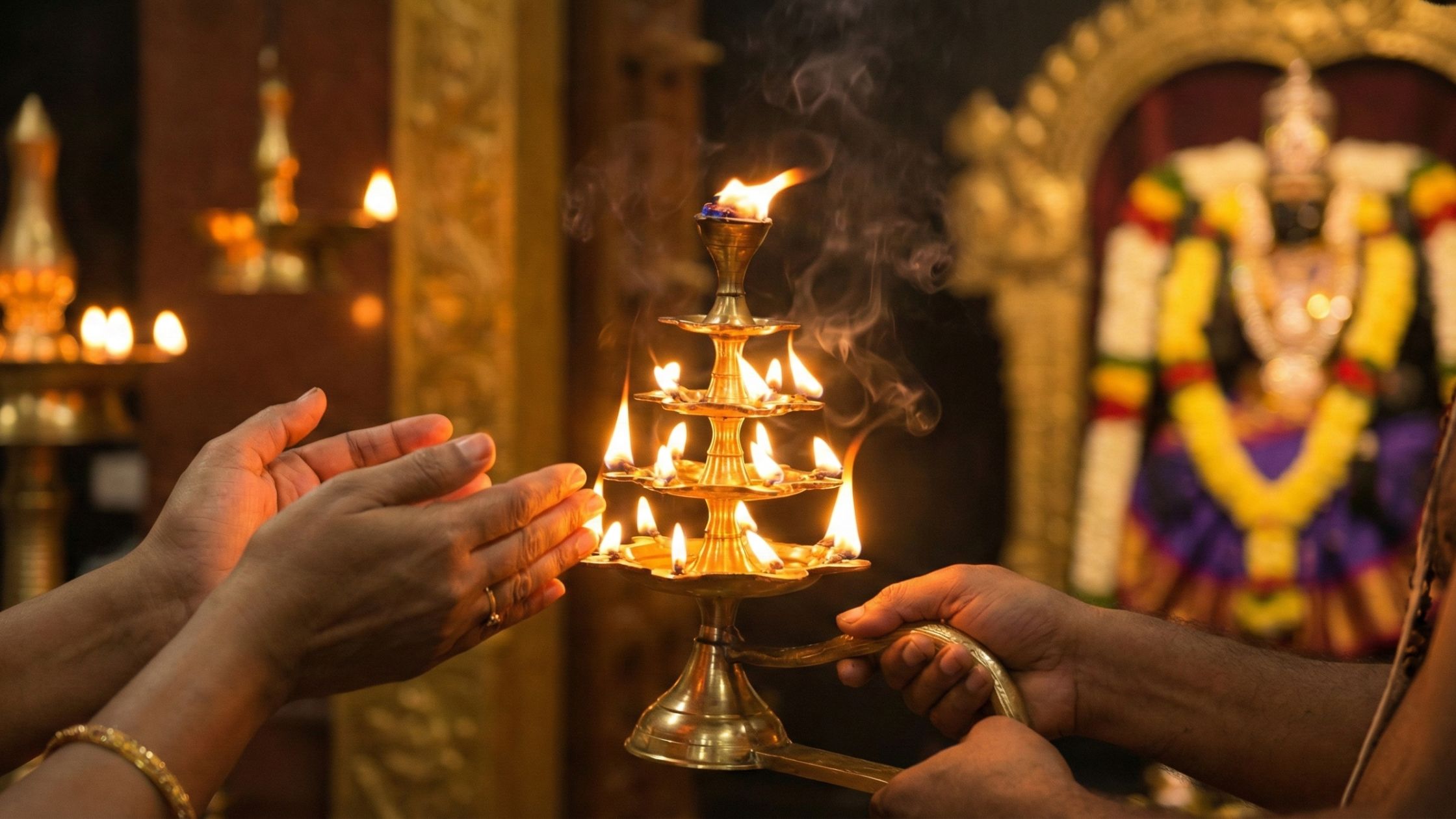
Why Do We Touch the Arati Flame? The Sacred Science of Receiving Divine Light
hy Do We Touch the Ārati Flame? The Sacred Science of Receiving Divine Light Watch the full video explanation https://youtube.com/shorts/io9EpnNA6Ow Why Do We Touch the Ārati Flame? The Sacred Science of Receiving Divine Light Agni, Prasāda & Temple Worship Explained Have you ever wondered why we touch that ārati flame and then place that warmth on our eyes and forehead? Most of us do it—in temples, at home shrines, during festivals. The priest waves the camphor flame before the deity, then brings it to us. We cup our hands over the light, draw that warmth toward ourselves, and touch our eyes and forehead in a gesture so automatic it feels instinctive. But almost no one knows why. Is it superstition? A cultural habit passed down without meaning? A symbolic gesture emptied of significance? The answer is far more profound. What appears as a simple ritual gesture reveals itself as a sophisticated theological transaction—a carefully designed system for transmitting divine grace from deity to devotee through the medium of consecrated light. I am Jayanth Dev, author of Dhantasura. And today, we’re examining what scripture actually says about this universal Hindu practice. Part I: Agni—The Divine Messenger The First Hymn of the Ṛg Veda To understand the ārati flame, we must first understand Agni (अग्नि)—the Vedic deity of fire. The Ṛg Veda (ऋग्वेद), humanity’s oldest continuously used religious text (composed approximately 1500-1200 BCE), begins not with praise of Indra, Varuṇa, or any of the celestial deities—but with Agni. Ṛg Veda 1.1.1: Sanskrit (Devanāgarī): अग्निमीळे पुरोहितं यज्ञस्य देवमृत्विजम् । होतारं रत्नधातमम् ॥ Sanskrit (IAST Transliteration): agnim īḷe purohitaṁ yajñasya devam ṛtvijam hotāraṁ ratna-dhātamam Word-by-Word Breakdown: agnim (अग्निम्) = Agni (accusative—Agni as object of praise) īḷe (ईळे) = I praise, I worship purohitam (पुरोहितम्) = the priest who sits in front, the foremost priest yajñasya (यज्ञस्य) = of the sacrifice devam (देवम्) = divine, god ṛtvijam (ऋत्विजम्) = the officiant, the ritual priest hotāram (होतारम्) = the invoker, the one who calls the gods ratna-dhātamam (रत्नधातमम्) = the best bestower of treasures/gems Translation: “I praise Agni, the purohita (priest placed in front), the divine priest of the sacrifice, the invoker who is the best bestower of treasures.” What This Establishes: Agni’s Unique Role This opening verse is theologically significant. The Ṛg Veda contains over 1,000 hymns to various deities—Indra (god of rain/thunder), Varuṇa (cosmic order), Sūrya (sun), Uṣas (dawn), and others. Yet it begins with Agni. Why? Because Agni occupies a unique mediating role in Vedic cosmology: 1. Agni is Purohita—The Foremost Priest The term purohita (पुरोहित) literally means “placed in front” (puras = in front, hita = placed). Agni is the priest who sits before the deity on behalf of humans, performing the sacrifice that we cannot perform directly. 2. Agni is Ṛtvij—The Divine Officiant He is both human fire (the flame we light) and divine fire (the sacred power that connects earth to heaven). He operates in both realms simultaneously. 3. Agni is Hotār—The Invoker The term hotār (होतार्) comes from the root hu (हु) = “to offer, to invoke.” Agni calls the gods to the sacrifice. When offerings are placed in fire, Agni carries them upward to the devas. 4. Agni is the Messenger Ṛg Veda 1.1.5: “Agni is the messenger between gods and men.” He is the carrier of offerings from humans to deities and the carrier of blessings from deities to humans. This is critical: Agni is not just fire. Agni is the medium of divine transaction. Part II: From Vedic Yajña to Temple Ārati The Evolution of Fire Worship In Vedic times (1500-500 BCE): Worship centered on yajña—elaborate fire rituals performed outdoors with mantras, offerings of ghee, grains, and soma. The structure: A sacred fire (yajña-agni) is established Offerings are made into the fire with specific mantras Agni carries these offerings to the appropriate deities The ritual concludes with participants receiving blessings The closing of the yajña involved presenting the flame to all participants, who would “take the light to fill the heart and mind.” This is the original form of what we now call ārati. The Temple Transformation As Hinduism evolved from Vedic yajña-centered worship to Purāṇic temple-centered worship (approximately 400 CE onwards), the grand outdoor fire sacrifice was ritualized into the temple lamp ceremony: Vedic Yajña → Temple Ārati Large fire pit → Small camphor/oil lamp Outdoor ritual space → Enclosed temple sanctum Direct offerings into fire → Flame waved before mūrti (deity form) Yajña participants → Temple devotees Final blessing with fire → Ārati distribution The core principle remained: Fire as the medium of divine transaction. Part III: The Ārati Ceremony—A Structured Ritual What Actually Happens During Ārati The word ārati (आरती) comes from Sanskrit ā-rāti (आ-राति): Ā (आ) = towards, near Rāti (राति) = to give, to offer (from root rā) Meaning: “The offering brought near”—specifically, the offering of light brought close to the deity. The Five-Element Offering Traditional ārati represents an offering of the Pañca-mahābhūta (पञ्चमहाभूत)—the five great elements that constitute material creation: 1. Pṛthvī (पृथ्वी) – Earth Represented by flowers, rice, sandalwood paste The solid, stable foundation 2. Jala (जल) – Water Represented by water in the conch shell (śaṅkha) The fluid, purifying element 3. Agni (अग्नि) – Fire Represented by the flame itself (camphor, ghee lamp, oil lamp) The transformative, illuminating element 4. Vāyu (वायु) – Air Represented by the fan (cāmara) waved before the deity The dynamic, life-giving breath 5. Ākāśa (आकाश) – Space/Ether Represented by the sound of bells, conch, and singing The subtle medium carrying vibration When all five elements are offered in ārati, the worshipper symbolically offers the entirety of material creation back to its source—the Divine. The Ārati Sequence Step 1: Preparation The priest (pūjāri) prepares the ārati plate with: A lamp with wicks soaked in ghee or pure camphor Sometimes flowers, incense, water A bell (ghaṇṭā) Step 2: Lighting and Consecration The flame is lit with accompanying mantras. The priest may chant: agnaye namaḥ – Salutations to Agni brahma-jyotiḥ namaḥ – Salutations to the
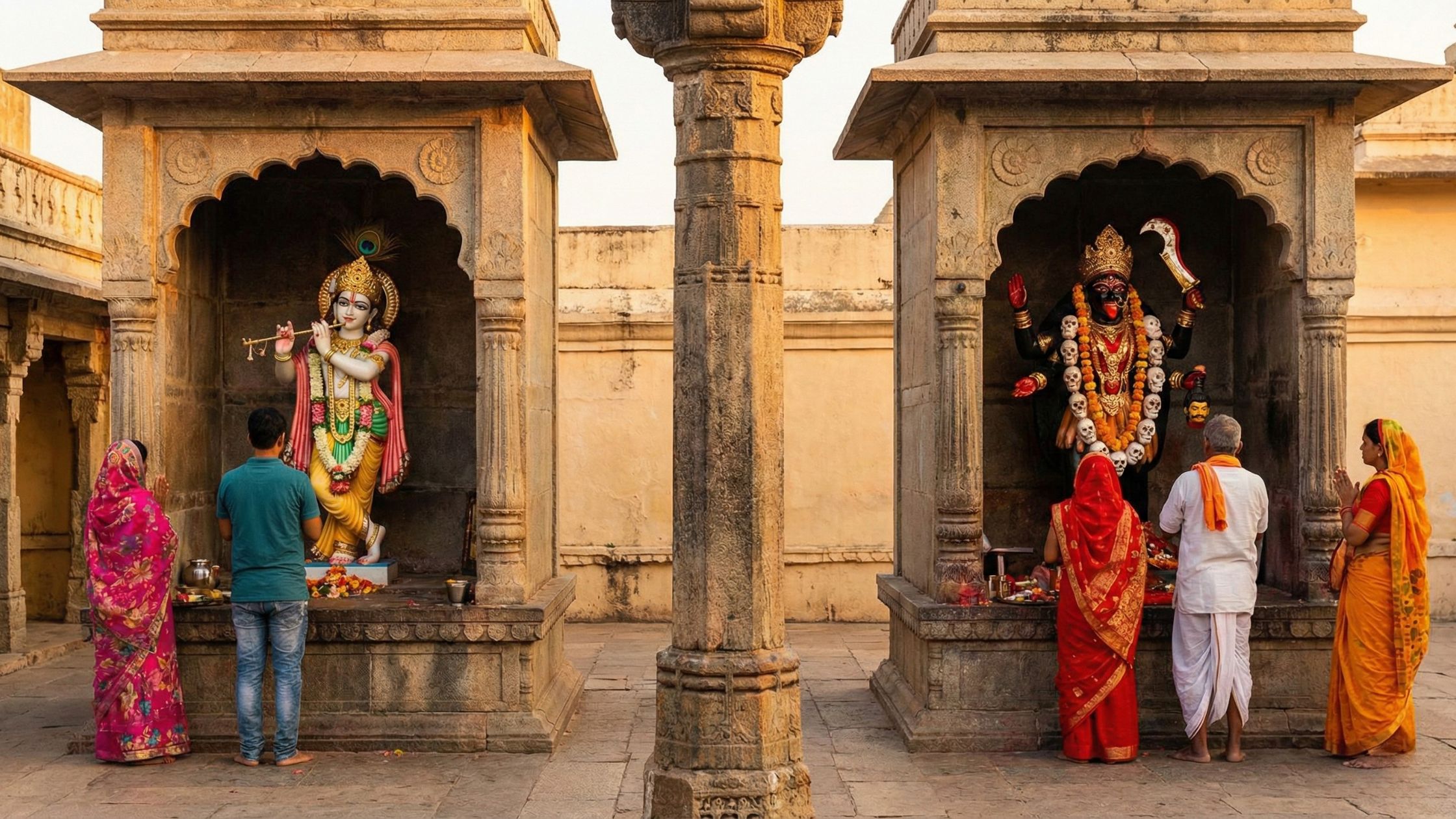
“Kali Is Actually Śrī Krishna?” — Let’s Open the Śāstra: Understanding Theological Frameworks in Sanātana Dharma
“Kālī Is Actually Śrī Krishna?” — Let’s Open the Śāstra: Understanding Theological Frameworks in Sanātana Dharma Watch the full video explanation https://youtube.com/shorts/YBtUDs6o6JQ Kālī Is Not Krishna? — Theological Frameworks Explained “Kālī is Krishna.” I keep hearing this. On Instagram reels. In WhatsApp forwards. In casual conversations about Hinduism. Before you share the next viral post claiming this equivalence—let’s actually open the śāstra. Because this statement, made carelessly without context, reveals something deeper than theological confusion. It reveals a fundamental misunderstanding of how Sanātana Dharma actually works—how it holds multiple valid theological frameworks simultaneously without collapsing them into simplistic uniformity. My name is Jayanth Dev, Author of Dhantasura. And today we’re examining what the texts actually say. The Problem: Theological Precision Matters Sanātana Dharma allows theological depth. It accommodates diverse approaches to the Divine. There are rich traditions that speak eloquently of the unity of Ultimate Reality—the non-dual Brahman beyond all names and forms. But there are also distinct tattvas (principles) described in Purāṇa and Itihāsa. Specific deity forms with specific functions, specific līlās (divine play), and specific relationships to cosmic order. If we are going to make a statement like “Kālī is Krishna,” we must ask: What do the texts actually say? Which sampradāya (theological tradition) are we speaking from? Are we discussing ultimate non-dual reality (where all distinctions dissolve)? Or are we discussing relative manifestations (where deity forms have specific identities and functions)? Conflating these levels creates confusion, not clarity. Let’s examine what the primary scriptures say about Krishna, what they say about Kālī, and where—if anywhere—they establish direct equivalence. Part I: Krishna’s Position in Vaiṣṇava Theology The Foundational Verse: Śrīmad Bhāgavatam 1.3.28 The Śrīmad Bhāgavatam, composed by Sage Vyāsa, is considered the mahā-purāṇa (great Purāṇa) by Vaiṣṇava traditions. It’s often called the “ripened fruit of the Vedic tree” (nigama-kalpa-taror galitaṁ phalam). In Canto 1, Chapter 3, Sage Śuka is describing the various avatāras (incarnations) of Viṣṇu: Matsya, Kūrma, Varāha, Narasiṁha, Vāmana, Paraśurāma, Rāma, Buddha, Kalki, and others. Then comes verse 28—one of the most significant theological statements in Purāṇic literature: Sanskrit (Devanāgarī): एते चांशकलाः पुंसः कृष्णस्तु भगवान् स्वयम् । इन्द्रारिव्याकुलं लोकं मृडयन्ति युगे युगे ॥ Sanskrit (IAST Transliteration): ete cāṁśa-kalāḥ puṁsaḥ kṛṣṇas tu bhagavān svayam indrāri-vyākulaṁ lokaṁ mṛḍayanti yuge yuge Word-by-Word Breakdown: ete (एते) = all these ca (च) = and aṁśa (अंश) = portions, direct expansions kalāḥ (कलाः) = portions of portions, secondary expansions puṁsaḥ (पुंसः) = of the Supreme Person kṛṣṇaḥ (कृष्णः) = Krishna tu (तु) = but (emphatic contrast) bhagavān (भगवान्) = the Supreme Personality possessing six opulences svayam (स्वयम्) = Himself, in person, the original indrāri (इन्द्रारि) = enemies of Indra (demons) vyākulam (व्याकुलम्) = disturbed lokam (लोकम्) = world mṛḍayanti (मृडयन्ति) = they mitigate, they protect yuge yuge (युगे युगे) = age after age Translation: “All of the above-mentioned incarnations are either direct portions (aṁśa) or portions of portions (kalā) of the Supreme Person, but Krishna is Bhagavān Himself (svayam). All of them appear in different ages to protect the world when it is disturbed by demons.” What This Establishes in Vaiṣṇava Theology This verse is doctrinally foundational for Gauḍīya, Vallabha, and other Krishna-centered Vaiṣṇava sampradāyas. Key theological claims: 1. Krishna is Svayam Bhagavān The term svayam means “Himself”—the original, complete form of the Supreme Lord, not a derivative or partial manifestation. All other avatāras—including Viṣṇu, Nārāyaṇa, Rāma—are described as aṁśa (direct expansions) or kalā (portions of expansions) emanating from Krishna. 2. Krishna is the Source, Not Derived Commentators like Śrīla Jīva Gosvāmī, Śrīdhara Svāmī, and Viśvanātha Cakravartī Ṭhākura extensively analyzed this verse. They emphasize: Krishna doesn’t come FROM Viṣṇu (the common Hindu understanding) Viṣṇu comes FROM Krishna Krishna is pūrṇa-brahma (complete Brahman), possessing all six opulences (aiśvarya) in full: wealth, strength, fame, beauty, knowledge, renunciation 3. This is a Specific Sampradāya Position This theological position is specific to Krishna-centered Vaiṣṇava theology. Other Vaiṣṇava sampradāyas (like Śrī Vaiṣṇava, founded by Rāmānuja) may interpret this differently—some seeing Nārāyaṇa as supreme and Krishna as an avatāra of Nārāyaṇa. The point: Even within Vaiṣṇava traditions, there are variations in how this verse is understood. Part II: Kālī’s Position in Śākta Theology The Goddess as Supreme Śakti: Devī Māhātmyam Now let’s examine what śāstra says about the Goddess and specifically Kālī. The primary text is the Devī Māhātmyam (देवी माहात्म्यम्), also called Durgā Saptaśatī (700 verses) or Caṇḍī Pāṭha. This text, found in the Mārkaṇḍeya Purāṇa (chapters 81-93), is the foundational scripture of Śākta (Goddess-centered) theology. Historical Context: Composed approximately 400-600 CE Describes the Goddess (Devī/Durgā) as supreme ultimate reality Presents her victory over the buffalo demon Mahiṣāsura Introduces forms like Kālī and the Saptamātṛkā (Seven Mothers) into mainstream Hindu worship The Key Verse: Yā Devī Sarva-Bhūteṣu One of the most famous verses from Devī Māhātmyam (Chapter 5, verses 12-27) is the Yā Devī Sarva-Bhūteṣu hymn: Sanskrit (Devanāgarī): या देवी सर्वभूतेषु शक्तिरूपेण संस्थिता । नमस्तस्यै नमस्तस्यै नमस्तस्यै नमो नमः ॥ Sanskrit (IAST Transliteration): yā devī sarva-bhūteṣu śakti-rūpeṇa saṁsthitā namas tasyai namas tasyai namas tasyai namo namaḥ Translation: “To that Goddess who abides in all beings in the form of power (śakti)—salutations to Her, salutations to Her, salutations to Her, salutations again and again.” This hymn continues with 32 verses, each describing the Goddess as residing in all beings as: Buddhi (intelligence) Nidrā (sleep) Kṣudhā (hunger) Chāyā (shadow/reflection) Śakti (power) Tṛṣṇā (thirst) Kṣānti (forbearance) Jāti (species-nature) Lajjā (modesty) Śānti (peace) Śraddhā (faith) Kānti (beauty) And many more… What This Establishes in Śākta Theology 1. The Goddess is Supreme Śakti In Śākta traditions, the Goddess (Devī/Śakti) is ultimate reality. She is: Ādya Śakti (primordial power) Brahma-svarūpiṇī (identical with Brahman) Jagad-ambā (Mother of the Universe) Prakṛti (Nature, the creative principle) 2. Kālī as Supreme Form Within Śākta theology, Kālī is often considered the supreme, most powerful form of the Goddess. Kālī Upaniṣad and Mahākāla Saṁhitā describe Kālī as: Mahākāla-svarūpiṇī (embodiment of Time itself) Brahma-rūpiṇī (form of Brahman) Beyond creation, sustenance, and destruction 3. This is a Specific Sampradāya Position Just as Krishna-centered theology is specific to certain Vaiṣṇava sampradāyas,
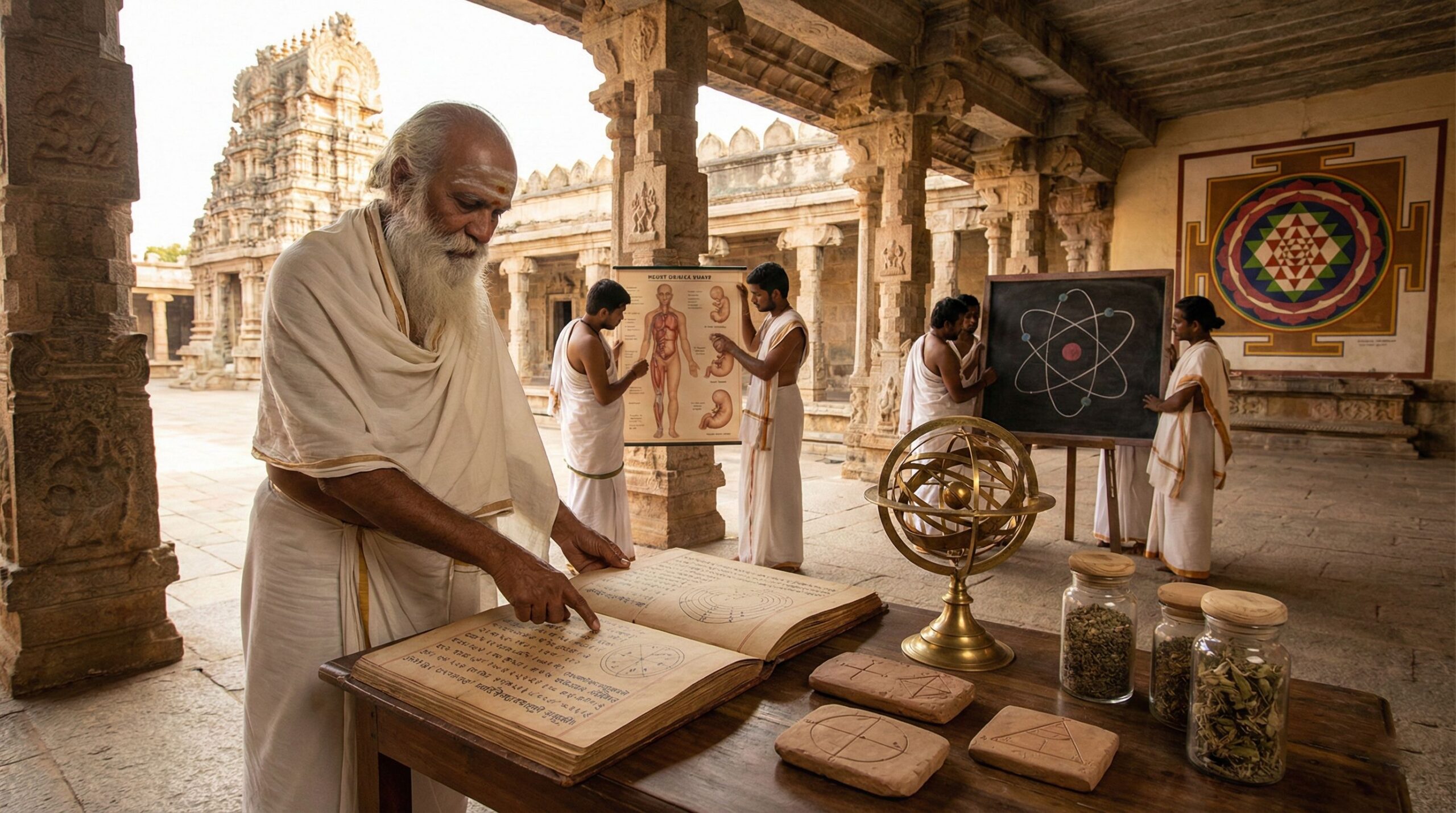
You Were Given an Incomplete Indian Timeline: Hindu Civilization’s Lost Intellectual Legacy
You Were Given an Incomplete Timeline: Hindu Civilisation’s Lost Scientific LegacyAryabhata, Zero, Atomic Theory, and Ancient India’s Knowledge Systems Watch the full video explanation You Were Given an Incomplete Timeline: Hindu Civilisation’s Lost Intellectual Legacy They removed this from your history books. Hindu civilisation gave the world mathematics, astronomy, embryology, atomic theory, gravitational concepts, linguistic analysis, surgical techniques, and philosophical systems—and nobody told you. Walk into any classroom today, open any standard history textbook, and you’ll find the same sanitized narrative: Ancient India was a land of spirituality, mythology, and social hierarchy. The Vedas were religious texts. The Puranas were stories. The temples were places of worship. End of story. But that’s not the complete story. That’s not even half the story. This is not about myth. This is not about metaphysics divorced from observation. This is about a knowledge civilization whose intellectual achievements were systematically excluded from the narrative you were taught in school—a civilization that developed sophisticated scientific models, mathematical systems, and philosophical frameworks that would not be “discovered” in Europe for another thousand years. Today, we open the complete record. Today, we restore what was deliberately deleted. The Classroom Version vs. The Historical Record: What They Taught You In most modern educational systems—whether in India itself or globally—the story of Hindu civilization follows a predictable, reductive pattern: What you were taught: Ancient India had a rich tradition of colorful mythology and religious stories Numerous gods and goddesses with elaborate rituals The caste system dominated social organization Spiritual and mystical traditions focused on the afterlife Philosophical texts dealt primarily with abstract metaphysics Society was largely agrarian and pre-scientific What you were NOT taught: Mathematical innovations that form the foundation of modern computing Astronomical models that accurately described Earth’s rotation and planetary motion—predating European discoveries by a millennium Detailed embryological observations documenting fetal development month by month without the aid of microscopes Atomic philosophy that proposed indivisible particles millennia before John Dalton Gravitational concepts articulated centuries before Isaac Newton Linguistic analysis that created the world’s most sophisticated grammatical framework Surgical procedures including cataract operations, rhinoplasty, and cesarean sections Philosophical systems that developed formal logic, epistemology, and consciousness studies The textbooks presented half a civilization—the cultural, religious, and social aspects—while conveniently omitting or minimizing the scientific, mathematical, and intellectual infrastructure that supported and enabled this civilization to thrive for millennia. This wasn’t accidental oversight. This wasn’t innocent omission due to limited space in textbooks. This was selective erasure—a deliberate construction of a narrative that portrayed non-Western civilizations as pre-scientific, mystical, and intellectually inferior. Let’s restore what was deleted. Let’s examine the evidence that changes everything. 1. EARTH IN MOTION: Aryabhata’s Revolutionary Astronomy (5th Century CE) The Discovery That Predated Copernicus by 1,000 Years In 499 CE, when the dominant cosmological model across most of the world placed Earth as a stationary sphere at the center of the universe with celestial bodies revolving around it, a 23-year-old Indian mathematician-astronomer named Āryabhaṭa (आर्यभट) composed the Āryabhaṭīya—a compact Sanskrit treatise of just 121 verses that would revolutionize astronomy. What Aryabhata stated—in the 5th century CE: In the Gola-pāda (Sphere section), Chapter 4, Verse 9 of the Āryabhaṭīya, Aryabhata made a declaration that would not be accepted in Europe for another thousand years: Sanskrit: अनुलोमगतिर्नौस्थः पश्यत्यचलं विलोमगं यद्वत् । अचलानि भानि तद्वल्लङ्कायां स्थितो यद्वत् पश्यति ॥ Translation: “Just as a person in a boat moving forward sees stationary objects (on the shore) as moving backward, just so are the stationary stars seen by people at Lanka (on Earth) as moving exactly towards the west (due to the eastward motion of the Earth).” Modern interpretation: ✓ Earth rotates on its axis from west to east ✓ Day and night occur due to this axial rotation ✓ The apparent westward motion of stars and celestial bodies is relative motion—caused not by their movement but by Earth’s rotation ✓ The stars are actually stationary (relative to Earth’s daily motion) Why This Discovery Was Revolutionary This was 1,044 years before Nicolaus Copernicus published De revolutionibus orbium coelestium (On the Revolutions of the Heavenly Spheres) in 1543 CE, which is traditionally credited as the beginning of the heliocentric revolution in European astronomy. But Aryabhata went even further. His achievements include: 1. Accurate Calculation of π (Pi): Aryabhata calculated π as 3.1416, accurate to four decimal places—a remarkable achievement for the 5th century. 2. Scientific Explanation of Eclipses: He explained that: Lunar eclipses occur when Earth’s shadow falls on the Moon Solar eclipses occur when the Moon passes between Earth and the Sun, blocking sunlight This was a revolutionary departure from mythological explanations (such as the demon Rahu swallowing celestial bodies). 3. Recognition of Reflected Light: Aryabhata stated that planets and the Moon shine by reflected sunlight—they are not self-luminous. This contradicted prevailing beliefs. 4. Trigonometric Tables: He developed detailed sine tables (called jyā in Sanskrit), which were foundational for astronomical calculations. 5. Place-Value System: His mathematical notation implicitly used zero and the decimal place-value system, which would later revolutionize mathematics globally. The Transmission and Impact The Āryabhaṭīya was translated into Arabic in the 8th century as Zij al-Arjabhar by the scholar Al-Khwarizmi, who himself is often (incorrectly) credited as the “father of algebra.” Through Arabic translations, Aryabhata’s astronomical models, trigonometric methods, and mathematical techniques profoundly influenced Islamic astronomy and, eventually, European Renaissance science. Yet his name appears nowhere in standard world history curricula. 2. EMBRYOLOGY IN PURĀṆA: The Bhāgavatam’s Detailed Developmental Stages Ancient Observation Without Modern Tools One of the most stunning examples of systematic observation in ancient Hindu texts appears in the Śrīmad Bhāgavatam, specifically in Canto 3, Chapter 31, titled “Lord Kapila’s Instructions on the Movements of the Living Entities.” This chapter provides a month-by-month description of embryological development that aligns remarkably with modern scientific understanding—all without the benefit of microscopes, ultrasound, or any modern medical technology. The Text: A Timeline of Development Verse 3.31.2: कलालं त्वेकरात्रेण पञ्चरात्रेण बुद्बुदम् । दशाहेन तु कर्कन्धूः पेश्यण्डं वा ततः परम् ॥ Translation: “On the first night, the sperm and
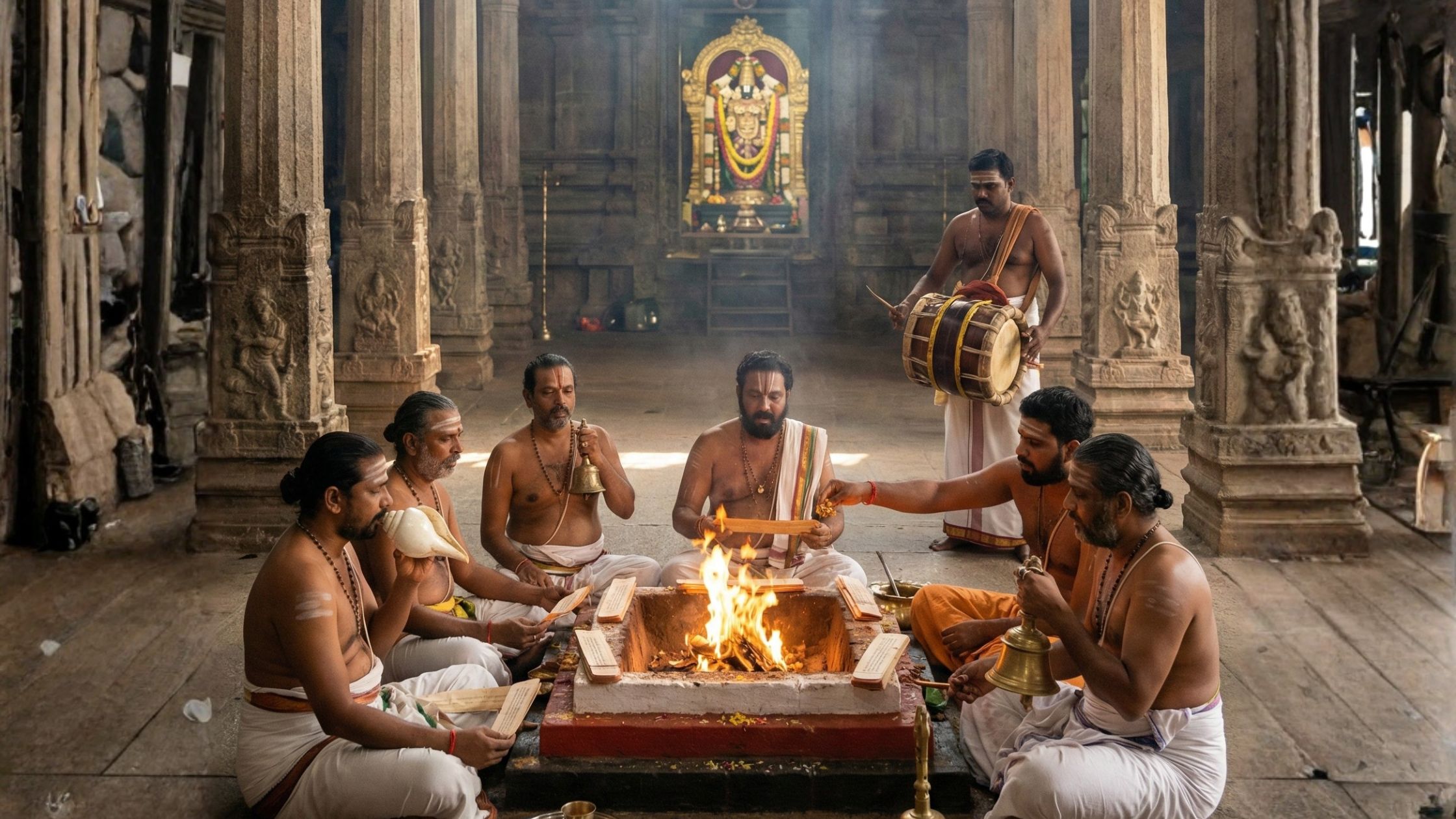
Why Do We Ring the Bell During Pūjā? The Sacred Science of Ghaṇṭā-Nāda
Why Ring Bell During Puja? Temple Bell Science & Skanda Purana Verse – Ghanta Nada Explained Watch the full video explanation https://youtube.com/shorts/XBYHSas57V4 Why Do We Ring the Bell During Pūjā? The Sacred Science of Ghaṇṭā-Nāda Why do we ring that small bell during ārati? Why does every temple begin worship with that sound? Walk into any Hindu temple—from the towering gopurams of Tamil Nadu to the marble mandirs of North India—and the first thing you encounter, even before darśana (sacred viewing), is the sound of a bell. The sharp, resonant clang that echoes through the sanctum sanctorum is so integral to temple worship that we’ve stopped questioning it. It feels natural, almost automatic. Ring the bell. Enter. Bow. Pray. But is it just ritual habit? A cultural artifact we’ve inherited without understanding? Or is something deeper happening—something rooted in ancient wisdom, codified in scriptures, and validated by both spiritual insight and modern science? The answer transforms a simple gesture into a profound act of sacred invocation. The Scriptural Foundation: What the Purāṇas Say Sanātana Dharma treats sound as sacred. The Vedas themselves were preserved through sound—śruti (श्रुति), meaning “that which is heard.” Mantras operate through sound vibration. Temple rituals are structured around acoustic precision. The ringing of the bell—ghaṇṭā-nāda (घण्टानाद)—is not decorative background noise. It is ritualized sound with scriptural mandate. The Skanda Purāṇa, one of the eighteen major Purāṇas and among the largest, contains specific instructions about bell-ringing during worship. In the section on Mārgaśīrṣa-māhātmya, Chapter 6, verses 1-30 describe the importance of bells in Viṣṇu worship. The text includes this powerful declaration: Sanskrit: घण्टानादं करोत्येव यः पूजाकर्मणि मानवः । सर्वपापविनिर्मुक्तो विष्णुलोकं स गच्छति ॥ Transliteration: Ghaṇṭā-nādaṁ karoty eva yaḥ pūjā-karmaṇi mānavaḥ sarva-pāpa-vinirmukto viṣṇu-lokaṁ sa gacchati Translation: “One who rings the bell during worship becomes freed from sins and attains the realm of Vishnu.” This is not metaphorical language. The Purāṇic tradition explicitly connects bell-ringing with pāpa-vimukti (liberation from sin) and spiritual elevation. The act of producing ghaṇṭā-nāda—the specific sound of the sacred bell—during pūjā-karma (worship action) generates purifying effects that extend beyond the immediate ritual moment. The Āgamic System: When and Why the Bell Is Rung Hindu temple worship follows precise protocols codified in Āgama śāstras—the ritual manuals governing temple construction, deity installation, and worship procedures. These texts, particularly the Pāñcarātra and Vaikhānasa Āgamas, specify exactly when the bell must be rung: 1. During Āvāhana (Invocation) When the deity is formally invited to be present in the mūrti (sacred form), the bell marks the transition from ordinary to sacred time. The sound announces: “Worship has begun. Divine presence is being invoked.” 2. During Upacāra Offerings The bell rings as each offering is made: While applying gandha (sandalwood paste) While offering puṣpa (flowers) While presenting dhūpa (incense) While waving dīpa (lamp) While offering naivedya (food) Each ring punctuates the ritual sequence, maintaining focus and marking transitions. 3. During Ārati (Lamp Waving Ceremony) The bell rings continuously during ārati, creating a sustained acoustic field that: Maintains devotional intensity Prevents mental wandering Synchronizes the worshippers’ attention Amplifies the collective energy The Āgamas make clear: The bell is not optional decoration. It is structural requirement. The Three Purposes: Why Sound Matters 1. Marks the Formal Beginning of Worship In daily life, we move through mundane activities—eating, working, talking, scrolling. Consciousness remains diffuse, scattered across multiple thoughts and sensory inputs. How do you signal to yourself that sacred time has begun? The bell does exactly this. Its sound creates a temporal boundary—a clear demarcation between ordinary time (laukika-kāla) and sacred time (daivika-kāla). The moment the bell rings, the mind receives a signal: “Stop. Shift. Attend.” This is why temples have large bells at the entrance. Devotees ring them upon entering not as superstition but as self-preparation—announcing to their own consciousness: “I am crossing from the worldly into the sacred.” 2. Focuses the Mind by Cutting Through Distraction The human mind is, by default, a wandering instrument. Ancient texts describe it as capala (चपल)—restless, monkey-like. Even during prayer, thoughts drift: What’s for dinner? Did I lock the door? That person looked at me strangely… The bell’s sharp sound acts as an acoustic anchor. When the bell rings, the brain’s auditory cortex is stimulated. The sudden, clear sound interrupts thought patterns. For a moment—even just a moment—mental chatter stops. That moment of silence is the opening where devotion can enter. Traditional bell design ensures this effect is sustained. Temple bells are crafted to produce prolonged resonance—the sound doesn’t immediately die but lingers, creating waves of vibration that continue for several seconds. This extended resonance keeps the mind tethered to the present, preventing it from slipping back into distraction. 3. Creates Sacred Acoustic Space Sound is not just heard—it transforms space. When a bell rings in an enclosed temple chamber, the sound waves bounce off stone walls, creating complex patterns of interference and resonance. The entire space becomes saturated with vibration. In traditional thought, this acoustic saturation is understood as purification. Just as incense (dhūpa) purifies the air and visual environment, the bell’s sound purifies the subtle atmosphere—removing stagnant energies, dispelling negative thought-forms, and establishing a field conducive to divine presence. The Skanda Purāṇa explicitly states: “Where a bell with my [Vishnu’s] name inscribed therein is kept in front, and where the idol of Viṣṇu is worshipped, know that I am present there.” The bell doesn’t just accompany worship—it enables divine presence. The Science of Temple Bells: Metallurgy Meets Metaphysics A temple bell is not just “any metal.” Traditional ghaṇṭās are crafted using pañcaloha (पञ्चलोह)—the five-metal alloy—or saptaloha (सप्तलोह)—the seven-metal alloy. The metals correspond to planets and their associated qualities: Metal Planet Quality Gold Sun Vitality, consciousness Silver Moon Emotional clarity, calm Copper Venus Beauty, harmony Iron Mars Strength, courage Tin Jupiter Wisdom, expansion Lead Saturn Discipline, grounding Mercury Mercury Intelligence, communication The precise ratios are traditional secrets passed down through generations of bell-makers. When these metals are combined and cast in specific proportions, the resulting bell produces a sound with unique characteristics: 1. Harmonic
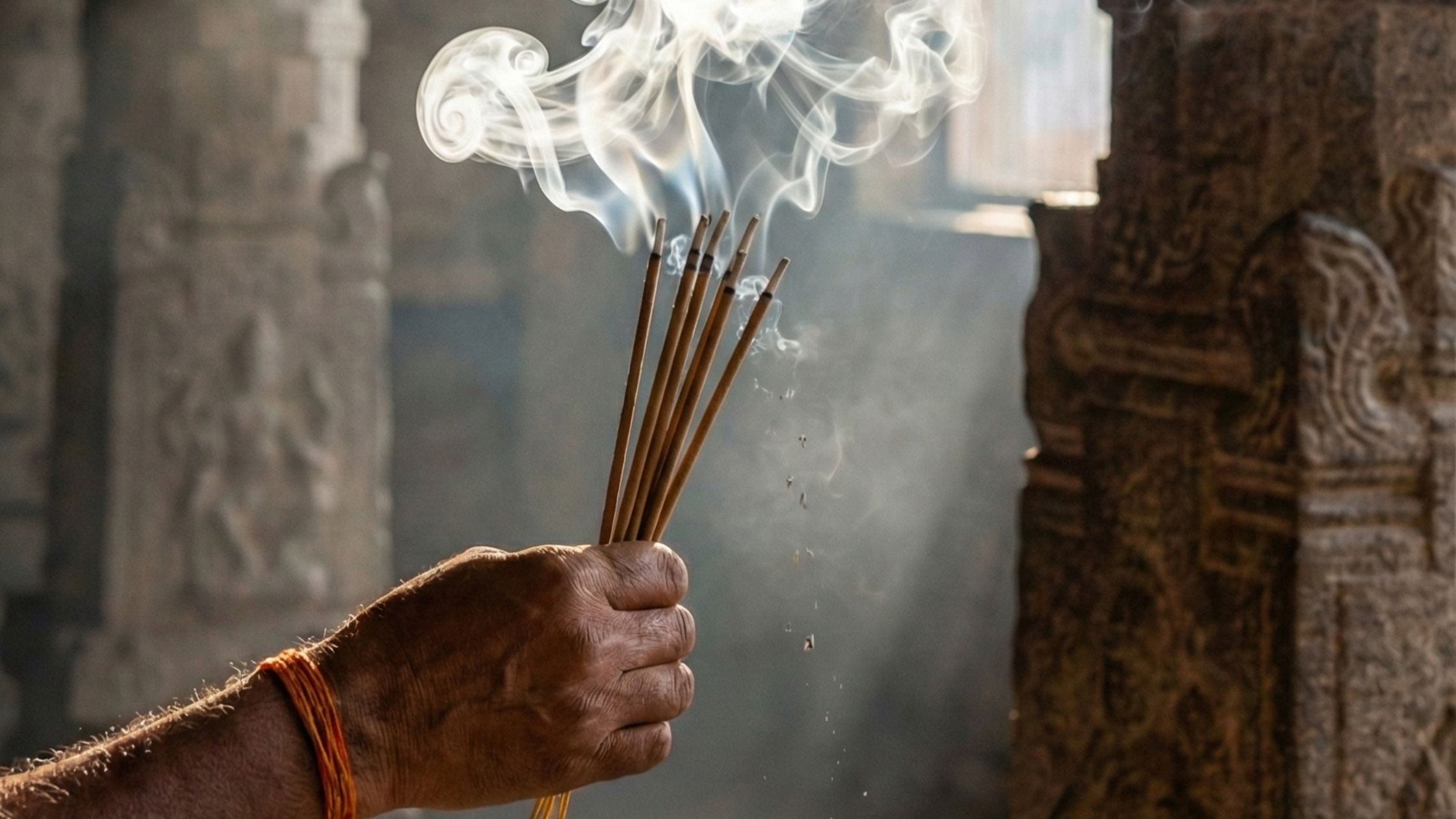
Why Do We Use Agarbatti During Ārati? The Ancient Science of Upacāra Worship
Why Do We Use Agarbatti During Ārati? The Ancient Upacāra System Explained Watch the full video explanation https://youtube.com/shorts/d4CLwKDakns Why Agarbatti in Puja? The Ancient Upacāra System | Dhūpa Explained Introduction: The Question Why do we light agarbatti in front of deities? Is it just fragrance? Is it ritual habit? Is it decoration? Or does it have a deeper meaning? Because in Sanātana Dharma, worship follows structure. Temple rituals were never random. They were codified. Every offering has meaning. Incense—dhūpa—is not decorative. It is part of a formal system of worship described in Purāṇic and Āgamic traditions. Let me show you the structure. Part I: The Scriptural Foundation Viṣṇu Purāṇa on Worship Sequence Sanskrit: गन्धं पुष्पं धूपदीपं नैवेद्यं च निवेदयेत् । IAST Transliteration: Gandhaṁ puṣpaṁ dhūpa-dīpaṁ naivedyaṁ ca nivedayet Word-by-Word Breakdown: gandham (गन्धम्) = fragrance, sandalwood paste puṣpam (पुष्पम्) = flowers dhūpa (धूप) = incense dīpam (दीपम्) = lamp, light naivedyam (नैवेद्यम्) = food offering ca (च) = and nivedayet (निवेदयेत्) = one should offer Translation: “One should offer fragrance, flowers, incense, lamp, and food.” What This Establishes This verse from the Viṣṇu Purāṇa lists dhūpa (incense) as a formal offering in deity worship. It’s not optional decoration. It’s not cultural habit. It’s part of the prescribed upacāra sequence. Part II: The Upacāra System—Structured Worship What Is Upacāra? Upacāra (उपचार) comes from: Upa (उप) = near, towards Cara (चर) = to move, to go Meaning: “Service,” “Attendance,” “Offering” In worship context: Upacāras are specific acts of service performed to honor the deity, treating the mūrti (sacred form) as a living presence requiring care, attention, and hospitality. The Three Main Systems Hindu worship codifies upacāras in three standard sequences: 1. Pañcopacāra (पञ्चोपचार) — Five Offerings Simplest form, suitable for daily home worship: Gandha (गन्ध) — Sandalwood paste or fragrant substance Puṣpa (पुष्प) — Flowers Dhūpa (धूप) — Incense Dīpa (दीप) — Lamp Naivedya (नैवेद्य) — Food offering Mantras used: “Gandham samarpayāmi” (I offer fragrance) “Puṣpam samarpayāmi” (I offer flowers) “Dhūpam samarpayāmi” (I offer incense) “Dīpam darśayāmi” (I show the lamp) “Naivedyam nivedayāmi” (I offer food) 2. Daśopacāra (दशोपचार) — Ten Offerings Intermediate form, common in temples: Expands the five into ten, adding: Āsana (seat) Svāgata (welcom) Pādya (water for feet) Arghya (water for hands) Ācamana (water for sipping) 3. Ṣoḍaśopacāra (षोडशोपचार) — Sixteen Offerings Most elaborate form, performed in major temples: The complete sequence includes: Āvāhana (आवाहन) — Invocation Āsana (आसन) — Offering seat Pādya (पाद्य) — Water for washing feet Arghya (अर्घ्य) — Water for hands Ācamana (आचमन) — Water for sipping Snāna (स्नान) — Bathing Vastra (वस्त्र) — Clothing Yajñopavīta (यज्ञोपवीत) — Sacred thread Gandha (गन्ध) — Fragrance Puṣpa (पुष्प) — Flowers Dhūpa (धूप) — Incense ✓ Dīpa (दीप) — Lamp Naivedya (नैवेद्य) — Food Tāmbūla (ताम्बूल) — Betel leaves/nuts Pradakṣiṇa (प्रदक्षिणा) — Circumambulation Namaskāra (नमस्कार) — Prostration/salutation Notice the Pattern In ALL three systems—5, 10, or 16 offerings—dhūpa (incense) appears consistently. This is not coincidence. This is structural. Part III: Why Dhūpa Specifically? The Three Dimensions 1. Sanctifies Space Dhūpa purifies the environment. When incense burns, the smoke: Spreads fragrant molecules throughout the space Displaces stagnant air Creates a fresh, elevated atmosphere Symbolically “cleanses” the area of negative energies Āgamic texts explain: “Dhūpa removes doṣa (impurities) from the environment, making it fit for divine presence.” Practical effect: The space feels different after incense is lit. The air becomes perfumed. The atmosphere shifts from mundane to sacred. This is environmental transformation. 2. Engages the Sense of Smell in Devotion Worship is multi-sensory engagement. Traditional upacāra systematically involves all five senses: Sense Upacāra How It’s Engaged Touch Gandha (paste applied), Vastra (cloth offered) Tactile contact with sacred substances Sight Dīpa (lamp), Puṣpa (colorful flowers) Visual beauty, radiant light Hearing Mantras, bells, chanting Sacred sound vibrations Taste Naivedya (food offered, then taken as prasāda) Consuming blessed food Smell Dhūpa (incense), Gandha (sandalwood paste) Aromatic engagement Why smell matters: Olfactory memory is the strongest form of memory Scent triggers emotional and spiritual states Fragrance creates association: “This smell = sacred space” Regular incense use conditions the mind to enter devotional mode When you smell incense: Your mind knows: “I am in worship mode.” This is sensory conditioning for spiritual practice. 3. Symbolizes Subtle Offering Rising Upward Dhūpa carries symbolic meaning. The rising smoke represents: ✓ Prayers ascending to the Divine ✓ The subtle body (sūkṣma śarīra) beyond the gross ✓ The movement from material to spiritual ✓ Devotion becoming refined and elevated Vedic parallel: In Vedic yajña (fire rituals), aromatic substances like: Ghee (clarified butter) Samidha (sacred wood) Guggulu (resin) Candana (sandalwood) …were offered into the fire. The smoke rising from the flames symbolized offerings reaching the devas (celestial beings) in higher realms. Temple dhūpa is the refined, controlled continuation of this Vedic practice. Instead of a large fire with billowing smoke (impractical in homes/temples), we use: Incense sticks (agarbatti) Incense cones Incense powder (dhūpa-cūrṇa) Resin incense (loban, benzoin, frankincense) Same principle. Adapted form. Part IV: Historical Development—From Yajna to Agarbatti Vedic Period: Yajña with Aromatic Substances In Vedic times (1500-500 BCE): Worship centered on yajña—fire rituals performed outdoors. Aromatic offerings into fire: Candana (sandalwood chips) Agaru (agarwood/oud) Guggulu (bdellium resin) Kuṅkuma (saffron) Karpūra (camphor) Purpose: Pleasing fragrance for devas Symbolic ascent of prayers Purification of ritual space The smoke was massive, thick, and visible from afar. Purāṇic Period: Temple Worship Emerges As temple worship developed (500 BCE onwards): Large outdoor yajñas became less common. Temple pūjā (worship of mūrtis in enclosed spaces) became dominant. Problem: You can’t light a massive fire inside a temple. Solution: Controlled incense offerings. Āgamic texts (temple manuals like Pāñcarātra Āgama, Vaikhānasa Āgama) codified how to offer dhūpa: Methods: Dhūpa-pātra (धूपपात्र) — Incense vessel A small clay or metal pot Filled with burning charcoal or embers Aromatic powders/resins sprinkled on top Smoke rises gently Dhūpa-daṇḍa (धूपदण्ड) — Incense stick Thin bamboo stick coated with aromatic paste Lit at one end Burns slowly, releasing fragrance This is the ancestor of modern agarbatti Modern Period: Agarbatti Becomes
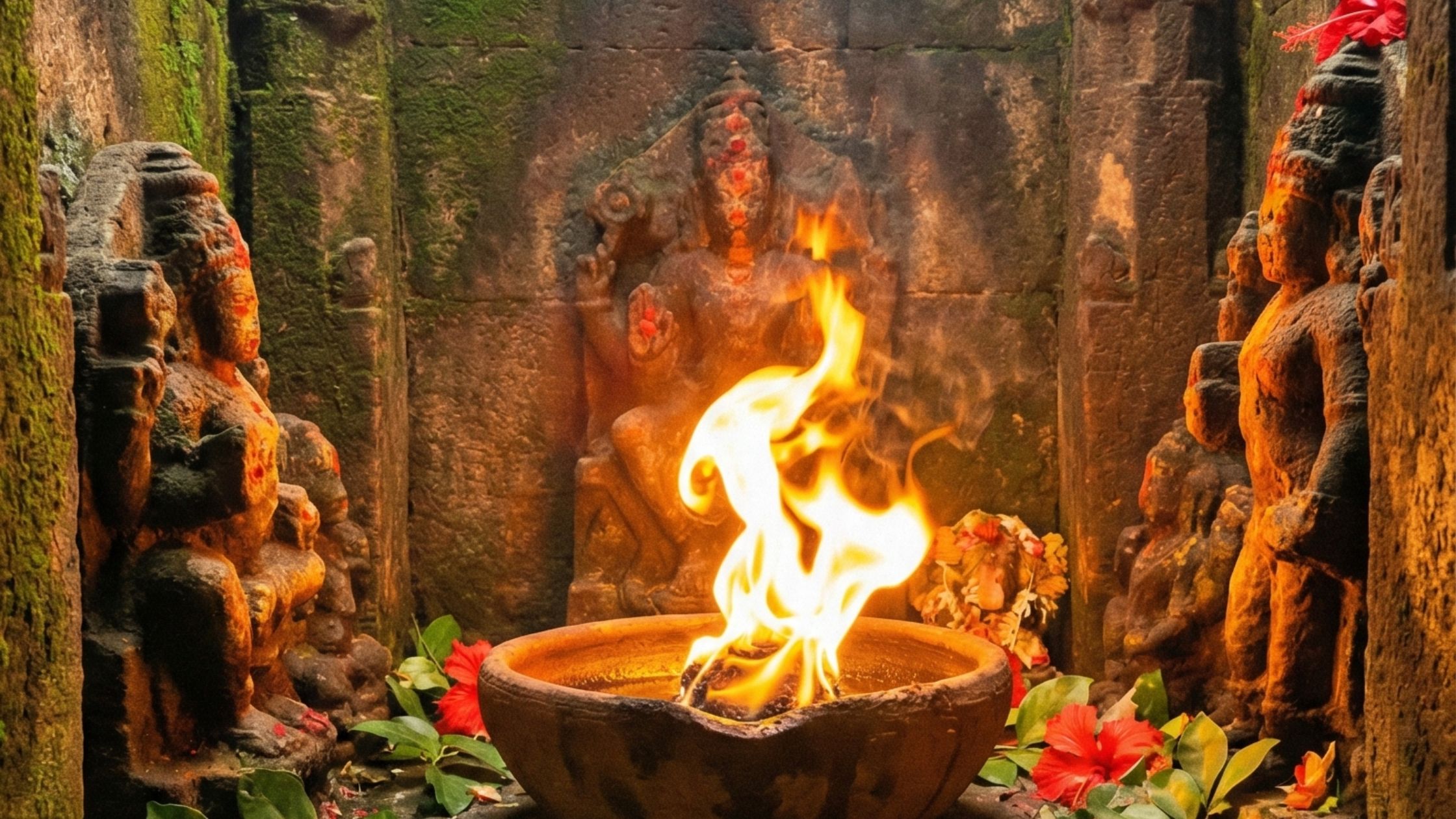
Has Hindu Dharma Lost Its Core? Where Is Bhakti? — A Reality Check
Has Hindu Dharma Lost Its Core? Where Is Bhakti? — A Reality Check Watch the full video explanation https://youtube.com/shorts/VIOUsm2ciGs Has Hindu Dharma Lost Its Core? Where Is Bhakti? | A Reality Check Introduction: The Uncomfortable Question We put our Devas on posters. We cheer when sacred ślokas play behind random violence to glorify a hero. We blast vulgar film songs in front of Gaṇeśa. Festivals turn into political rallies. Temples become photo-op locations. Dharma gets reduced to WhatsApp forwards. And then we claim to be protecting the Dharma. In the midst of all this noise, performative displays, and cultural theater— Where is Bhakti? Let me give you a reality check. Because Sanātana Dharma did not survive for millennia because of noise. It survived because of devotion. Temples were preserved through devotion. Saints revived society through devotion. Civilization was sustained through devotion. Not through slogans. Not through political mobilization. Not through cultural performance. Through Bhakti. And śāstra defines what the highest Dharma actually is. Part I: What Śāstra Says—The Supreme Dharma Śrīmad Bhāgavatam 1.2.6 Sanskrit (Devanāgarī): स वै पुंसां परो धर्मो यतो भक्तिरधोक्षजे । अहैतुकी अप्रतिहता ययाऽत्मा सुप्रसीदति ॥ Sanskrit (IAST Transliteration): sa vai puṁsāṁ paro dharmo yato bhaktir adhokṣaje ahaitukī apratihatā yayātmā suprasīdati Word-by-Word Breakdown: sa (स) = that vai (वै) = certainly, indeed puṁsām (पुंसाम्) = for mankind, for all people paraḥ (परः) = supreme, highest dharmaḥ (धर्मः) = occupation, duty, religion yataḥ (यतः) = by which bhaktiḥ (भक्तिः) = devotional service, devotion adhokṣaje (अधोक्षजे) = unto the Transcendent Lord (one beyond sensory perception) ahaitukī (अहैतुकी) = without selfish motive, causeless apratihatā (अप्रतिहता) = uninterrupted, unbroken yayā (यया) = by which ātmā (आत्मा) = the self, the soul suprasīdati (सुप्रसीदति) = becomes completely satisfied Translation: “The supreme Dharma for humanity is that by which devotion to the Transcendent Lord is cultivated — devotion that is causeless and uninterrupted — by which the soul becomes fully satisfied.” The Critical Phrase: “Paro Dharmaḥ” Paro dharmaḥ (परो धर्मः) = supreme Dharma The Bhāgavatam does NOT say: ❌ Ritual is the supreme Dharma ❌ Display is the supreme Dharma ❌ Political mobilization is the supreme Dharma ❌ Cultural performance is the supreme Dharma ❌ Temple construction is the supreme Dharma ❌ Festivals are the supreme Dharma The Bhāgavatam says: ✓ Bhakti is the supreme Dharma That which cultivates devotion to the Transcendent Lord—that is paro dharma. Everything else is secondary. Part II: What Is Bhakti According to Śāstra? The Two Qualities: Ahaitukī & Apratihatā The verse defines bhakti with two essential characteristics: 1. Ahaitukī (अहैतुकी) — Without Selfish Motive / Causeless Etymology: A (अ) = without Hetu (हेतु) = cause, motive, reason Meaning: Bhakti that is ahaitukī is not performed for: Material gain Social status Political power Cultural identity Community belonging Show or display Ahaitukī bhakti means: “I worship not to GET something. I worship because I LOVE.” Contrast with modern practice: Modern “devotion” is often transactional: “I do puja so business succeeds” “I visit temple so my exam goes well” “I perform rituals so my marriage happens” “I celebrate festival to show I’m a good Hindu” This is NOT ahaitukī bhakti. This is motivated religion—using God as a means to material ends. 2. Apratihatā (अप्रतिहता) — Uninterrupted / Unbroken Etymology: A (अ) = not Pratihata (प्रतिहत) = obstructed, checked, stopped Meaning: Bhakti that is apratihatā is: Continuous Not dependent on circumstances Not conditional on mood Not seasonal (only during festivals) Not social (only in public gatherings) Apratihatā bhakti means: “My remembrance of the Divine continues regardless of external conditions.” Contrast with modern practice: Modern “devotion” is event-based: Bhakti during Navratri, forgotten rest of the year Devotion on Diwali, absent otherwise Temple visit once a month, no daily remembrance Performative display at festivals, private life disconnected This is NOT apratihatā bhakti. This is seasonal religion—wearing devotion like festival clothing. Part III: The Modern Reality Check What We Actually Do 1. We Put Devas on Posters The scene: Truck drivers paste posters of Hanuman on their vehicles. Political parties print Rama’s image on flags. WhatsApp groups forward Ganesha GIFs on Wednesdays. The question: Is there remembrance? Or is there decoration? Is there devotion? Or is there cultural performance? Putting a deity’s image somewhere without internal connection is not bhakti. It’s aesthetic Hinduism—using sacred imagery for cultural identity, not spiritual transformation. 2. We Cheer When Ślokas Play Behind Violence The scene: A film hero massacres dozens of enemies while Hanuman Chalisa plays in the background. The audience erupts in applause. Sacred verses become background score for bloodshed. The question: Do we honor the śloka? Or do we weaponize it? Do we contemplate its meaning? Or do we use it for emotional manipulation? When sacred sound becomes entertainment enhancement, we’ve lost the core. The Hanuman Chalisa is not a battle anthem. It is a devotional hymn of surrender. Using it to glorify violence is sacrilege disguised as devotion. 3. We Blast Vulgar Songs in Front of Ganesha The scene: Gaṇeśa Chaturthi pandals with loudspeakers blaring: Film songs Item numbers DJ remixes Vulgar lyrics Right in front of Ganesha’s mūrti. The question: If we truly felt the presence of the Divine, would we behave this way? If we believed Ganesha is actually there, would we blast obscenity at Him? The answer is obvious: We don’t actually believe He’s there. We treat the mūrti as a cultural prop. The noise, the vulgarity, the disrespect—all of it reveals: We are performing a cultural festival. We are not practicing bhakti. 4. Festivals Turn Into Political Rallies The scene: Rām Navami processions with: Political party flags Slogans against “the other” Weaponry on display Provocative routes through minority neighborhoods The purpose: Not devotion. Mobilization. Not remembrance. Demonstration of power. The question: Has the festival honored Rama? Or has it used Rama? Has it cultivated bhakti? Or has it generated political energy? When a festival’s primary function is political messaging, the spiritual core has been hollowed out. 5. Temples Become Photo-Op Locations The scene: People at temples: Taking selfies in
“I Drink. I Smoke. I Don’t Follow Ritual. I Think I’m a Sinner.” — Stop That Thinking. Bhakti Is For You.
“I Drink. I Smoke. I Don’t Follow Ritual. I Think I’m a Sinner.” — Stop That Thinking. Bhakti Is For You. Watch the full video explanation https://youtube.com/shorts/SDu9NYoGNz0 “I Think I’m a Sinner” — Stop That Thinking. Bhakti Is For You | Bhāgavatam 2.3.10 Introduction: The Confession I drink. I smoke. I eat non-vegetarian food. I don’t go to temple. I don’t follow rituals. I don’t meditate. I break every rule. I think I am a sinner. Stop that thinking right now. Let me tell you why. Because Sanātana Dharma does not describe Bhagavān (the Supreme Lord) as insecure. It does not describe Him as waiting to punish. It does not describe Him as keeping score. The central teaching across scripture is: Remembrance (smaraṇa) Orientation toward the Divine Bhakti (devotion) Let me show you what the śāstra actually says. Part I: The Radical Verse Śrīmad Bhāgavatam 2.3.10 Sanskrit (Devanāgarī): अकामः सर्वकामो वा मोक्षकाम उदारधीः । तीव्रेण भक्तियोगेन यजेत पुरुषं परम् ॥ Sanskrit (IAST Transliteration): akāmaḥ sarva-kāmo vā mokṣa-kāma udāra-dhīḥ tīvreṇa bhakti-yogena yajeta puruṣaṁ param Word-by-Word Breakdown: akāmaḥ (अकामः) = one without desires (desireless) sarva-kāmaḥ (सर्वकामः) = one with all desires (full of material wants) vā (वा) = or, either mokṣa-kāmaḥ (मोक्षकामः) = one desiring liberation udāra-dhīḥ (उदारधीः) = one with broad/generous intelligence tīvreṇa (तीव्रेण) = with intensity, with great force bhakti-yogena (भक्तियोगेन) = through devotional service yajeta (यजेत) = should worship puruṣam (पुरुषम्) = the Supreme Person param (परम्) = the Supreme, the ultimate Translation: “Whether one has no desires, many desires, or desires liberation, one who is broad-minded should worship the Supreme Person with intense devotion.” Part II: The Radical Inclusiveness Three Categories—ALL Invited This verse is radical in its inclusiveness. It divides all people into three categories: 1. Akāmaḥ (अकामः) — The Desireless Who are they? Pure devotees Those who want nothing for themselves Those who only seek the happiness of the Lord Example: The gopīs of Vrindavan Characteristics: No personal agenda Complete surrender Love without expectation of return These are the spiritual elite—the highest practitioners. 2. Sarva-kāmaḥ (सर्वकामः) — Full of All Desires Who are they? People wanting material success Those seeking wealth, health, relationships Those with worldly ambitions People pursuing pleasure, comfort, security Characteristics: Full of wants Driven by desires Engaged in worldly pursuits This is most of humanity. 3. Mokṣa-kāmaḥ (मोक्षकामः) — Desiring Liberation Who are they? Yogis seeking freedom from rebirth Jñānīs (knowledge-seekers) wanting to merge with Brahman Those tired of material existence Characteristics: Spiritual ambition Desire to escape suffering Seeking ultimate freedom These are serious spiritual aspirants. The Instruction Is the Same for ALL Three Here’s what’s revolutionary: The Bhāgavatam does NOT say: ❌ “Akāmaḥ people—you should worship the Supreme Lord.” ❌ “Sarva-kāmaḥ people—you’re too impure. Get your life together first.” ❌ “Mokṣa-kāmaḥ people—you should worship.” The Bhāgavatam says: ✓ ALL THREE should worship the Supreme Person with INTENSE devotion (tīvreṇa bhakti-yogena). No prerequisites. No waiting period. No “become perfect first.” Just: Approach with bhakti. Part III: What This Means for You You Don’t Have to Be Perfect If you: Drink alcohol Smoke cigarettes Eat non-vegetarian food Don’t visit temples Don’t follow rituals Break traditional rules Have messy habits Struggle with discipline You are sarva-kāmaḥ—full of desires. And the Bhāgavatam says: ✓ You too should worship the Supreme Person with intense devotion. Not: ❌ “Clean up your act first” ❌ “Stop all your bad habits” ❌ “Become vegetarian” ❌ “Start following rituals” ❌ “Prove you’re serious” But: ✓ Right now, as you are, approach with bhakti. The Term: Udāra-Dhīḥ (Broad-Minded) Udāra-dhīḥ (उदारधीः) = one with broad/generous intelligence What does “broad-minded” mean here? It means recognizing: ✓ That all paths eventually lead to the Supreme ✓ That demigods are limited in what they can give ✓ That material pursuits are temporary ✓ That the Supreme Lord is the ultimate source of everything Even if you’re full of material desires— If you have the intelligence to recognize that ultimately, everything comes from the Supreme, then you should worship Him directly. You don’t have to be desire-free. You just have to be intelligent enough to go to the source. Part IV: The One Requirement—Tīvreṇa (With Intensity) What Does “Intense Devotion” Mean? Tīvreṇa bhakti-yogena = with intense devotional service Tīvra (तीव्र) literally means: Fierce Strong Forceful Concentrated Like unmixed sunlight (very powerful) The commentary explains: “As the unmixed sun ray is very forceful and is therefore called tīvra, similarly unmixed bhakti-yoga of hearing, chanting, etc., may be performed by one and all regardless of inner motive.” Notice: “regardless of inner motive.” You can have: Material desires Impure motives Mixed intentions Worldly goals And still practice bhakti with intensity. What Intensity Does NOT Mean Intensity does NOT mean: ❌ Following all rituals perfectly ❌ Being vegetarian ❌ Going to temple daily ❌ Meditating for hours ❌ Living like a monk ❌ Renouncing everything Intensity MEANS: ✓ Sincerity when you do remember ✓ Focus when you do chant ✓ Attention when you do think of the Divine ✓ Earnestness in your connection Even if it’s just for a few moments. Part V: Bhakti Recognizes Human Imperfection The Tradition Knows You’re Not Perfect Sanātana Dharma is not naïve. It knows that: People have desires People struggle with discipline People make mistakes People are imperfect That’s WHY the Bhāgavatam includes sarva-kāmaḥ (full of desires) in the verse. It’s not saying: “If you’re perfect (akāmaḥ), worship the Lord.” It’s saying: “Even if you’re full of desires (sarva-kāmaḥ), worship the Lord.” Discipline May Come Later—Or Not The verse does NOT say: “First become akāmaḥ (desireless), then worship.” It says: “Whether you’re akāmaḥ, sarva-kāmaḥ, or mokṣa-kāmaḥ—worship.” Bhakti is the doorway. What happens after? Discipline may refine your life (you might naturally reduce harmful habits) Rituals may structure your life (you might find value in temple visits) Ethics may elevate your life (you might become more compassionate) Or: You might remain messy You might struggle for years You might never become “perfect” But bhakti connects life to Bhagavān. And that connection is what
Don’t Confuse Guru with God: Krishna’s Teaching on Action, Not Worship
Don’t Confuse Guru with God: Krishna’s Teaching on Action, Not Worship Watch the full video explanation https://youtube.com/shorts/ZhYTEegjWtw Don’t Confuse Guru with God: Krishna’s Teaching on Action Over Personality Worship Introduction: The Problem Some “gurus” say: “Do abhiṣeka to me.” “Wear this ring and your karma will change.” “Keep this stone and your destiny will shift.” “Join my ashram. Dedicate your life to me.” “I am your only path.” “Without me, you are lost.” “Serve me, and you will be saved.” Remember: If someone tells you enlightenment comes from a paid course or personality worship, measure it against the Gītā. Because Sanātana Dharma has Guru–Śiṣya paramparā (teacher-disciple tradition). But it also has śāstra as authority. The ultimate Guru in the Mahābhārata is Krishna. When Arjuna collapsed and refused to fight, Krishna had the perfect opportunity to say: “Leave everything. Stay with me. Serve me. Worship me.” He did not. Let’s go to the text. Part I: The Moment of Crisis Arjuna’s Collapse Mahābhārata, Bhagavad Gītā 1.28-47 Standing on the battlefield of Kurukṣetra, facing his own relatives, teachers, and friends arrayed in the opposing army, Arjuna breaks down completely. His symptoms: Bodily weakness (śarīram mama sīdati) Trembling (vepathu) Mouth drying (mukhaṁ ca pariśuṣyati) Body hair standing on end (romāharṣa) Bow slipping from his hand (gāṇḍīvaṁ sraṁsate hastāt) Skin burning (tvak caiva paridahyate) Mind whirling (na ca śaknomy avasthātum bhra) Inability to stand (bhramīva ca me manaḥ) His statement: “I do not desire victory, nor kingdom, nor pleasures. Of what use is kingship to me, O Govinda? Of what use are pleasures or even life?” (BG 1.32) “Better to live in this world by begging than to kill these noble teachers. Though they are my teachers, they are intent on their own selfish ends—and were I to kill them, my enjoyment of wealth and pleasures would be tainted with blood.” (BG 2.5) Final declaration: “I will not fight.” (BG 2.9) Then Arjuna falls silent, sitting on the chariot with his bow cast aside. The Perfect Opportunity This is the perfect opportunity for a personality cult. Arjuna is: Broken (psychologically shattered) Confused (morally disoriented) Helpless (unable to act) Vulnerable (open to suggestion) Dependent (looking for external authority to tell him what to do) A modern “guru” in this situation would say: “Arjuna, you are in such pain because you are separated from me. Leave this battlefield. Renounce this world. Come to my ashram. Serve me. Dedicate your life to me. Only through me can you find peace.” Or: “Arjuna, wear this sacred amulet. It will protect you. Chant my name 108 times daily. Send money to my foundation. Your karma will change.” Krishna had the perfect setup for creating: Dependency Blind devotion Lifelong servitude Personality cult Financial extraction He chose differently. Part II: What Krishna Actually Said The Foundational Teaching 📖 Bhagavad Gītā 3.8 Sanskrit (Devanāgarī): नियतं कुरु कर्म त्वं कर्म ज्यायो ह्यकर्मणः । शरीरयात्रापि च ते न प्रसिद्ध्येदकर्मणः ॥ Sanskrit (IAST Transliteration): niyataṁ kuru karma tvaṁ karma jyāyo hy akarmaṇaḥ śarīra-yātrāpi ca te na prasiddhyed akarmaṇaḥ Word-by-Word Breakdown: niyatam (नियतम्) = prescribed, obligatory kuru (कुरु) = perform, do (imperative) karma (कर्म) = action, duty tvam (त्वम्) = you karma (कर्म) = action (repeated for emphasis) jyāyaḥ (ज्यायः) = superior, better hi (हि) = certainly, indeed akarmaṇaḥ (अकर्मणः) = than inaction śarīra-yātrā (शरीरयात्रा) = bodily maintenance, physical survival api (अपि) = even ca (च) = and te (ते) = your na (न) = not prasiddhyet (प्रसिद्ध्येत्) = would be possible, would succeed akarmaṇaḥ (अकर्मणः) = through inaction Translation: “Perform your prescribed duty, for action is superior to inaction. By ceasing activity, even your bodily maintenance will not be possible.” What Krishna Did NOT Say Krishna did NOT say: ❌ “Leave everything and follow me” ❌ “Worship me and you will be saved” ❌ “Only through me can you reach liberation” ❌ “Renounce the world and join my ashram” ❌ “Send me offerings and your karma will change” ❌ “Wear this ring blessed by me” ❌ “Chant my name and all your problems will disappear” What Krishna DID Say Krishna said: ✓ “Perform your prescribed duty” (niyataṁ kuru karma) ✓ “Action is superior to inaction” (karma jyāyo hy akarmaṇaḥ) ✓ “You cannot even maintain your body without action” (śarīra-yātrāpi ca te na prasiddhyed akarmaṇaḥ) The message: Act according to your dharma. Don’t escape into renunciation. Don’t create dependency on me. Stand on your own feet. Engage with the world responsibly. Part III: The Pattern Throughout the Gītā Krishna Consistently Redirects to Action and Responsibility Throughout the Bhagavad Gītā, Krishna never builds dependency. Instead, he consistently: 1. Clarifies Dharma Bhagavad Gītā 2.31: “Considering your specific duty as a kṣatriya, you should not waver. For a kṣatriya, there is no better engagement than fighting on behalf of dharma.” Message: Your duty is specific to your role. Fulfill it. Don’t escape it. 2. Emphasizes Self-Effort Bhagavad Gītā 6.5: “uddhared ātmanātmānaṁ nātmānam avasādayet ātmaiva hyātmano bandhur ātmaiva ripurātmanaḥ” “One must elevate oneself by one’s own mind, not degrade oneself. The mind alone is one’s friend as well as one’s enemy.” Message: You must elevate yourself. You are responsible. Not me. Not external objects. You. 3. Encourages Discernment Bhagavad Gītā 2.41: “vyavasāyātmikā buddhir ekeha kuru-nandana bahu-śākhā hyanantāśca buddhayo’vyavasāyinām” “Those who are on this path are resolute in purpose, and their aim is one. O beloved child of the Kurus, the intelligence of those who are irresolute is many-branched.” Message: Develop firm discernment. Don’t scatter your mind following every teacher or teaching. 4. Warns Against Blind Rituals Bhagavad Gītā 2.42-43: “yām imāṁ puṣpitāṁ vācaṁ pravadanty avipaścitaḥ veda-vāda-ratāḥ pārtha nānyad astīti vādinaḥ” “Men of small knowledge are very much attached to the flowery words of the Vedas, which recommend various fruitive activities for elevation to heavenly planets, resultant good birth, power, and so forth.” Message: Don’t get lost in ritual mechanics without understanding. Don’t chase external rewards through ceremony. 5. Grants Final Freedom of Choice Bhagavad Gītā 18.63: “iti te jñānam ākhyātaṁ guhyād guhyataraṁ mayā vimṛśyaitad aśeṣeṇa yathecchasi tathā