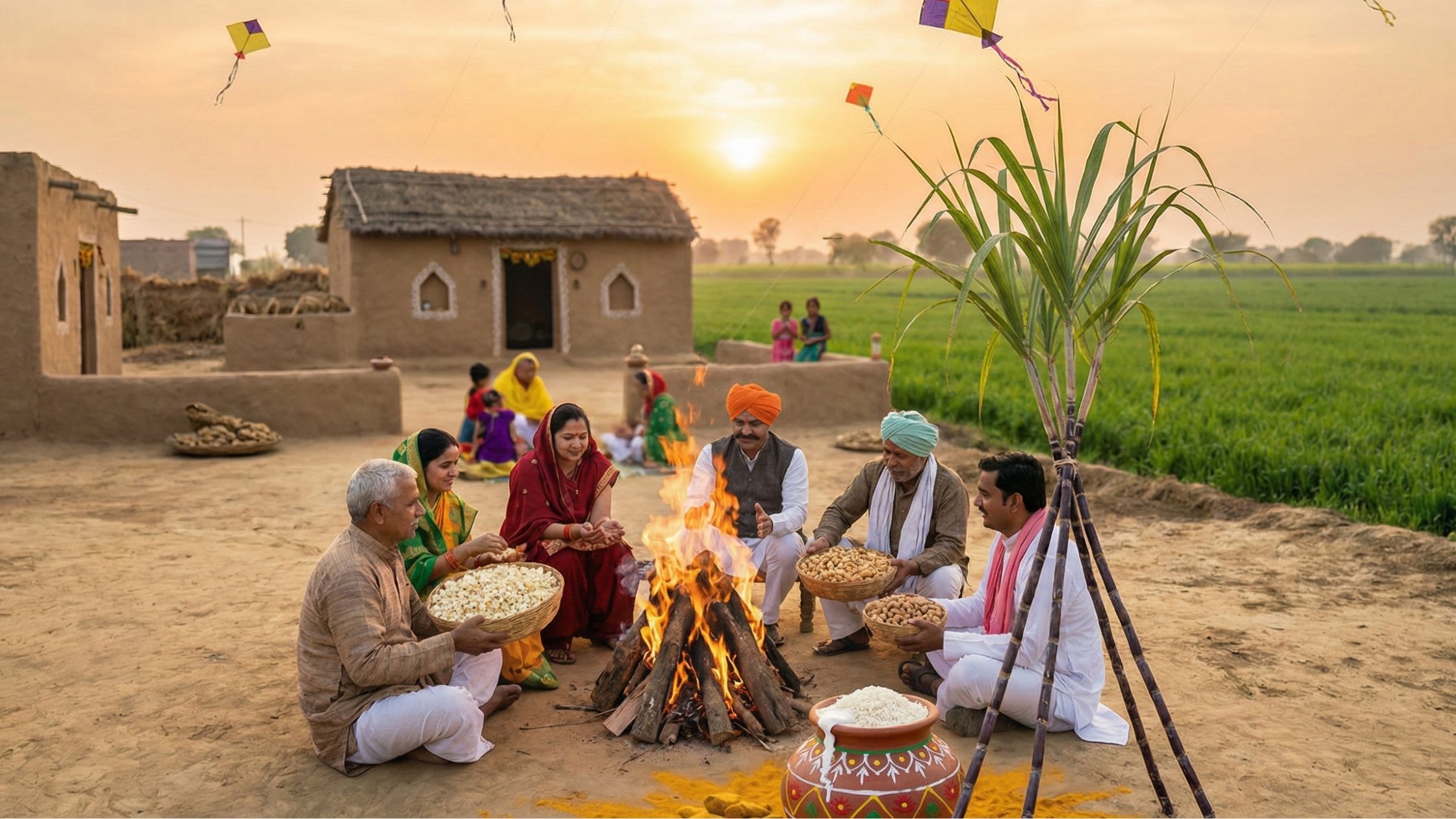
Makara Sankranti, Pongal & Lohri: The Cosmic Science Behind India’s Winter Celebrations Watch the full video explanation Makara Sankranti, Pongal & Lohri: The Science, Śāstra, and One Core Message Every mid-January, a remarkable phenomenon unfolds across India: millions celebrate what appears to be different festivals—Makara Sankranti in Maharashtra and Gujarat, Pongal in Tamil Nadu, Lohri in Punjab, Magh Bihu in Assam, Poush Sankranti in Bengal. The rituals differ, the foods vary, the names change. Yet all occur on the same astronomical date. Is this mere coincidence? Or does a deeper cosmic and biological science unite these seemingly disparate celebrations? Today, we’re embarking on a journey through ancient astronomy, Ayurvedic medicine, Vedic timekeeping, and cultural anthropology to uncover the profound unity underlying India’s mid-winter festivals. When A Warrior Chose His Moment To Die To understand the significance of Uttarayana—the astronomical event at the heart of these festivals—we must begin with one of the Mahabharata’s most powerful stories. Bhishma’s 58-Night Wait Bhishma Pitamaha, the grandsire of the Kuru dynasty, possessed a unique blessing: Icchha Mrityu—the power to choose the moment of his death. After falling on the 10th day of the Kurukshetra war, pierced by countless arrows forming a bed beneath him, he lay conscious for 58 days and nights. Why didn’t he simply choose to die immediately and end his agony? Because he was waiting for a specific astronomical moment. The Sacred Timing Mahabharata, Shanti Parva 47.3 records: शुक्लपक्षस्य चाष्टम्यां माघमासस्य पार्थिव । प्रजापतये च नक्षत्रे माध्यं प्राप्ते दिवाकरे ॥ निवृत्तमात्रे त्वयन उत्तरे वै दिवाकरे । समावेशयदात्मानमात्मन्येव समाहितः ॥ Translation: “On the eighth day of the bright fortnight of Magha month, when the sun was at midday and the moon in Rohini Nakshatra, when Uttarayana had finally begun, Bhishma, fully absorbed, merged his soul into the Supreme Soul.” Bhishma waited specifically for Uttarayana—the day the sun begins its northward journey. Why? Krishna’s Explanation: The Two Paths In Bhagavad Gita 8.24, Lord Krishna explains: अग्निर्ज्योतिरहः शुक्लः षण्मासा उत्तरायणम् । तत्र प्रयाता गच्छन्ति ब्रह्म ब्रह्मविदो जनाः ॥ Transliteration: Agnir jyotir ahaḥ śuklaḥ ṣaṇmāsā uttarāyaṇamTatra prayātā gacchanti brahma brahmavido janāḥ Translation: “Fire, light, day, the bright fortnight, the six months of Uttarayana—those who know Brahman and depart during this period attain the Supreme Brahman.” The next verse (8.25) describes the opposite path: धूमो रात्रिस्तथा कृष्णः षण्मासा दक्षिणायनम् । तत्र चान्द्रमसं ज्योतिर्योगी प्राप्य निवर्तते ॥ Translation: “Smoke, night, the dark fortnight, the six months of Dakshinayana—the yogi departing during this period attains the lunar light and returns [to the cycle of rebirth].” Uttarayana represents the path to liberation; Dakshinayana represents the path of return. Bhishma’s wait wasn’t superstition—it was based on a sophisticated understanding of cosmic timing and spiritual science. The Astronomical Foundation: What Is Uttarayana? The Solar Movement The earth’s tilted axis (23.5 degrees) creates the appearance that the sun “moves” northward and southward throughout the year. Uttarayana (uttara = north, ayana = movement) marks the period when the sun begins its apparent northward journey from the Tropic of Capricorn toward the Tropic of Cancer. Dakshinayana (dakshina = south) is the opposite—when the sun moves southward. Surya Siddhanta: The Ancient Astronomical Text The Surya Siddhanta, one of the earliest Indian astronomical treatises (composed approximately 400-500 CE, though containing knowledge from earlier periods), defines sankranti: मेषादिषु यदा सूर्यः संक्रान्तिं कुरुते द्विज । तदा संक्रान्तिरित्युक्ता सर्वकर्मप्रसाधिका ॥ Transliteration: Meṣādiṣu yadā sūryaḥ saṅkrāntiṁ kurute dvijaTadā saṅkrāntir ityuktā sarva-karma-prasādhikā Translation: “When the Sun transitions from one zodiac sign to another, O twice-born one, that moment is called Sankranti, and it is auspicious for all sacred actions.” Makara Sankranti specifically refers to the sun’s transition into Makara Rashi (Capricorn)—marking the beginning of Uttarayana. The Calendar Anomaly Here’s an interesting historical fact: Makara Sankranti was once synonymous with the Winter Solstice (shortest day, around December 21-22). Due to the precession of the equinoxes (a gradual shift in Earth’s rotational axis), these dates have drifted apart over millennia. Ancient texts reference Uttarayana as the Winter Solstice itself. Today, we celebrate Makara Sankranti on January 14-15 based on Sayana (tropical) calculations, while the actual solstice occurs in late December. This explains why Bhishma Ashtami (his death anniversary) falls in Magha month (January-February), several weeks after the modern Sankranti date—he likely departed on the actual Winter Solstice of his era. The Biological Science: Why Winter’s End Matters Ayurveda’s Seasonal Framework: Ritucharya Ancient Indian medicine didn’t view the body as independent from nature—it understood humans as deeply embedded in seasonal rhythms. Ritucharya (ritu = season, charya = regimen) is Ayurveda’s science of seasonal adaptation. The Six Seasons and Two Kalas Ashtanga Hridaya, Sutrasthana Chapter 3 divides the year into: Adana Kala (Northern Solstice) – Sun takes strength: Shishira (Late Winter: Mid-January to Mid-March) Vasanta (Spring: Mid-March to Mid-May) Grishma (Summer: Mid-May to Mid-July) Visarga Kala (Southern Solstice) – Sun releases strength: 4. Varsha (Monsoon: Mid-July to Mid-September) 5. Sharad (Autumn: Mid-September to Mid-November) 6. Hemanta (Early Winter: Mid-November to Mid-January) Why Hemanta-Shishira Transition Matters Charaka Samhita notes that during Hemanta and Shishira, human beings possess Pravara Bala—supreme strength. Why? The Physiological Mechanism When external temperature drops: Vasoconstriction occurs (blood vessels narrow in extremities) Blood circulates more to the core body and digestive system Jatharagni (digestive fire) intensifies significantly Hunger increases Body demands more nourishment Metabolic rate elevates to generate internal heat Makara Sankranti marks the transition from Hemanta to Shishira—the peak period of digestive strength, when the body can efficiently process heavy, nourishing foods. The Traditional Foods: Biological Intelligence Now the traditional foods make scientific sense: Sesame (Til) and Jaggery (Gud) Charaka Samhita, Sutrasthana states: तिलाः स्निग्धा उष्णा बल्याः कफवातहराः स्मृताः ॥ Transliteration: Tilāḥ snigdhā uṣṇā balyāḥKapha-vāta-harāḥ smṛtāḥ Translation: “Sesame seeds are unctuous, warming, strength-giving, and balance Vata and Kapha doshas.” Scientific Benefits: Sesame seeds provide: Healthy fats (46-63% oil content) Internal warmth (ushna virya) Calcium (975 mg per 100g) Magnesium, zinc, iron Lignans with antioxidant properties Jaggery provides: Immediate energy (glucose) Iron (11 mg per 100g) Minerals (potassium, magnesium) Warmth and blood purification Together, they support: Thermal regulation in cold weather Bone
The Sacred Science of Aarti: Why We Touch the Flame and Bring It to Our Eyes
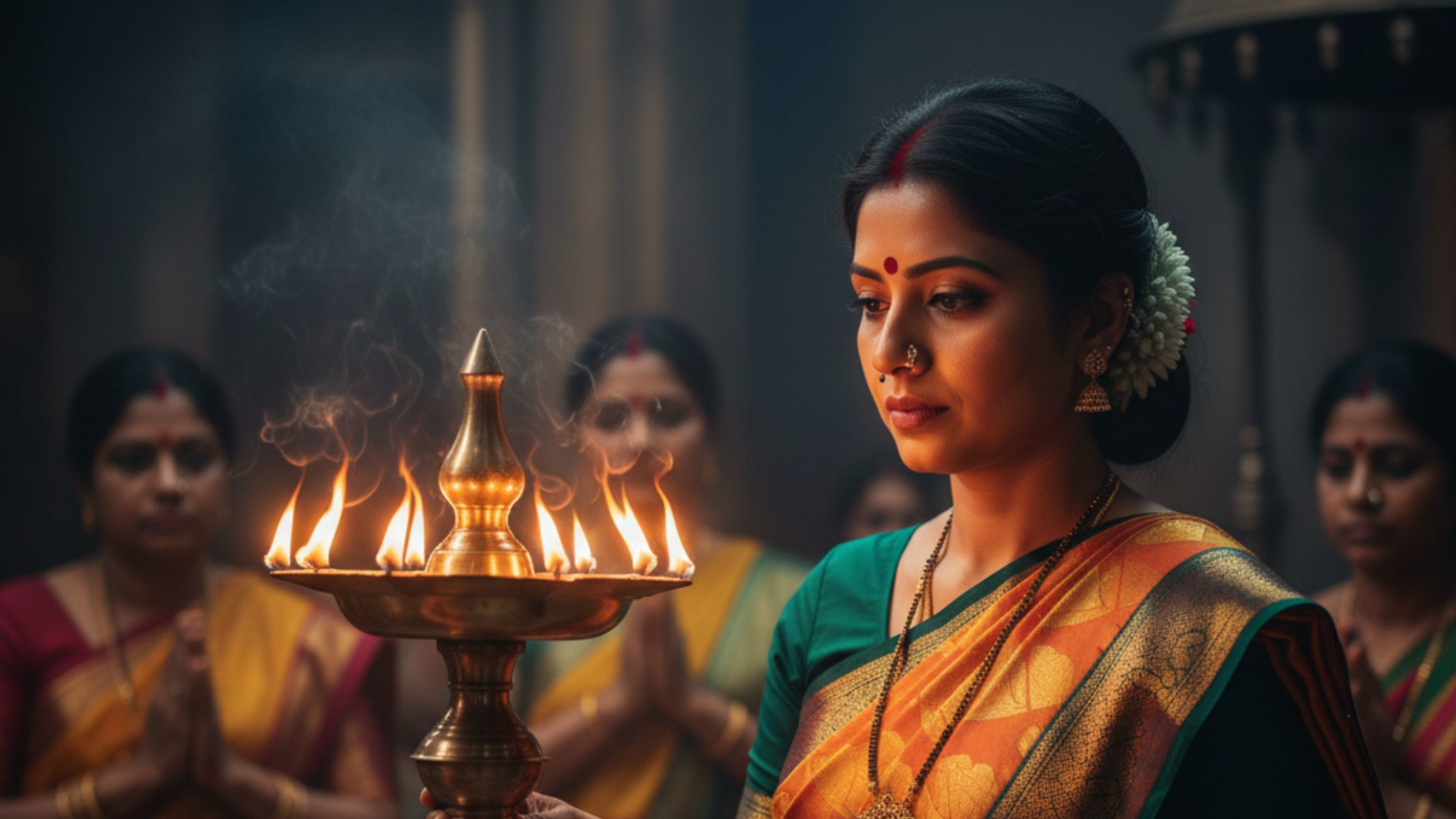
The Sacred Science of Aarti: Why We Touch the Flame and Bring It to Our Eyes Watch the full video explanation https://youtube.com/shorts/CFvy13EADDM The Sacred Science of Aarti: Why We Touch the Flame and Bring It to Our Eyes Every evening in temples across India and around the world, a timeless ritual unfolds. Priests wave lamps before deities in circular motions while devotional songs fill the air. Then comes the moment millions participate in without fully understanding: the flame is brought to devotees, who cup their hands over it and bring that warmth to their eyes and forehead. Why do we do this? What ancient wisdom encoded in this gesture has been preserved for thousands of years? Today, we’re exploring the profound spiritual science behind this practice—a ritual that transforms fire into a carrier of divine grace, and a simple gesture into an act of profound transformation. The First Word: When The Vedas Begin With Fire To understand the significance of Agni (fire) in Hindu worship, we must journey to the very beginning—not just of ritual, but of the oldest continuously preserved spiritual literature in human history. Rig Veda 1.1.1: The Opening Invocation The Rig Veda, composed approximately 3,500 years ago, begins not with a cosmological creation myth or philosophical abstraction, but with a hymn to Agni—the divine fire: अग्निमीळे पुरोहितं यज्ञस्य देवमृत्विजम् होतारं रत्नधातमम् Transliteration: Agnim īḷe purohitaṁ yajñasya devam ṛtvijamHotāraṁ ratnadhātamam Translation: “I praise Agni, the chosen priest, the divine minister of sacrifice,The invoker, the one who bestows the jewel of divine wealth.” This opening verse of the Rig Veda—the first word of humanity’s oldest scripture—is Agnim (Agni). This is no accident. The ancient rishis understood something profound: Agni is the medium through which the human reaches the divine, and the divine reaches the human. Why Agni? The Three-Level Reality The Vedas describe Agni as existing simultaneously on three planes: On Earth: As physical fire (bhū-loka-agni) In the Atmosphere: As lightning (antarikṣa-agni) In the Heavens: As the sun (dyuloka-agni) Agni is thus the connecting principle—the transformer that carries offerings from the material plane to the divine realm. When we understand this, the Aarti ritual suddenly reveals its deeper significance. Etymology: What Does “Aarti” Actually Mean? The word Aarti (or Arati) is derived from the Sanskrit term आरात्रिक (ārātrika). Sanskrit Breakdown: आ (ā): complete, total, fully रात्रि (rātri): night, darkness क (-ka): suffix indicating the action or instrument Literal Meaning: “That which removes darkness” or “that which dispels the night” But here’s where it gets profound: This isn’t just about physical darkness. In Vedantic philosophy, rātri (night) symbolises: Ignorance (avidyā) Material identification (dehātma-buddhi) Spiritual unconsciousness Therefore, Aarti is the ceremony that dispels the night of our material sojourn with the light of divine consciousness. Alternative Etymology Another interpretation breaks down “arti” as: आ (ā): complete रति (rati): love Thus, Ārati = “complete love” or “unconditional devotion” offered to the deity through the medium of light. The Ritual Architecture: Five Elements, One Offering A traditional Aarti ceremony is a magnificent offering of the entire material creation to the deity. The items used represent the Pañcamahābhūta—the five great elements: Aarti Element Sanskrit Represents Cosmic Element Flame/Lamp दीप (dīpa) Light, Energy Fire (Agni) Peacock Fan मयूरमुख (mayūramukha) Movement, Breath Air (Vāyu) Water in Vessel जल (jala) Fluidity, Life Water (Ap) Flowers पुष्प (puṣpa) Solid Form, Beauty Earth (Pṛthvī) Yak-tail Fan चामर (cāmara) Subtle Space, Sound Ether (Ākāśa) When all five elements are offered in Aarti, the worshipper symbolically offers the entirety of material creation back to its source—the divine. The Science of the Circling Motion The priest circles the flame before the deity in a specific pattern—always clockwise (pradakṣiṇa direction). Why Clockwise? In Vedic cosmology: The Sun moves from East to West (clockwise when facing North) This is the direction of cosmic order (Ṛta) Moving clockwise aligns human action with cosmic movement It represents moving forward in spiritual evolution, not backwards into ignorance The circular motion itself has significance: Circles represent infinity, completion, the eternal The circle of flame creates a maṇḍala—a sacred geometric space This sanctifies the deity’s image and the surrounding space Agni: The Divine Messenger In over 200 hymns of the Rig Veda, Agni is described with specific epithets that reveal his unique role: Ṛtvij – The Divine Priest ऋत्विजम् Ṛtvijam – “The one who officiates at the sacrifice at the right time” Agni is not just fire—he is the cosmic priest who performs the sacrifice on our behalf. Hotā – The Invoker होतारम् Hotāram – “The summoner, the caller of the gods” Agni calls the gods to partake of the offerings. He is the messenger who carries our prayers upward and brings divine blessings downward. Vaiśvānara – The Universal Fire One name for Agni is Vaiśvānara (वैश्वानर), meaning “belonging to all people” or “universal.” This Agni is not just the ritual fire, but the fire of consciousness present in all beings—the divine spark within. The Moment of Transformation: When Light Becomes Prasāda Here’s the crucial understanding that most people miss: When the flame is waved before the deity, it transforms. The Scriptural Principle According to Agni Purāṇa and traditional Āgamic texts: Physical flame is offered to the deity with mantras and devotion The deity’s divine presence (sannidhya) infuses the flame The light that was merely physical now carries divine śakti (power/grace) It becomes Prasāda—a “gracious gift” charged with blessings This is why the same flame that illuminated the deity is then brought to devotees. It’s not just fire anymore—it’s consecrated light carrying the deity’s blessings. The Sacred Gesture: Why We Touch Eyes and Forehead Now we reach the heart of the mystery: Why do we cup our hands over the flame and bring that warmth to specific parts of our body? The Physical Action After Aarti, devotees: Cup both palms slightly above the flame (not touching it directly) Feel the warmth gathering in their hands Bring palms to the eyes (touching closed eyelids gently) Bring palms to the forehead (at the ājñā chakra location) Sometimes, also touch the
Sharabha Upanishad Exposed: Manuscript Evidence, Linguistics, and Historical Truth
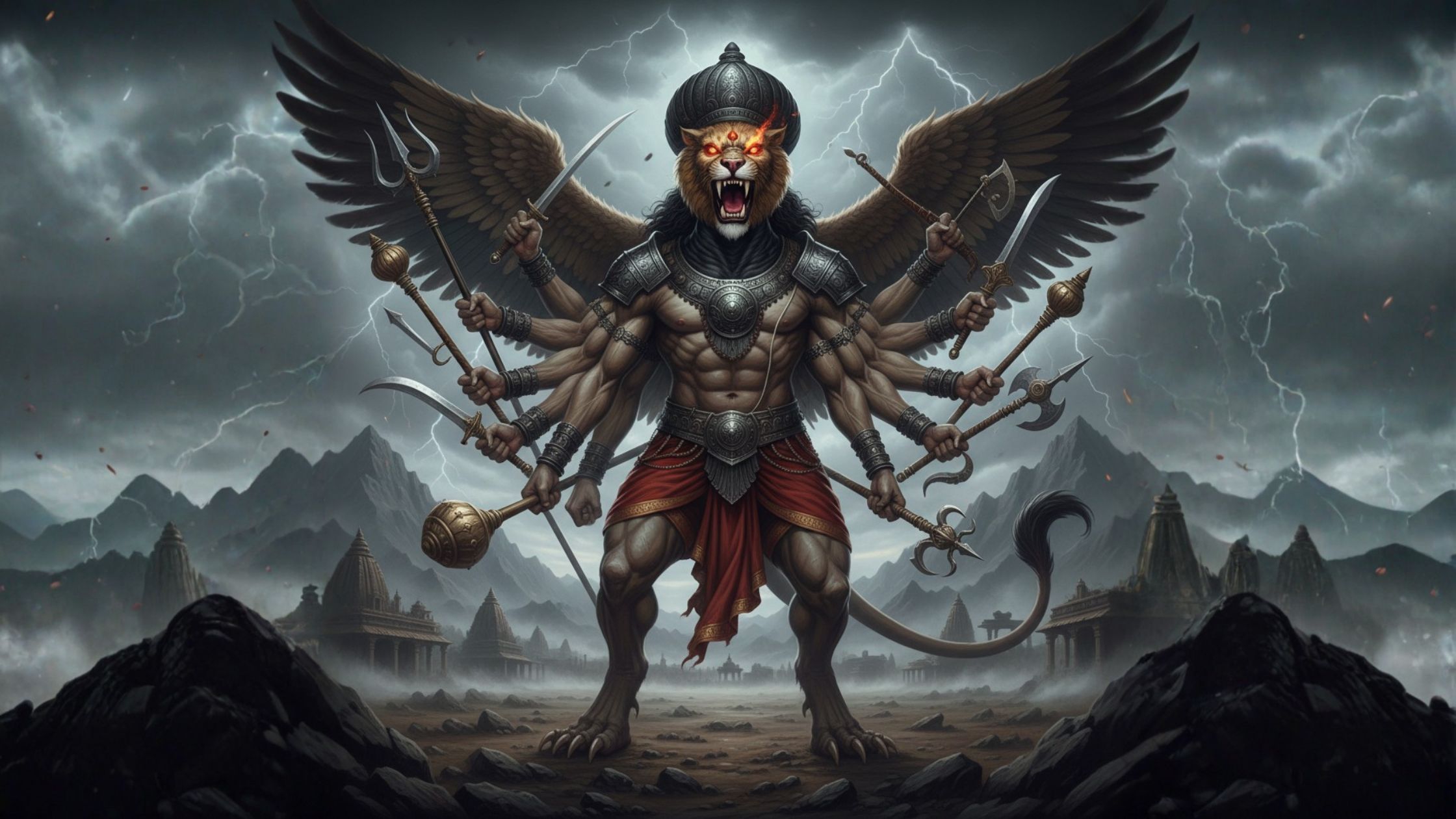
The Sharabha Upanishad: A Forensic Examination of a Medieval Sectarian Text Watch the full video explanation Why the Sharabha–Narasimha conflict narrative fails scriptural, linguistic, and historical tests In the age of viral WhatsApp forwards and YouTube shorts, few controversies have divided Hindu communities as sharply as the Sharabha story. The narrative is dramatic: Lord Shiva, witnessing Narasimha’s uncontrollable rage after slaying Hiranyakashipu, transforms into Sharabha—a terrifying bird-beast hybrid—and proceeds to defeat, kill, and even wear Narasimha’s skin as a garment. This story has been shared millions of times as “authentic ancient scripture.” But what if I told you this narrative isn’t ancient wisdom—it’s medieval propaganda created during one of the darkest periods of sectarian warfare in Hindu history? Today, we’re conducting a forensic analysis of the Sharabha Upanishad using manuscript evidence, linguistic forensics, historical documentation, and scriptural authentication protocols that would stand in any academic court. Part I: The Text That Doesn’t Exist (Where It Should) The Silence of the Giants Let’s begin with the most damning piece of evidence: scholarly silence. Between the 8th and 13th centuries CE, three towering intellectual giants systematically preserved, commented upon, and transmitted authentic Vedic literature: Adi Shankaracharya (c. 700-750 CE) Wrote comprehensive commentaries (bhashyas) on 10-11 principal Upanishads These include: Isha, Kena, Katha, Mundaka, Mandukya, Aitareya, Prashna, Taittiriya, Brihadaranyaka, Chandogya, and possibly Shvetashvatara Also commented on the Brahma Sutras and Bhagavad Gita Never once mentioned the Sharabha Upanishad Sri Ramanujacharya (1017-1137 CE) Founded Vishishtadvaita (qualified non-dualism) philosophy Wrote extensive commentaries on Vedantic texts Established the philosophical foundation for Vaishnavism Complete silence on Sharabha Sri Madhvacharya (1238-1317 CE) Established Dvaita (dualistic) Vedanta Wrote commentaries on principal Upanishads, Brahma Sutras, and Bhagavad Gita Systematically refuted various philosophical positions Never addressed the Sharabha narrative Why This Silence Matters These weren’t casual readers—they were professional philosophers whose life’s work was preserving and transmitting authentic Vedic knowledge. They lived during the precise period when sectarian conflicts intensified (8th-13th centuries), yet none of them found the Sharabha Upanishad worthy of mention. If this text were genuinely ancient and authoritative, it would be impossible for all three Acharyas to ignore it. They commented on texts far more obscure than a dramatic story about divine conflict. Their collective silence screams one conclusion: The text didn’t exist during their lifetimes. Part II: Manuscript Forensics—The Paper Trail Doesn’t Lie The 1400 CE Barrier Modern manuscript studies employ sophisticated dating techniques combining: Paleography (script analysis) Material science (paper/palm leaf aging) Linguistic analysis (language evolution patterns) Transmission patterns (copying lineages) The verdict on Sharabha Upanishad manuscripts is unequivocal: NO manuscripts predating 1400 CE have been discovered. For context, consider authentic texts: Text Oldest Manuscripts Approximate Composition Brihadaranyaka Upanishad c. 1000 CE manuscripts c. 700-600 BCE Chandogya Upanishad c. 1000 CE manuscripts c. 700-600 BCE Bhagavad Gita c. 400-500 CE manuscripts c. 200 BCE-200 CE Bhagavata Purana c. 1030 CE (mentioned by Al-Biruni) c. 500-1000 CE Sharabha Upanishad c. 1400 CE (earliest) c. 1200-1500 CE The Textual Instability Problem Authentic texts preserved through the guru-shishya (teacher-student) tradition show remarkable textual stability. Variations exist, but the core content remains consistent across regions and centuries. The Sharabha Upanishad shows the opposite pattern: Multiple contradictory versions exist No consistent transmission lineage can be traced Regional variations suggest independent composition rather than faithful transmission Narrative inconsistencies between versions This is the signature of a late composition that never underwent the rigorous preservation process of authentic Vedic texts. Part III: Linguistic Forensics—The Language Betrays the Fraud Sanskrit: A Language with a Documented Evolution Sanskrit, perhaps more than any ancient language, has a meticulously documented evolution thanks to Panini’s Ashtadhyayi (c. 4th century BCE) and centuries of grammatical scholarship. Classical Sanskrit (c. 500 BCE – 500 CE): Strict adherence to Panini’s grammatical rules Simple, direct compound formations (e.g., rajaputra = king’s son) Direct Vedic terminology (yajna, soma, brahman) Complex, highly systematized sentence construction Minimal regional linguistic influence Medieval Sanskrit (c. 1000-1500 CE): Simplified grammatical patterns, less rigid Paninian adherence Elaborate, decorative compound formations Heavy sectarian theological terminology Influence from regional Prakrits and early vernacular languages More accessible but less precise grammatical structures The Sharabha Upanishad’s Linguistic Signature A detailed analysis of the Sharabha Upanishad reveals: Compound word formations typical of medieval texts Sectarian theological vocabulary developed during Shaiva-Vaishnava conflicts Grammatical patterns showing post-Paninian simplification Regional linguistic influences (Tamil, Kannada markers) Prose style matching 12th-14th century compositions This is equivalent to finding a “Shakespeare” play written in modern American English slang—the language itself exposes the anachronism. Part IV: What Ancient Texts Actually Say About Narasimha Bhagavata Purana: The Authentic Account The Bhagavata Purana (Srimad Bhagavatam), composed between 500-1000 CE and universally recognized as authentic, provides the authoritative Narasimha narrative. Bhagavata Purana 7.8-9 describes: Narasimha’s appearance to protect Prahlada The slaying of Hiranyakashipu at twilight on a threshold Narasimha’s fierce form causing fear among the demigods Prahlada’s prayers calming Narasimha Narasimha blessing Prahlada and departing peacefully NO mention of: Uncontrollable rage threatening creation Shiva appearing as Sharabha Any conflict between Narasimha and Shiva Narasimha’s skin being worn as a garment The Fundamental Verse: Krishna as Supreme Bhagavata Purana 1.3.28: एते चांशकलाः पुंसः कृष्णस्तु भगवान् स्वयम् इन्द्रारिव्याकुलं लोकं मृडयन्ति युगे युगे Transliteration: ete cāṁśa-kalāḥ puṁsaḥ kṛṣṇas tu bhagavān svayamindrāri-vyākulaṁ lokaṁ mṛḍayanti yuge yuge Translation: “All these incarnations are either plenary portions or parts of plenary portions of the Supreme Personality of Godhead, but Krishna is the original Personality of Godhead Himself. All of them appear on the earth whenever there is a disturbance created by the demons.” This verse establishes: Krishna (Vishnu) as the original Supreme Being (bhagavan svayam) All other devas, including manifestations of Shiva, as secondary The Narasimha avatar as a plenary portion of this Supreme Lord A text claiming Shiva defeats and kills Narasimha contradicts this foundational verse of an authentic Purana. Vishnu Purana’s Clear Statement The Vishnu Purana, another Mahapurana with established antiquity, describes Vishnu as: The source from which Brahma and Shiva emerge The ultimate reality underlying all existence The goal of all spiritual practice Vishnu Purana 1.22.20: “From

The Mysterious Yali: The Forgotten Story Behind South India’s Most Enigmatic Temple Guardian
The Mysterious Yali: The Forgotten Story Behind South India’s Most Enigmatic Temple Guardian Watch the full video explanation Yali: The Forgotten Temple Guardian and Its Lost Connection Across the Ocean Have you ever noticed them? Those fierce creatures carved into temple pillars across South India—beings with bulging eyes, sharp claws, curved tusks, and bodies that seem to defy nature itself. Some have lion faces roaring in eternal vigilance. Others sport elephant heads with magnificent trunks. A few bear horse-like features that seem to gallop through stone. You’ve walked past them your entire life. You’ve photographed them, admired their artistry, perhaps even touched their weathered surfaces for blessings. But do you know their story? This is Yali—one of the most mysterious and misunderstood figures in Indian temple architecture. And what if I told you that this guardian carved in South Indian temples has a forgotten connection to a kingdom thousands of kilometers away across the ocean? What Exactly Is Yali? Yali is not just one creature—it’s a family of hybrid guardians that embody the ultimate protective force. Ancient texts and temple architecture describe various forms: Simhayali – Lion-bodied Yali, the most ferocious form Gajayali – Elephant-headed Yali with a powerful trunk Ashwayali – Horse-faced Yali representing speed and power Vyaghrayali – Tiger-bodied Yali for aggressive protection The Samaranga Sutradhara, a comprehensive architectural treatise written by King Bhoja in the 11th century CE, meticulously lists approximately 16 different types of Yali. Each variation serves a specific purpose in temple iconography and spiritual symbolism. But Yali is far older than the 11th century. The Ancient Texts Speak: Sangam Literature’s Super Predator The oldest and clearest descriptions of Yali come from Sangam literature—the classical Tamil texts composed between 300 BCE and 300 CE. These aren’t mythological fantasies written by priests in ivory towers. These are verses composed by poets, warriors, and observers who wrote about the world as they understood it. Consider this powerful verse from Narinai 205: “Aali Nanman…” This line is crucial. “Aali” is the ancient Tamil word for Yali, and this verse describes it explicitly as a super predator—a creature that stands above all others in the food chain. The text doesn’t speak of it as a mythological symbol or artistic imagination. It speaks of it as something known, something feared, something real. But this isn’t the only reference. Yali appears repeatedly across Sangam literature: Akanaanuru 78 – Describes Yali’s hunting prowess Akanaanuru 252 – References Yali in battle contexts Akanaanuru 301 – Mentions Yali’s territorial dominance Puranaanuru 207 – Compares warriors to Yali’s strength The consistency of these references is striking. Ancient Tamil poets mention Yali not as a one-off fantasy, but as a creature integrated into their understanding of the natural and supernatural world. They describe it killing tigers, dragging elephants, dominating forests—a being of supreme power. The Pallava Connection: When Indian Kings Sailed East Here’s where history takes a fascinating turn. During the Pallava period (3rd to 9th centuries CE), the Yali motif absolutely exploded across South Indian temple architecture. Suddenly, every major temple featured elaborate Yali carvings. Why this sudden proliferation? Because the Pallavas were among the earliest Indian dynasties to systematically explore Southeast Asia. Ancient Indian kingdoms didn’t just trade spices and silk—they traded ideas, stories, architectural techniques, and spiritual practices. And in their voyages across the Bay of Bengal, Pallava envoys encountered a remarkable kingdom called Kutai Martadipura in present-day Indonesia. The Yupa Stones: Evidence Written in Stone How do we know this connection is real and not mere speculation? Because of the Yupa stones—standing stone inscriptions that serve as irrefutable archaeological evidence of contact between Indian and Southeast Asian civilizations. These stones, found in the Kutai region of East Kalimantan, Indonesia, are inscribed in Sanskrit using early Brahmin Pallava script. One inscription reads: “Sri Mata Sri Narendrasya Kudungasya MahatmanaPutro Svavarmo Vikyataha Vansakrita Yatatsuman…” Translation: “The illustrious and righteous son of the great king Kudungga, Svavarman, famous for his noble lineage…” These Yupa stones prove beyond doubt that there was real, documented contact between Indian kings (specifically those using Pallava script) and the Kutai dynasty during the 4th-5th centuries CE. And this is where our story becomes extraordinary. Enter Lembuswana: Indonesia’s Elephant Guardian The Kutai kingdom had its own powerful guardian figure called Lembuswana (also known as Gajamina in some traditions). This wasn’t a minor folkloric creature—it was a central guardian figure in Indonesian royal and spiritual iconography. What did Lembuswana look like? Elephant head with a magnificent trunk Buffalo horns curving from its temples Lion’s mane flowing majestically Lion’s body muscled and powerful Huge eagle wings capable of flight Is Lembuswana identical to Yali? No. But is it unmistakably connected? Absolutely. The Theory: What the Pallava Envoys Saw Imagine this scenario: Pallava ambassadors, traders, and explorers arrive in Kutai. They’re welcomed to royal courts, taken to sacred sites, shown the kingdom’s treasures and guardian figures. They see Lembuswana—carved in wood, cast in bronze, described in local legends as an unstoppable protector stronger than any single animal. The Pallava visitors recognize something familiar yet foreign. They have their own traditions of composite creatures. But this Indonesian guardian adds new dimensions to their understanding. When they return to India, they carry these impressions home. And gradually, these influences merge with existing Indian traditions of hybrid creatures, resulting in the evolution and proliferation of Yali carvings across Pallava temples. Consider the parallels: Yali in Indian Tradition: Kills tigers effortlessly Drags elephants from waterholes Guards temple entrances and pillars Represents ultimate protective power Associated with royal authority Lembuswana in Kutai Tradition: Guards rivers and kingdoms Possesses unstoppable strength Protects against all threats Represents sovereign power Associated with royal dynasties Both are hybrid predators. Both transcend natural animal hierarchies. Both appear in contexts of royal and sacred power. Two Cultures, One Guardian: Coincidence or Connection? Here’s what makes this theory compelling: Two cultures separated by thousands of kilometers of ocean both describe remarkably similar guardian beasts. Both are explicitly described as being stronger than lions and stronger than
What Does “33 Koti Devatāḥ” Really Mean?
What Does “33 Koti Devatāḥ” Really Mean? Watch the full video explanation 33 Types or 33 Crore Hindu Deities? The Complete Scriptural Truth Revealed If you’ve been active in Hindu spiritual circles on social media, you’ve likely encountered a heated debate that refuses to die down: Does Hinduism have 33 types of deities (33 koti) or 33 crore deities (330 million)? WhatsApp forwards, YouTube Shorts, and Instagram Reels have turned this into one of the most confusing topics in modern Hindu discourse. The viral message that circulates claims definitively: “There are NOT 33 crore deities, but 33 TYPES of deities as mentioned in the Brihadaranyaka Upanishad.” But is this the complete truth? Or is this another case of incomplete knowledge being spread without proper scriptural verification? Today, we’re diving deep into the Vedas, Upanishads, and Puranas to settle this confusion once and for all. The Viral WhatsApp Message: What It Claims The popular message that has spread across social media platforms states that, according to the Brihadaranyaka Upanishad, Hindu deities are categorised into 33 types: 12 Adityas (solar deities) 11 Rudras (forms of Lord Shiva) 8 Vasus (elemental deities) 1 Indra (king of gods) 1 Prajapati (creator deity) When you add these up, you get exactly 33 categories. The message concludes triumphantly: “See! It’s 33 types, not 33 crore!” This has been shared millions of times, with many people confidently correcting others based on this “knowledge.” The Problem: This Knowledge Is Incomplete Before we accept this explanation, let’s pause and think critically. If we’re limiting ourselves to just these 33 categories, where do we place: Ganesha – The remover of obstacles Durga Devi – The warrior goddess Mahakali – The fierce form of Shakti Saraswati Devi – The goddess of knowledge Ganga Devi – The sacred river goddess Kamdhenu – The divine wish-fulfilling cow Chitragupta – The divine accountant Dhanvantari – The physician of the gods Kuber – The lord of wealth Apsaras like Rambha, Urvashi, and Menaka The list goes on. When you start counting even from memory, you can easily name 50-60 deities that don’t neatly fit into these 33 categories. This immediately tells us that the viral message is painting an incomplete picture. What Do the Vedas Actually Say? Let’s go to the source – the Vedas themselves. In the Yajurveda, Chapter 33, Verse 7, it clearly states: “Anyad dwindringūdachhaddevānavachāsparyanṇa trīṇiśhatā (300) trī sahasrāṇi (3000) triṇśakcha (30) navacha (9) devā” Translation: 3,339 deities in total (3000 + 300 + 30 + 9 = 3,339) Notice something important? The Vedas don’t mention 33 at all. There’s no confusion between “type” (koti) and “crore” here because the actual number given is far beyond 33. Evidence from the Puranas Vishnu Purana’s Account In Vishnu Purana, Part 2, Chapter 12, Verse 7, it states: “Tritisa hajār tritisa sau tritisa devagaṇa chandramrit ka pān karte hain” This mentions that 33,333 divine beings (30,000 + 3,000 + 300 + 33) drink the nectar of immortality with Chandra (the Moon god). Two crucial points here: We’re already far beyond 33 types The text says “these many gods drink nectar there” – NOT that these are ALL the gods. This is describing a specific gathering, not the total count. Skanda Purana’s Clear Declaration This is where we get our definitive answer. In Skanda Purana, Maheshwar Khand, Chapter 6, Verse 7, it is explicitly written: “How 33 crore deities appeared from the rays of Lord Shambhu’s (Shiva’s) flames” The Skanda Purana leaves no room for ambiguity. It clearly uses the term “crore” (10 million), stating 33 crore (330 million) deities. Further evidence from the Skanda Purana, Kashi Khand, Chapter 62, Verse 99, breaks down the numbers: Ganas: 1 crore 2 lakhs (12 million) Chamunda deities: 9 crores (90 million) Bhairavis: 1 crore (10 million) Bhagavata Purana’s Testimony The Shrimad Bhagavatam (Bhagavata Purana), Canto 6, Chapter 6, Verse 17 mentions that millions of Rudras were born, of which 11 are the principal ones – these are the 11 Rudras mentioned in that viral message about 33 types. So the 33 categories represent the principal deities, not the total count. Why 33 Crore Makes Perfect Sense 1. Divine Families Just as humans have families, so do deities. If we count humans, we don’t just count “types” of humans – we count individuals. Similarly: Lord Shiva has His consort Parvati, sons Ganesha and Kartikeya Each deity has its family members, attendants, and associates All of these are divine beings 2. Kula Devatas (Family Deities) Travel across India, and you’ll find: Himachal Pradesh alone has over 60,000 temples Nearly every mountain has its own presiding deity Every village has its own Kula Devata (family deity) or Grama Devata (village deity) These aren’t modern inventions – they’ve been worshipped for generations 3. Temple Evidence Ancient temples established by great Acharyas like Ramanujacharya and Madhvacharya often depict hundreds or thousands of deities. The Jagannath Puri temple has images of 120 deities inside who receive the Mahaprasad. 4. Cosmic Management System Consider the vastness of cosmic administration: 14 Planetary Systems (Lokas): Upper: Brahmaloka, Tapaloka, Janaloka, Maharloka, Swargaloka, Bhuvarloka Middle: Bhurloka (our Earth) Lower: Atala, Vitala, Sutala, Talatala, Mahatala, Rasatala, Patala Below all these are the various realms of Naraka (hell), managed by Yamaraja and his staff, including Chitragupta and countless assistants. Add to this: 28 major planets and celestial bodies, each with presiding deities Countless stars and galaxies Rivers, mountains, forests – all with presiding deities Natural forces and elements Our entire Earth is like a speck in this vast universe. To manage such an enormous cosmic system, 33 crore deities is not excessive – it might even be conservative! So, Where Did the “33 Types” Idea Come From? The Brihadaranyaka Upanishad does indeed contain a fascinating conversation between sage Vidagdha and sage Yajnavalkya. When asked “How many gods are there?”, Yajnavalkya answers in stages: First: 3,306 deities Then categorises them into 33 types Further condensed to: 6 (main categories) Then: 3 Then: 2 Then: 1.5 Finally: 1 (the ultimate supreme reality)